
Houndstooth Design Jacquard Fabric for Fashion, Tailoring, and Interior Applications
Houndstooth Design Jacquard Fabric is a classic knitted jacquard fabric developed for garments and decorative textile applications that require visual identity, tactile comfort, elastic recovery, and reliable manufacturing consistency. Recognized by its broken-check pattern and geometric rhythm, houndstooth has remained relevant across coats, pants, suits, dresses, bags, drapes, blinds, rugs, and upholstery. This fabric combines the traditional appeal of houndstooth with modern computerized jacquard knitting technology, creating a textile that is distinctive, practical, and adaptable to contemporary product development.
The fabric is produced with a classic pattern texture and a three-dimensional visual effect. Unlike ordinary printed houndstooth fabrics, jacquard construction forms the pattern through the fabric structure itself. This gives the textile greater depth, a stronger sense of craftsmanship, and a more durable appearance because the design is not merely placed on the surface. The result is a fabric that looks refined from a distance and reveals texture, dimension, and technical precision when viewed up close.
Houndstooth Design Jacquard Fabric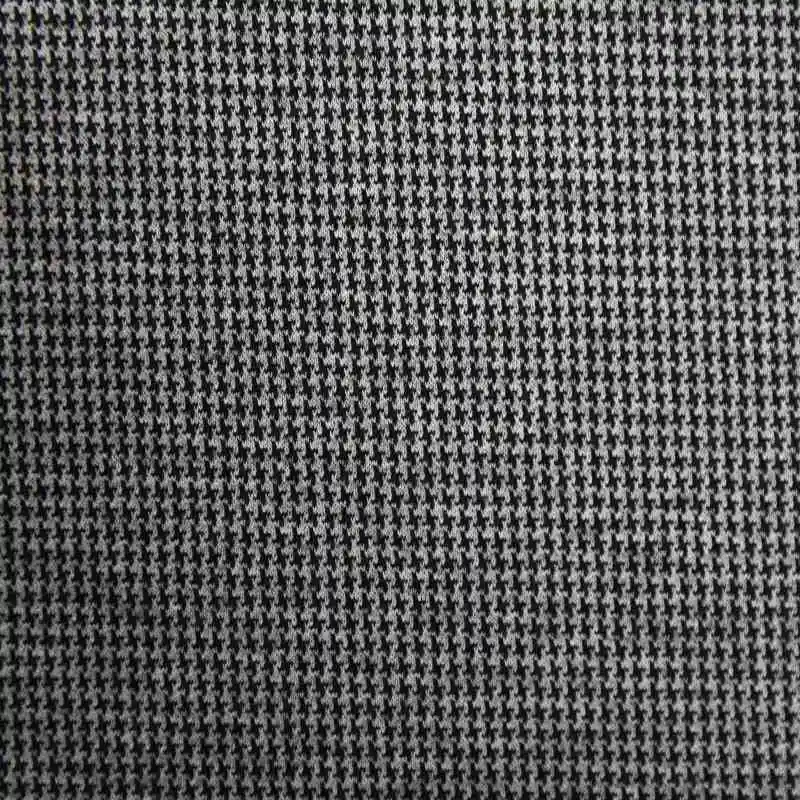
For apparel brands, garment factories, designers, and textile buyers, the value of Houndstooth Design Jacquard Fabric lies in its balance of style and performance. It is comfortable, soft, and elastic, making it suitable for garments that need movement and wearability. It also offers customization in pattern and thickness, allowing the fabric to be adapted to different seasonal collections, market segments, and finished product requirements. Whether used in structured coats or flexible dresses, this jacquard fabric can support both classic and modern design directions.
Product Overview
Houndstooth Design Jacquard Fabric belongs to the knitted jacquard fabric category. It is produced through computerized jacquard equipment, enabling detailed pattern control and repeat accuracy. The houndstooth motif is a globally recognized pattern that has appeared in fashion and interiors for decades. Its visual effect is bold but not excessive, making it easy to combine with solid colors, leather trims, metal accessories, or minimal garment silhouettes.
Traditional houndstooth is often associated with wool suiting and woven textiles, but knitted jacquard technology gives the pattern new advantages. Knitted construction provides elasticity and softness that many woven fabrics cannot easily achieve without additional finishing or fiber engineering. This makes the fabric suitable for buyers who want the sophistication of houndstooth with the comfort expected from modern knitwear and blended fabrics.
The product can be used for coats, pants, suits, dresses, and other fashion items. In interior applications, the same pattern can be used for drapes, roman blinds, rugs, and furniture upholstery where a strong visual motif is desired. Because the pattern and thickness can be customized, customers can select a lighter version for dresses and decorative panels or a heavier version for coats and upholstery-related uses.
Why Houndstooth Remains a Timeless Pattern
Houndstooth is one of the most recognizable textile patterns in the world. Its broken checks create a sense of movement, structure, and contrast. The pattern is not a simple square check; it is a tessellated geometric form that repeats with visual balance. This makes it suitable for both traditional and progressive design concepts.
In fashion, houndstooth can signal elegance, confidence, and heritage. It has often been used in coats, tailored jackets, skirts, trousers, and accessories. In interior design, it can add character to a room without depending on floral or abstract decoration. Its strong geometry pairs well with modern furniture, classic wood, neutral color palettes, and metallic accents.
The strength of houndstooth is that it is visually memorable while remaining highly versatile. A large-scale houndstooth pattern creates a dramatic statement, while a smaller repeat can appear refined and professional. This adaptability gives designers freedom to build multiple product lines from the same concept. The jacquard construction further enhances the design because the pattern becomes part of the fabric architecture rather than a temporary surface decoration.
Core Product Advantages
The most important advantage of Houndstooth Design Jacquard Fabric is its structural pattern. Since the design is created by jacquard knitting, it has more texture and durability than ordinary printed alternatives. Printed fabrics may be attractive, but their patterns depend on surface color application. With jacquard fabric, the design is integrated into the textile construction, giving it a richer hand feel and a more premium look.
Another advantage is comfort. The fabric is soft and elastic, making it easier to wear in daily movement. This is especially important for pants, dresses, and fitted garments. Customers increasingly expect garments to look polished while still feeling comfortable. A knitted jacquard fabric supports this requirement by offering a combination of structure, stretch, and softness.
The fabric also provides a three-dimensional effect. The surface is not flat like many printed textiles. The classic houndstooth pattern has texture, visual relief, and a sense of depth. This can improve the perceived value of finished garments and interior products. A coat made from textured jacquard fabric can look more refined on display, while a cushion, blind, or upholstery panel can appear more substantial and decorative.
Customization is another major strength. Pattern scale, thickness, and technical parameters can be adjusted to meet different market needs. A fashion customer may request a lighter hand feel and smaller pattern repeat for dresses, while an outerwear customer may prefer greater thickness and a bolder design. Interior applications may require a different weight, density, or finishing effect. The ability to customize supports product differentiation and helps customers avoid generic fabric offerings.
Advantages Over Common Competitor Fabrics
Compared with printed houndstooth fabrics, jacquard houndstooth fabric offers more depth and longer-lasting design integrity. Printed patterns can fade, crack, or lose sharpness depending on use, washing, abrasion, and dyeing quality. Jacquard patterning is formed through fabric construction, so the motif remains physically present even after regular use. This makes it especially valuable for garments and interiors that need repeated handling or extended service life.
Compared with ordinary woven houndstooth fabrics, knitted jacquard houndstooth fabric offers improved elasticity and comfort. Woven fabrics can provide excellent stability and tailoring sharpness, but they are often less flexible unless blended with stretch fibers or finished for mechanical comfort. Knitted jacquard fabric naturally supports movement, making it suitable for modern consumers who expect garments to perform throughout the day.
Compared with simple knit fabrics, this jacquard fabric has a stronger design identity. Plain knits may be comfortable but visually basic. Houndstooth jacquard adds a recognizable pattern and premium surface texture without needing excessive printing or embellishment. For apparel brands, this reduces the need for additional decoration while still delivering strong shelf appeal.
Compared with low-grade textured fabrics, this product benefits from advanced computerized jacquard production. Precise electronic control helps maintain pattern consistency, repeat accuracy, and fabric quality. In competitive markets, stable production quality can reduce cutting loss, improve garment consistency, and strengthen buyer confidence.
Compared with overly heavy decorative textiles, customized knitted jacquard fabric can be engineered for the intended purpose. Thickness can be adjusted, so customers are not limited to one rigid specification. This flexibility is particularly useful for buyers serving multiple markets, including women’s fashion, men’s tailoring, casualwear, uniforms, home decoration, and accessory manufacturing.
| Comparison Item | Houndstooth Design Jacquard Fabric | Common Alternative | Practical Benefit |
|---|---|---|---|
| Pattern Formation | Jacquard structure integrated into the fabric | Surface printing or simple weave pattern | Richer texture and stronger design durability |
| Comfort | Soft knitted hand feel with elasticity | Often flatter, stiffer, or less flexible | Better wearability for garments requiring movement |
| Visual Effect | Classic houndstooth with three-dimensional texture | Flat visual appearance | Higher perceived value and stronger visual identity |
| Customization | Pattern and thickness can be adjusted | Limited standard options | Supports seasonal collections and different applications |
| Manufacturing Precision | Produced by computerized jacquard equipment | May depend on less controlled processes | Improved repeat consistency and production reliability |
Advanced Computerized Jacquard Manufacturing
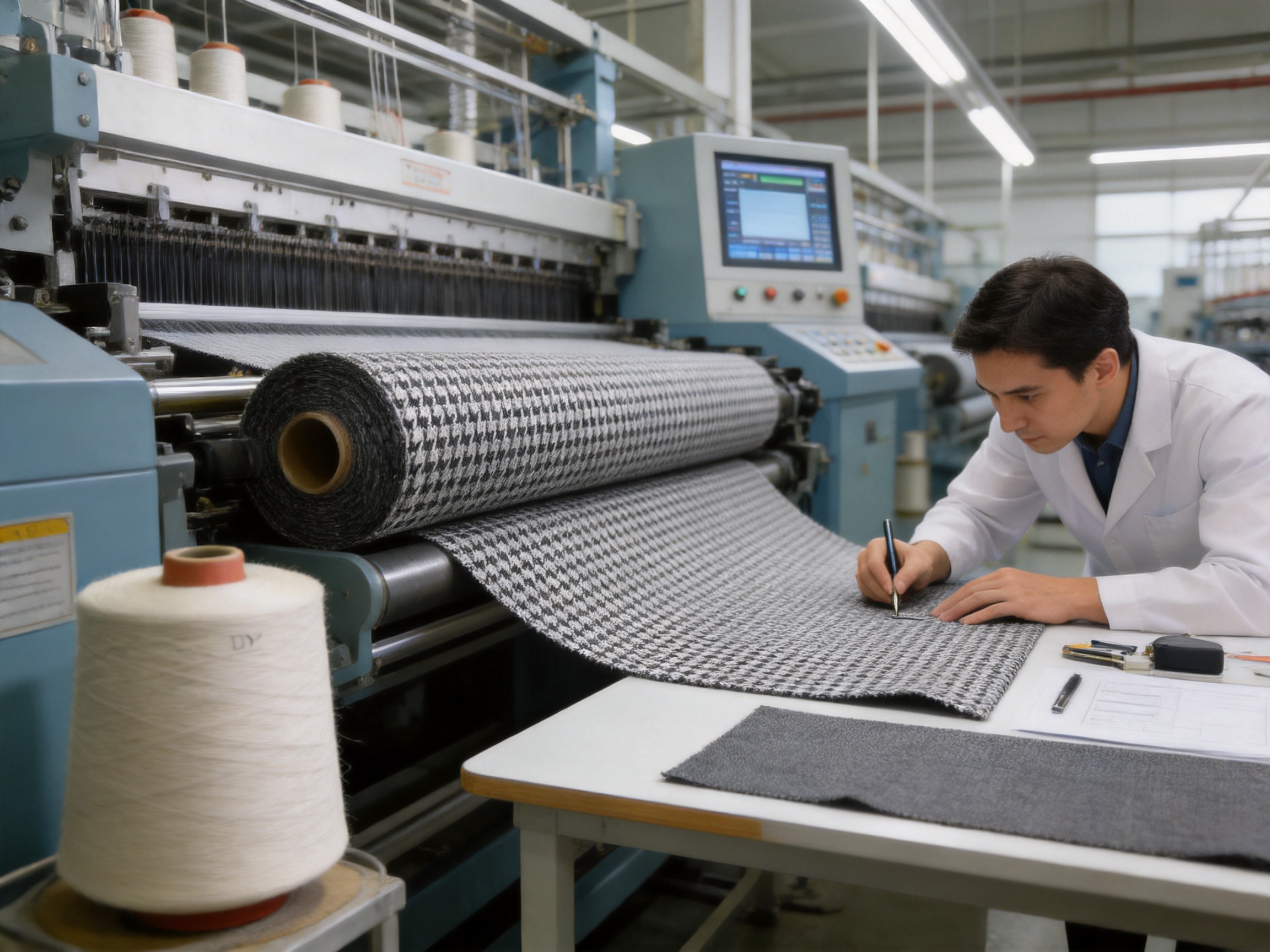
The fabric is produced by imported computerized jacquard machinery. This manufacturing approach is important because jacquard fabric requires accurate control of yarn movement, pattern formation, density, and repeat alignment. Computerized systems allow complex houndstooth motifs to be translated into machine instructions, making it possible to produce consistent texture and repeat effects across production batches.
Computerized jacquard production reduces the limitations of manual pattern control. It supports detailed motif development, repeat adjustment, pattern scaling, and efficient sampling. For customers, this means new designs can be developed with greater flexibility. A classic houndstooth pattern can be enlarged, reduced, modified, or combined with different textures to suit a brand’s design language.
Advanced jacquard machines also help maintain fabric consistency. In garment production, inconsistent fabric can create problems during cutting, matching, sewing, and finishing. If the pattern repeat is unstable, garment panels may not align properly. Computerized equipment improves pattern precision, helping customers achieve better finished garment presentation and reducing production risk.
In addition, the production process benefits from integrated textile expertise, including yarn preparation, fabric production, dyeing support, finishing, and sales coordination. This integrated capability helps control quality at different stages rather than treating fabric as a single isolated step. For buyers, this can improve communication efficiency and shorten the path from concept to bulk order.
Yarn and Material Strengths
High-quality jacquard fabric begins with suitable yarn selection. The company behind this product has experience in blended fabrics, polyester, spandex-related textiles, and DTY polyester yarn production and processing. This background supports the development of knitted jacquard fabrics that require both visual quality and functional performance.
DTY polyester yarn, also known as drawn textured yarn, is widely used in knitted and woven textiles because it provides bulk, softness, elasticity, and dimensional stability. When applied properly, DTY can help create fabrics with comfortable hand feel, good drape, and practical durability. In jacquard construction, yarn consistency is especially important because uneven yarns can affect pattern clarity and fabric surface appearance.
Blended fiber knowledge is also valuable. Polyester can contribute strength, dimensional stability, and easy-care properties. Rayon can improve softness, drape, and a more natural touch. Spandex can enhance elasticity and recovery when required by the product specification. By understanding these fiber characteristics, the manufacturer can support customers in selecting fabric structures that meet garment or interior performance expectations.
For Houndstooth Design Jacquard Fabric, the combination of yarn engineering and jacquard structure creates a product that is not only decorative but also practical. It is not limited to visual appeal. It is designed to be worn, sewn, shaped, and used in real production environments.
Comfort, Softness, and Elasticity
Modern textile buyers increasingly evaluate fabric by touch as much as appearance. A pattern may attract attention, but the hand feel often determines whether a fabric is accepted for apparel use. Houndstooth Design Jacquard Fabric is described as comfortable, soft, and elastic. These qualities make it especially suitable for garments that need both structure and flexibility.
Softness contributes to wearer satisfaction. A fabric that feels harsh may be rejected even if it looks stylish. Soft jacquard fabric can be used in coats, dresses, trousers, and suits without making the wearer feel restricted. This is important for contemporary clothing, where comfort is no longer limited to casualwear. Even tailored garments are expected to provide mobility and pleasant touch.
Elasticity improves fit and movement. A fabric with appropriate stretch can adapt to body motion, reduce pressure at stress points, and improve garment recovery after wear. For pants and dresses, elasticity can improve comfort during sitting, walking, and daily movement. For fitted jackets or suits, it can add modern wearability while preserving a polished appearance.
The knitted construction supports these comfort advantages. While woven textiles may offer crispness, knitted jacquard fabric provides a more flexible textile base. This allows designers to create garments that appear structured but feel more relaxed and wearable.
Three-Dimensional Texture and Premium Appearance
The three-dimensional effect of the houndstooth jacquard fabric is a major selling point. Texture can change how a fabric interacts with light, shadow, and movement. A raised or dimensional surface gives the pattern greater presence and prevents the fabric from looking flat. This is especially useful for coats, suits, dresses, and interior products displayed under retail or showroom lighting.
A three-dimensional jacquard pattern can also improve the perceived craftsmanship of finished goods. Consumers often associate textured fabrics with higher quality because they reveal more technical work than plain surfaces. For brands, this can support stronger product positioning without relying solely on logos or complicated garment construction.
The classic houndstooth motif becomes more distinctive when formed through texture. The broken-check pattern gains visual rhythm and depth, allowing garments and interiors to stand out while still feeling elegant. This balance is one reason houndstooth remains popular in both fashion and decoration.
Customization for Pattern and Thickness
One of the product’s key advantages is customization. Pattern and thickness can be customized according to customer requirements. This flexibility is highly valuable because different applications demand different fabric characteristics. A winter coat requires a different thickness from a dress. Upholstery fabric may require a different structure from a pair of trousers. A bold fashion collection may need a larger houndstooth scale, while a formal suit may require a smaller, more restrained pattern.
Pattern customization allows customers to adjust the visual personality of the fabric. Scale, contrast, arrangement, and texture can influence the final design effect. A large houndstooth can appear contemporary and dramatic. A medium repeat can be classic and commercially versatile. A smaller repeat can be refined and suitable for professional clothing.
Thickness customization supports seasonal and functional requirements. Lighter versions may be suitable for spring and autumn dresses, skirts, and soft jackets. Medium-weight versions can work for pants, suits, and structured garments. Heavier versions may be used for coats, decorative cushions, heavier drapes, or selected upholstery applications.
This customization capability gives buyers more control over product development. Instead of selecting from fixed stock options, customers can collaborate on fabric specifications that better match their target consumer and manufacturing process.
Applications in Coats
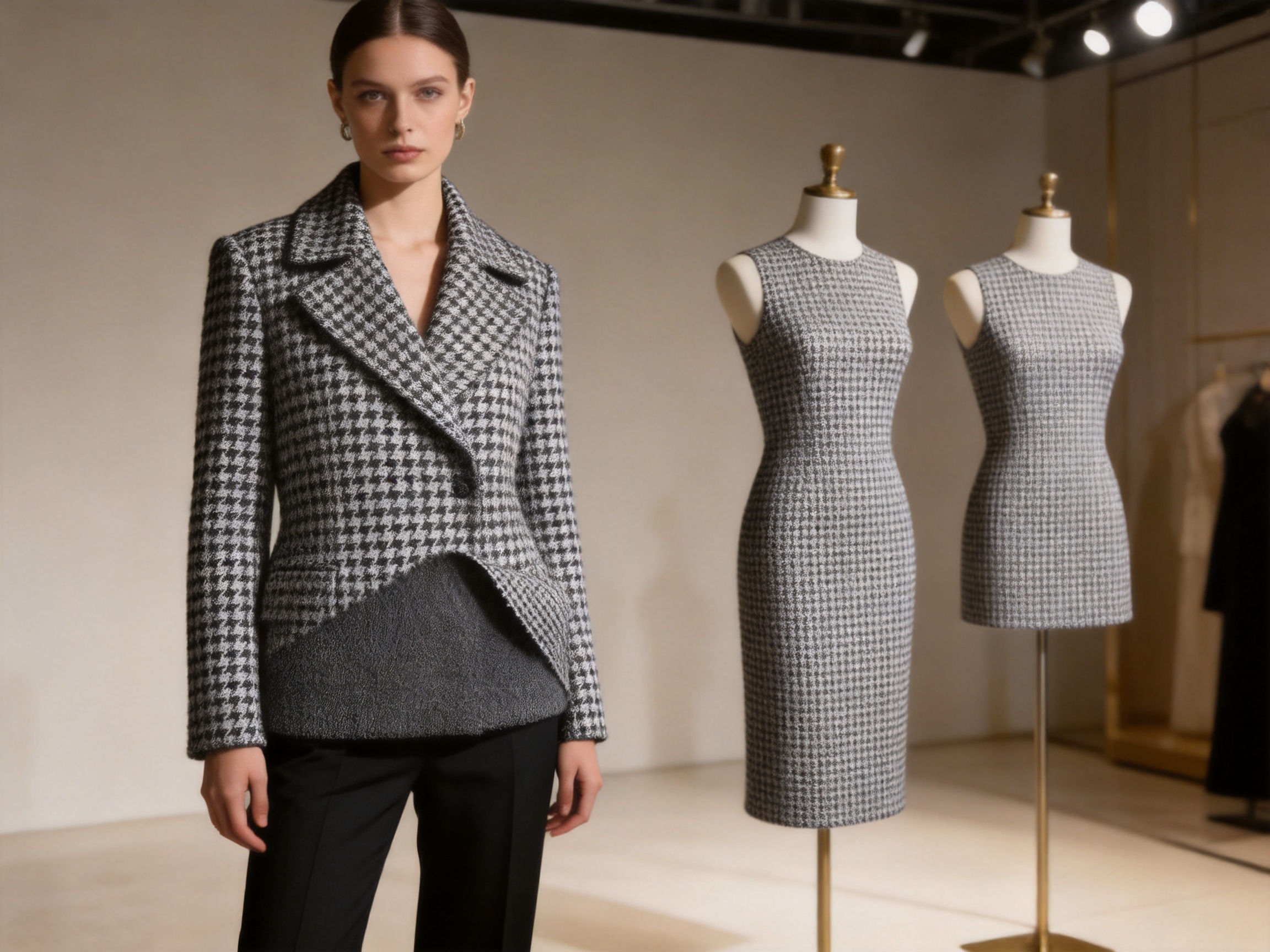
Houndstooth Design Jacquard Fabric is highly suitable for coats because the pattern has a strong outerwear identity. A coat is often the most visible part of an outfit, and houndstooth gives it instant recognition. The jacquard texture adds depth, making the coat look substantial and refined.
For women’s coats, the fabric can support classic silhouettes, oversized shapes, cropped jackets, and belted styles. For men’s or unisex outerwear, it can be used in tailored coats, casual jackets, and statement pieces. The elastic knitted nature can improve comfort, especially in designs that require ease of movement.
Compared with flat printed coat fabrics, jacquard houndstooth can offer a richer surface and more premium look. The pattern is less likely to appear superficial because it is part of the construction. This helps brands develop outerwear that feels both classic and updated.
Applications in Pants and Suits
Pants require fabric that can handle movement, fit, and recovery. The soft and elastic qualities of knitted jacquard fabric make it suitable for fashion trousers, coordinated sets, and modern suits. A houndstooth pattern can add tailored sophistication while the knitted structure supports daily wear comfort.
For suits, the fabric can be used in jackets and matching pants or skirts. The three-dimensional effect can give the suit a distinctive surface without needing additional decoration. In modern apparel markets, consumers often seek garments that combine professional appearance with comfort. This product supports that direction by blending a classic pattern with knit performance.
For pants, pattern scale is important. Smaller houndstooth patterns can create a more formal look, while larger patterns can create a fashion-forward statement. Because pattern customization is available, customers can select an appropriate scale for their market.
Applications in Dresses
Dresses benefit from fabrics that drape well, feel comfortable, and provide visual appeal. Houndstooth Design Jacquard Fabric can be customized in thickness, making it possible to develop dress fabrics that are not too heavy while still retaining texture. The elastic quality helps the dress move with the body and can improve comfort in fitted or semi-fitted styles.
The houndstooth motif can be used for classic sheath dresses, casual knit dresses, structured fashion dresses, and seasonal collections. Designers can combine the fabric with solid panels, collars, belts, pleats, or contrast trims. Because the fabric already has a strong pattern, garment construction can remain clean while still achieving a memorable look.
For retail presentation, houndstooth dresses are visually effective. The pattern is recognizable from a distance, while the jacquard texture invites closer inspection. This makes the fabric suitable for brands that want garments with shelf appeal and long-term style value.
Applications in Interiors
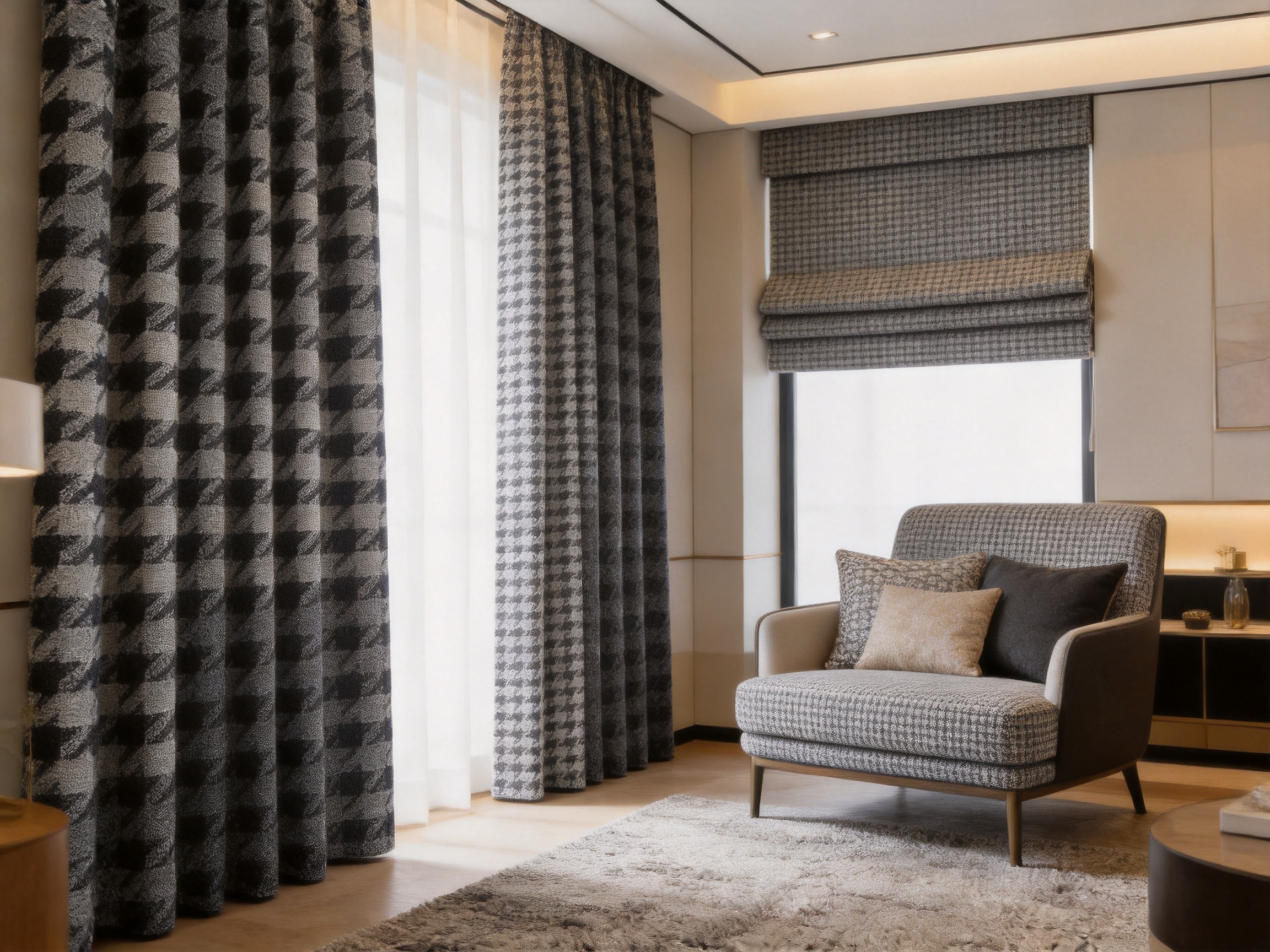
Although the product is highly suitable for apparel, the houndstooth pattern is also popular in interior design. It can be used for drapes, roman blinds, rugs, decorative panels, and upholstery-related applications. In interiors, houndstooth brings geometric energy and visual structure. It can create contrast in minimalist rooms or add refinement to traditional spaces.
For drapes and roman blinds, pattern scale and fabric weight are important. A customized jacquard fabric can be adjusted to support the desired hanging effect and visual impact. For upholstery or furniture accents, a stronger thickness may be selected depending on the product requirement. For rugs or decorative textile items, the three-dimensional pattern can create a strong tactile impression.
Interior designers often use houndstooth as a statement pattern because it is bold yet disciplined. It can be paired with solid textiles, leather, wood, glass, or metal. Jacquard construction enhances this effect by making the pattern feel woven or knitted into the material rather than printed onto the surface.
Quality Control and Production Reliability
Quality control is essential in jacquard fabric production. Pattern precision, yarn consistency, fabric density, elasticity, color uniformity, finishing effect, and hand feel all influence final performance. A manufacturer with experience in yarn production, fabric processing, dyeing support, finishing, and sales has a stronger foundation for managing these variables.
In jacquard manufacturing, even small inconsistencies can affect appearance. If yarn tension is unstable, the pattern may look uneven. If machine settings are not controlled, repeat accuracy can suffer. If finishing is not carefully managed, the fabric may lose softness or dimensional stability. Advanced production equipment and process experience help reduce these risks.
For buyers, stable quality is not only a technical issue but also a commercial advantage. Reliable fabric reduces garment defects, improves cutting efficiency, and supports repeat orders. When brands develop a successful style, they need confidence that future fabric batches will remain consistent. A manufacturer with integrated capabilities can better support this requirement.
Integrated Manufacturing Strength
The production enterprise is located in a textile industrial area and has substantial production and plant facilities. Its operations include production and processing, post-dyeing, finishing, and sales of blended fabrics such as polyester and spandex-related textiles, as well as DTY polyester yarn production, processing, and sales. This integrated structure allows better coordination from yarn to finished fabric.
Integrated manufacturing is important because textile quality is built through multiple stages. Yarn quality affects knitting performance. Knitting precision affects pattern clarity. Dyeing affects color and appearance. Finishing affects hand feel, stability, elasticity, and final usability. When these processes are coordinated by an experienced manufacturer, the final fabric can be better controlled.
The company also operates with research, development, production, and sales capabilities. This helps customers who need more than standard goods. Design development, sample adjustment, technical communication, and order execution can be handled with a stronger understanding of the complete production chain. For buyers seeking customized houndstooth jacquard fabric, this is a major advantage.
Export-Oriented Service and Customer Collaboration
As a self-operated export business integrating research and development, production, and sales, the manufacturer is positioned to serve both domestic and international customers. Export-oriented textile supply requires attention to communication, documentation, order planning, packaging, quality standards, and delivery coordination. These capabilities matter when customers are located in different markets and operate under different product development schedules.
Customer collaboration is especially important for customized jacquard fabric. Buyers may need to discuss pattern scale, color concept, yarn composition, thickness, stretch, finishing, and application. A cooperative manufacturing philosophy supports better product development because fabric solutions are not always one-size-fits-all. The goal is to help customers create products that match their brand, market, and technical requirements.
In competitive textile sourcing, service strength can be as important as machine strength. Buyers need quick responses, practical suggestions, stable sampling, and reliable bulk production. A manufacturer with both production equipment and textile experience can help reduce development time and improve order confidence.
Design Value for Fashion Brands
For fashion brands, Houndstooth Design Jacquard Fabric offers a ready-made design identity. The houndstooth pattern is already known to consumers, yet jacquard texture gives it a fresh and premium appearance. This combination helps brands develop products that feel familiar but not ordinary.
The fabric supports multiple fashion categories. It can be used in capsule collections, coordinated sets, statement coats, officewear, casual tailoring, dresses, and accessories. Its adaptability allows brands to create a complete theme across several product types. A collection might include a houndstooth coat, matching pants, a dress, and smaller accessories, all using coordinated fabric variations.
Because pattern and thickness can be customized, the same design concept can be adjusted for different price levels or seasons. A lighter version may serve a spring collection, while a thicker version may support autumn and winter outerwear. This flexibility can improve material planning and brand continuity.
Design Value for Interior Brands
Interior brands can use houndstooth jacquard fabric to create strong decorative effects. The pattern is geometric, recognizable, and highly compatible with many design styles. It can appear classic in black-and-white combinations, warm in neutral tones, bold in high-contrast colors, or modern in oversized repeats.
For furniture and window treatments, texture matters. A jacquard houndstooth surface can add depth and tactile interest. It can transform simple furniture shapes into statement pieces and give drapes or blinds a more crafted appearance. Compared with flat printed decorative fabric, jacquard fabric can feel more substantial and refined.
Interior markets also benefit from customization. Different rooms and product categories require different weights, pattern scales, and finishes. The ability to customize thickness and pattern helps interior brands develop products for residential, hospitality, office, and retail environments.
Production Process From Concept to Finished Fabric
The production process begins with customer requirements or internal product development. The desired pattern scale, fabric thickness, hand feel, elasticity, color direction, and application are discussed. For houndstooth jacquard, the pattern must be converted into a technical design suitable for computerized jacquard production.
Next comes yarn selection. Yarn type, count, texture, and composition influence the final fabric. Polyester, rayon, spandex-related components, and DTY yarn knowledge can be used to develop the desired balance of softness, stability, elasticity, and appearance. Suitable yarn preparation helps ensure stable knitting performance.
The jacquard knitting stage forms the fabric structure and pattern. Imported computerized jacquard machinery provides accurate control over the design. The classic houndstooth motif is created through the fabric construction, producing the three-dimensional texture and pattern clarity that distinguish the product.
After knitting, the fabric may go through dyeing, finishing, inspection, and packing processes according to order requirements. Finishing is especially important because it influences hand feel, dimensional stability, surface appearance, and usability. The fabric is then inspected for quality, including pattern consistency, fabric defects, width, weight, stretch, and overall appearance.
Practical Benefits for Garment Manufacturers
Garment manufacturers need fabrics that are attractive but also workable. Houndstooth Design Jacquard Fabric provides a strong visual result while supporting sewing and production needs. Its knitted structure can offer flexibility during garment construction, and its pattern consistency helps with panel matching and cutting planning.
Because the fabric has its own decorative texture, garment designs do not always require complex construction. Simple silhouettes can become visually strong when made with jacquard houndstooth. This can help manufacturers produce attractive garments without excessive trims or complicated details.
Customization also helps garment factories meet buyer specifications. If a customer needs a certain thickness or pattern scale, the fabric can be developed accordingly. This reduces compromise and supports more precise product execution.
Practical Benefits for Textile Buyers
Textile buyers often evaluate suppliers based on quality, price competitiveness, customization, production capacity, service, and reliability. This houndstooth jacquard fabric offers advantages in several of these areas. Its structural pattern and three-dimensional effect create a premium product value. Its soft and elastic hand feel supports modern comfort requirements. Its customization options support differentiated sourcing.
Advanced computerized production improves consistency and can reduce the risk of pattern or repeat problems. Integrated manufacturing capabilities support more efficient communication and quality control. Experience in DTY yarn and blended fabrics provides a stronger technical foundation for developing suitable specifications.
For buyers seeking an alternative to standard printed houndstooth or conventional woven checks, this product provides a compelling option. It combines visual heritage with knitted performance and modern manufacturing control.
Sustainability and Responsible Use Considerations
While the provided product information focuses on performance and manufacturing, responsible textile use is increasingly important in global markets. Durable, well-made fabrics can support longer product life by maintaining appearance and performance over time. Jacquard patterning may help reduce dependence on certain surface decoration methods because the design is integrated into the fabric structure.
Customization can also contribute to responsible production by helping buyers order fabric that suits the exact application. When fabric thickness, pattern scale, and performance are properly matched to the end product, waste caused by unsuitable material selection may be reduced. Stable quality and reliable repeat production can further help reduce defects and unnecessary loss during garment manufacturing.
For buyers with specific sustainability requirements, discussions may include yarn composition, dyeing standards, finishing processes, packaging preferences, and compliance needs. A manufacturer with integrated production knowledge is better positioned to support such technical communication.
How to Select the Right Specification
When selecting Houndstooth Design Jacquard Fabric, buyers should begin with the intended application. A coat may require more body, warmth, and thickness. Pants may need elasticity, recovery, and abrasion suitability. Dresses may require softness, drape, and lighter weight. Interior products may require stronger thickness, decorative texture, and dimensional stability.
The second consideration is pattern scale. Large houndstooth patterns create a bold fashion statement and are often suitable for coats, decorative panels, and statement interiors. Medium repeats are versatile for suits, trousers, and dresses. Small repeats are more subtle and can work well for professional clothing or refined decorative use.
The third consideration is hand feel. Some customers may prefer a soft, plush touch, while others may prefer a firmer structure. Finishing can be adjusted according to the desired result. The fourth consideration is color. Houndstooth is traditionally associated with black and white, but many modern variations use grey, beige, navy, brown, red, or seasonal colors.
Finally, buyers should consider order planning, testing needs, and garment production methods. Early communication about cutting, sewing, washing, and finishing expectations helps ensure the fabric is developed appropriately.
Maintenance and End-Use Performance
Care recommendations depend on the final fabric composition, dyeing process, finishing method, and end-use application. In general, jacquard knitted fabrics should be handled according to professional care guidance provided for the specific order. Garment and interior manufacturers should conduct appropriate testing before bulk production, especially for shrinkage, colorfastness, pilling, stretch recovery, and dimensional stability.
For apparel, sample garments should be evaluated for fit, seam behavior, drape, and comfort after wear simulation or washing tests. For interiors, abrasion, light exposure, and stability may be considered depending on use. Because customization is available, technical expectations should be discussed before final confirmation.
A careful testing and approval process helps ensure that the fabric performs well in the target product. This is especially important for brands that sell in different climates or to customers with different care habits.
Q&A Section
What is Houndstooth Design Jacquard Fabric?
It is a knitted jacquard fabric featuring the classic houndstooth pattern. The design is formed through jacquard construction rather than only surface printing, giving the fabric a textured, three-dimensional appearance.
What makes this fabric different from printed houndstooth fabric?
The pattern is integrated into the fabric structure, which creates greater depth, texture, and premium appearance. Printed fabrics may look flat, while jacquard fabric provides a more substantial and durable visual effect.
Is the fabric comfortable for clothing?
Yes. The fabric is designed to be comfortable, soft, and elastic. These qualities make it suitable for coats, pants, suits, dresses, and other garments that require both visual style and wearability.
Can the pattern be customized?
Yes. The houndstooth pattern can be customized in scale and design details according to customer requirements. This helps brands create unique styles for different markets and seasons.
Can the thickness be customized?
Yes. Thickness can be adjusted for different uses. Lighter specifications may be suitable for dresses, while heavier versions may be used for coats or selected interior applications.
What equipment is used to produce the fabric?
The fabric is produced by imported computerized jacquard machines. This equipment supports accurate pattern control, stable repeats, and consistent fabric production.
What are the main applications?
The fabric can be used for coats, pants, suits, dresses, bags, drapes, roman blinds, rugs, upholstery-related products, and decorative textile applications.
Why is houndstooth popular in both fashion and interiors?
Houndstooth is a classic tessellated pattern with strong visual recognition. It is bold but balanced, making it suitable for elegant garments, statement fashion pieces, and decorative interiors.
How does the manufacturer support quality?
The manufacturer has integrated capabilities in textile production and processing, including yarn-related experience, fabric production, dyeing support, finishing, and sales. This helps control quality across multiple production stages.
Who should consider buying this fabric?
Fashion brands, garment factories, textile buyers, interior product manufacturers, and designers seeking a classic patterned fabric with modern comfort and jacquard texture should consider this product.
Conclusion
Houndstooth Design Jacquard Fabric is a strong choice for customers who need a textile that combines classic pattern heritage, modern knitted comfort, and advanced manufacturing precision. Its houndstooth design is instantly recognizable, while its jacquard construction provides texture, depth, and a premium three-dimensional effect. Compared with printed alternatives and many standard fabrics, it offers stronger design integration, better tactile richness, and broader customization potential.
The fabric’s comfort, softness, and elasticity make it suitable for apparel such as coats, pants, suits, and dresses. Its visual strength and customizable thickness also support interior uses such as drapes, roman blinds, rugs, and upholstery-related products. This flexibility allows buyers to develop coordinated collections and differentiated products for multiple markets.
Behind the product is advanced computerized jacquard manufacturing, integrated textile processing experience, and knowledge of blended fabrics and DTY polyester yarn. These strengths support reliable quality, efficient customization, and practical customer collaboration. For brands and manufacturers seeking a refined houndstooth fabric with both aesthetic and functional value, Houndstooth Design Jacquard Fabric provides a competitive and versatile solution.
References
1. Spencer, David J. Knitting Technology: A Comprehensive Handbook and Practical Guide. Woodhead Publishing.
2. Kadolph, Sara J. Textiles. Pearson Education.
3. Braddock Clarke, Sarah E., and Marie O’Mahony. Techno Textiles: Revolutionary Fabrics for Fashion and Design. Thames and Hudson.
4. Goswami, B. C., Anandjiwala, R. D., and Hall, D. M. Textile Sizing. Marcel Dekker.
5. Wilson, Jacquie. Handbook of Textile Design: Principles, Processes and Practice. Woodhead Publishing.