
Jacquard Houndstooth Fabric: Structure, Performance, and Versatile Textile Applications
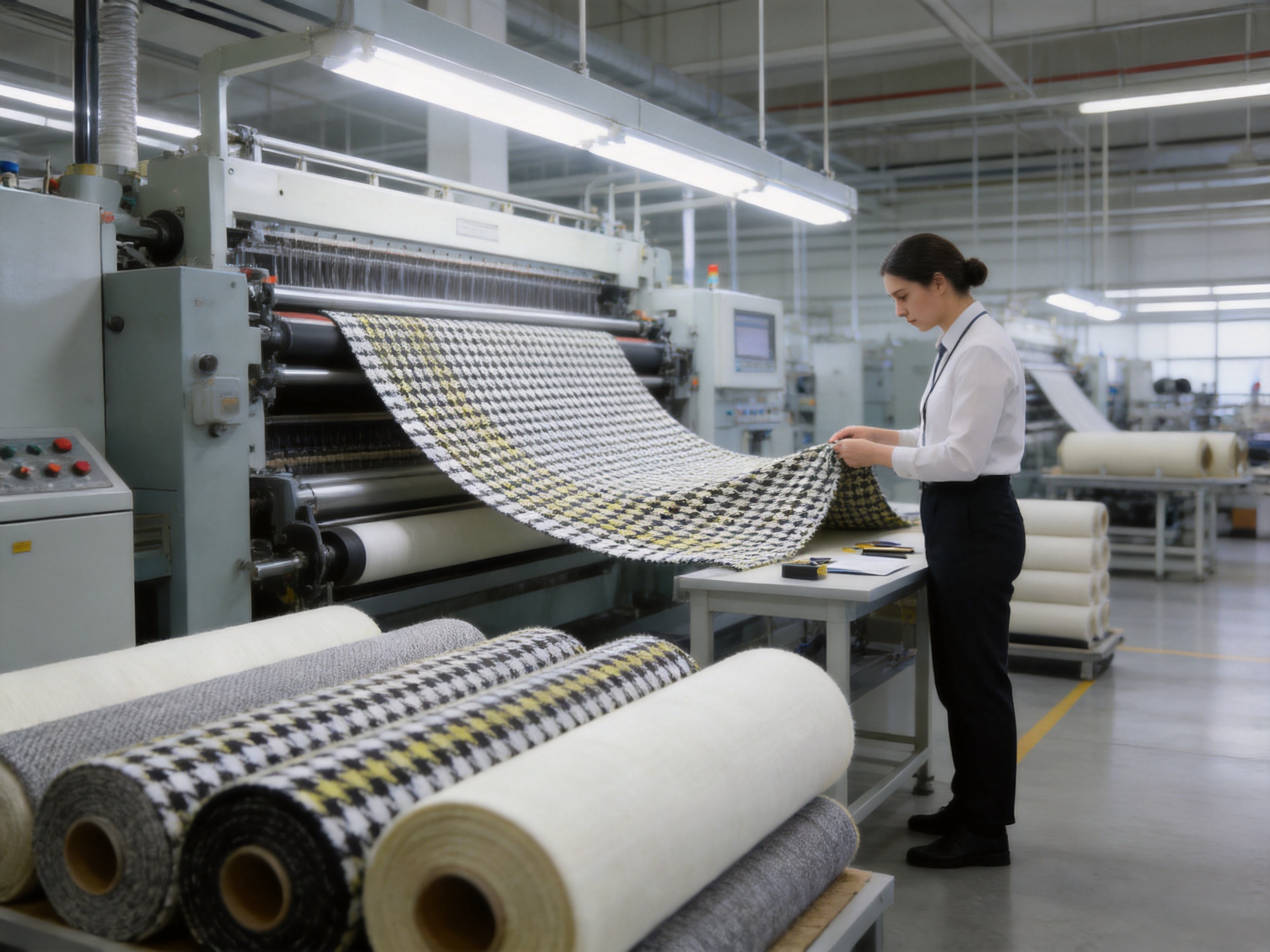
Jacquard houndstooth fabric combines a recognizable geometric pattern with the comfort, durability, and dimensional flexibility required by modern apparel and interior projects. Its characteristic broken-check appearance creates a refined visual effect, while the jacquard construction gives the fabric a substantial handle and a more integrated pattern than many printed alternatives. The result is a material that can support fashion garments, upholstery, curtains, cushions, caravan interiors, sofas, chairs, and a wide range of creative textile applications.
This fabric is designed for buyers who need more than an attractive surface. A successful textile must also provide reliable handling during cutting and sewing, suitable stability in use, a comfortable touch, and a consistent appearance across a continuous length. Jacquard houndstooth fabric answers these requirements through its woven pattern structure, soft finish, robust body, and two-direction stretch. These properties make it appropriate for both professional manufacturing and individual projects.
Produced and supplied by Hangzhou Jinfeng Textile Co., Ltd., the fabric benefits from the company’s experience in blended textile production, post-dyeing, finishing, and DTY polyester yarn manufacturing. The company operates an integrated production and sales model, enabling it to coordinate raw material preparation, fabric processing, finishing, inspection, and customer service. This integrated approach supports consistency and allows customers to source related textile materials from an experienced textile manufacturer.
Understanding Jacquard Houndstooth Fabric
Houndstooth is a classic textile pattern formed from repeated, angular broken checks. Its visual identity is immediately recognizable, but its appearance can vary according to the size of the repeat, the contrast between colors, the yarn arrangement, and the thickness of the fabric. In a jacquard construction, the pattern is created through the organization of yarns during fabric formation rather than being applied only to the finished surface.
This distinction is important. A printed fabric can reproduce a houndstooth image on a plain textile, but a jacquard fabric develops its pattern through the construction of the textile itself. The pattern therefore becomes a structural part of the material. This can provide a richer surface, a more tactile appearance, and a stronger sense of depth. It also helps the fabric retain its distinctive design when used on three-dimensional products such as cushions, chairs, coats, or upholstered panels.
The supplied jacquard houndstooth fabric is described as beautiful, soft, thick, and robust. These qualities are not mutually exclusive. A carefully balanced textile can have a substantial body while remaining pleasant to touch. This combination is particularly useful for products that require visual sophistication and physical endurance, including outerwear, furniture coverings, and decorative household textiles.
Pattern Built into the Fabric
Jacquard production provides designers with opportunities to create patterns that are more integrated than surface decoration. The houndstooth motif can appear crisp and dimensional because different yarn arrangements contribute to the contrast and texture. When the fabric is viewed under changing light, the surface may show subtle variations in depth and reflection, giving finished products a premium appearance.
Because the pattern is part of the fabric construction, it can be used in designs where a printed coating may be less suitable. Garments, cushions, sofa panels, and chair covers are often exposed to movement, folding, handling, and friction. A structurally developed design can maintain a more natural textile appearance throughout these uses.
Softness with a Substantial Handle
Softness is a major advantage for apparel and home furnishings. In coats and blazers, a soft hand contributes to comfort and helps the garment feel more refined. In cushions, chairs, and sofas, softness creates a more inviting surface. At the same time, a thick and robust handle helps the material retain a sense of quality and provides enough body for structured applications.
The balance between softness and weight also affects sewing and installation. Very thin fabrics may require additional lining or support, while excessively rigid materials can be difficult to shape. A substantial yet flexible jacquard can offer a practical middle ground, allowing it to be used for tailored apparel, decorative panels, loose covers, and other projects that need both form and comfort.
Key Product Advantages
Jacquard houndstooth fabric offers several advantages over ordinary printed houndstooth textiles, lightweight fashion fabrics, and less substantial upholstery materials. Its benefits can be evaluated through pattern construction, hand feel, stretch, durability, design flexibility, and ordering convenience.
Integrated Jacquard Appearance
The principal advantage is the integrated jacquard pattern. Instead of relying only on ink or pigment applied to a flat surface, the fabric uses a construction method that gives the design a more textile-based character. This can produce a richer look and a more convincing tactile effect, especially when the houndstooth repeat is viewed at close range.
For apparel brands, this integrated appearance can help create garments with a more elevated visual identity. For interior designers, it can add depth to furniture and decorative products. For smaller creative projects, it provides a finished appearance that may otherwise require additional layering, quilting, or surface embellishment.
Two-Direction Stretch
The fabric stretches in two directions, giving users more options when planning a project. Two-direction stretch can support comfort in garments and help fabric adapt to gently curved surfaces in upholstery applications. It may also reduce the visual tension that can occur when a rigid textile is fitted over cushions, rounded chair backs, or other shaped forms.
In fashion apparel, stretch can support ease of movement and improve the relationship between the textile and the garment pattern. In interior applications, it can assist with fitting and shaping, provided that the project is designed with the fabric’s stretch direction in mind. Designers should always test the material before large-scale production, especially when exact recovery, seam performance, or high-contact use is important.
Thick and Robust Construction
The fabric’s thickness gives it a stable and substantial appearance. This is valuable in coats, blazers, cushions, curtains, sofa covers, and chairs, where a lightweight textile may appear insubstantial or require multiple layers. A robust construction can also help products retain a structured silhouette and support a more premium tactile experience.
For upholstery projects, fabric weight and body influence both appearance and installation. A fabric with sufficient substance can cover a base more effectively and create cleaner visual lines. For curtains, a thicker textile may provide a fuller drape and a more decorative presence. For apparel, the same body can help tailored garments maintain their intended shape.
Soft Surface for Comfort-Oriented Uses
Many robust fabrics sacrifice softness, but this material is intended to remain comfortable while providing durability and body. A soft surface is especially important for products that come into frequent contact with the skin, such as coats, blazers, cushions, and seating. It can also make the fabric more enjoyable to handle during cutting, sewing, fitting, and installation.
Classic Design with Broad Market Appeal
Houndstooth has remained relevant across fashion and interiors because it combines heritage character with strong graphic clarity. The pattern can be used in formal, contemporary, retro, minimalist, or eclectic settings depending on color selection and scale. It can serve as a principal design element or as an accent within a larger collection.
For apparel manufacturers, a classic pattern can reduce dependence on short-lived visual trends. For interior suppliers, it can work across residential, hospitality, office, and transport-related environments. The fabric’s versatility enables buyers to develop multiple product categories from one textile base.
Continuous-Length Supply
The product can be ordered in the quantity required and supplied in one continuous piece. This is beneficial for manufacturers and project users who want to minimize unnecessary joins. Continuous fabric can make cutting plans more efficient, reduce visual interruptions, and simplify the covering of long or connected surfaces.
For curtains and large upholstery projects, continuity is particularly useful. A single piece can help preserve pattern alignment and color consistency across the installation. In apparel production, continuous yardage or meterage supports organized cutting layouts and reduces the need to combine separate remnants.
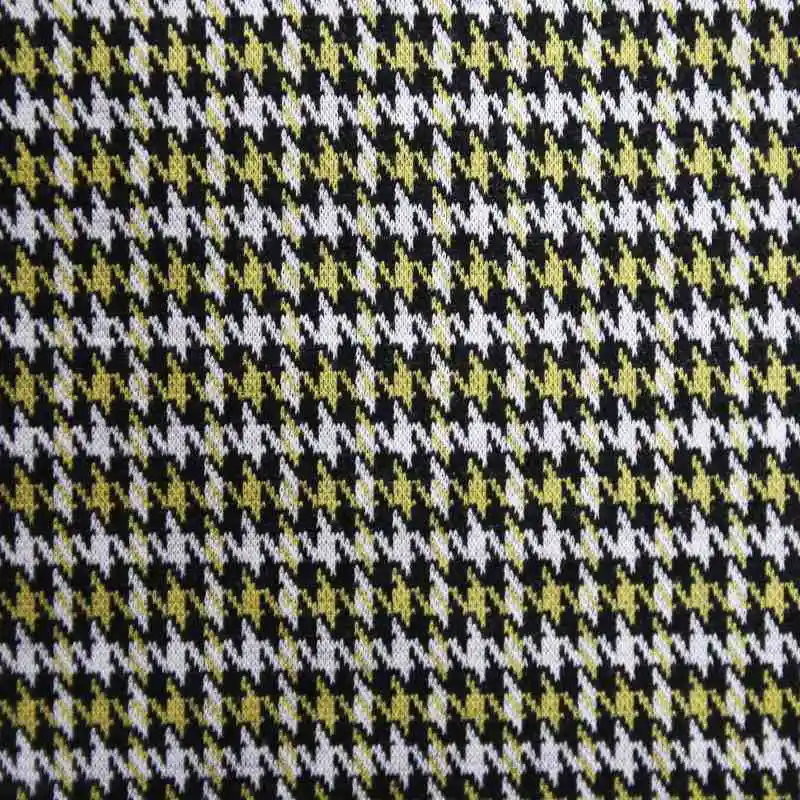
Jacquard Houndstooth Fabric
Applications in Fashion Apparel
Jacquard houndstooth fabric is well suited to garments that require visual structure, warmth, and a distinctive surface. The supplied material is specifically appropriate for coats and blazers, but its use can extend to jackets, skirts, vests, tailored dresses, fashion accessories, and selected costume designs.
Coats
Coats benefit from a thick and robust textile because the outer layer must create a clear silhouette and withstand regular handling. Houndstooth adds visual character without requiring complicated surface decoration. The soft hand makes the coat more comfortable, while the fabric body can support lapels, collars, cuffs, panels, and structured construction details.
Designers can use the pattern direction to influence the visual rhythm of the garment. Matching the repeat across center fronts, pockets, and side seams can create a highly coordinated appearance. Alternatively, deliberately changing the direction of the pattern can highlight selected panels or create a contemporary design effect.
Blazers and Tailored Jackets
Blazers require a material that can support shaping while remaining wearable. Jacquard houndstooth fabric provides an attractive balance between a tailored appearance and a softer, more comfortable handle. It can be used for single-breasted or double-breasted silhouettes, cropped jackets, oversized styles, and coordinated suit separates.
The two-direction stretch may contribute to improved movement through the shoulders, sleeves, and upper back. Pattern makers should account for stretch during fitting and may need to adapt ease, seam allowances, lining choices, and interfacing. A sample garment or toile is recommended before a full production run.
Contemporary Fashion Collections
The pattern can be interpreted in both traditional and modern ways. A smaller repeat may appear refined and understated, while a larger repeat can create a bold statement. Designers can combine the fabric with solid-color materials, leather-like trims, knitted components, smooth lining, or contrasting jacquards.
Because the textile already has a strong pattern, it can simplify styling. A single coat or blazer made from the material may serve as the visual focus of an outfit. This can help brands develop distinctive collections without relying on extensive embroidery, printing, or additional ornamentation.
Applications in Upholstery and Home Furnishings
The fabric’s substantial construction and classic pattern make it useful for upholstery and interior decoration. It can be used for cushions, sofas, chairs, curtains, caravan interiors, decorative panels, and other furnishing projects. Its versatility allows both small-scale customization and broader commercial applications.
Cushions
Cushions are an effective application because the houndstooth pattern can become a prominent decorative feature on a relatively small surface. The soft fabric creates a comfortable touch, while the robust body helps the cushion maintain a more finished appearance. Designers can use the material for complete cushion covers, front panels, borders, piping combinations, or mixed-pattern arrangements.
Pattern placement is important when making cushions. The repeat should be considered in relation to the size and shape of the cover. Centering the houndstooth motif can produce a formal look, while offset placement can create a more relaxed and contemporary effect. When several cushions are used together, combining different scales or solid colors can prevent the design from becoming visually repetitive.
Sofas and Chairs
On sofas and chairs, the fabric becomes part of the overall interior environment. Its geometric pattern can emphasize the lines of the furniture and bring visual definition to otherwise plain forms. The thickness of the textile may help it cover furniture surfaces with a stable, substantial appearance.
For shaped upholstery, the two-direction stretch may offer useful flexibility during fitting. However, professional upholsterers should evaluate the stretch direction, expected friction, seam placement, and pattern matching before installation. High-use furniture may require appropriate protective treatment, careful maintenance planning, and testing according to the intended environment.
Curtains
Jacquard houndstooth fabric can provide curtains with a fuller and more decorative presence than lightweight printed materials. The pattern can contribute a strong architectural element to a room, particularly when used in spaces with neutral walls and simple furnishings. Depending on the color and repeat, the fabric may suit residential rooms, offices, hospitality interiors, showrooms, and display environments.
When used for curtains, buyers should assess the required width, drop, fullness ratio, heading style, lining, and pattern direction. Continuous material is advantageous because it can support the production of long curtain panels with fewer joins. Accurate measurement and a sample installation remain important for achieving the desired drape.
Caravan and Transport Interiors
The material is also suitable for caravan-related projects and other compact interior applications. Caravan interiors often require textiles that combine visual warmth with practical handling. Houndstooth can add a tailored, home-like quality to seating, cushions, side panels, and decorative sections.
In these settings, the textile should be selected according to the expected level of use, cleaning requirements, exposure to sunlight, and installation method. The fabric’s softness and body can contribute to comfort and appearance, while the pattern can help conceal minor visual irregularities associated with frequent use. As with any interior textile, project-specific performance testing is recommended.
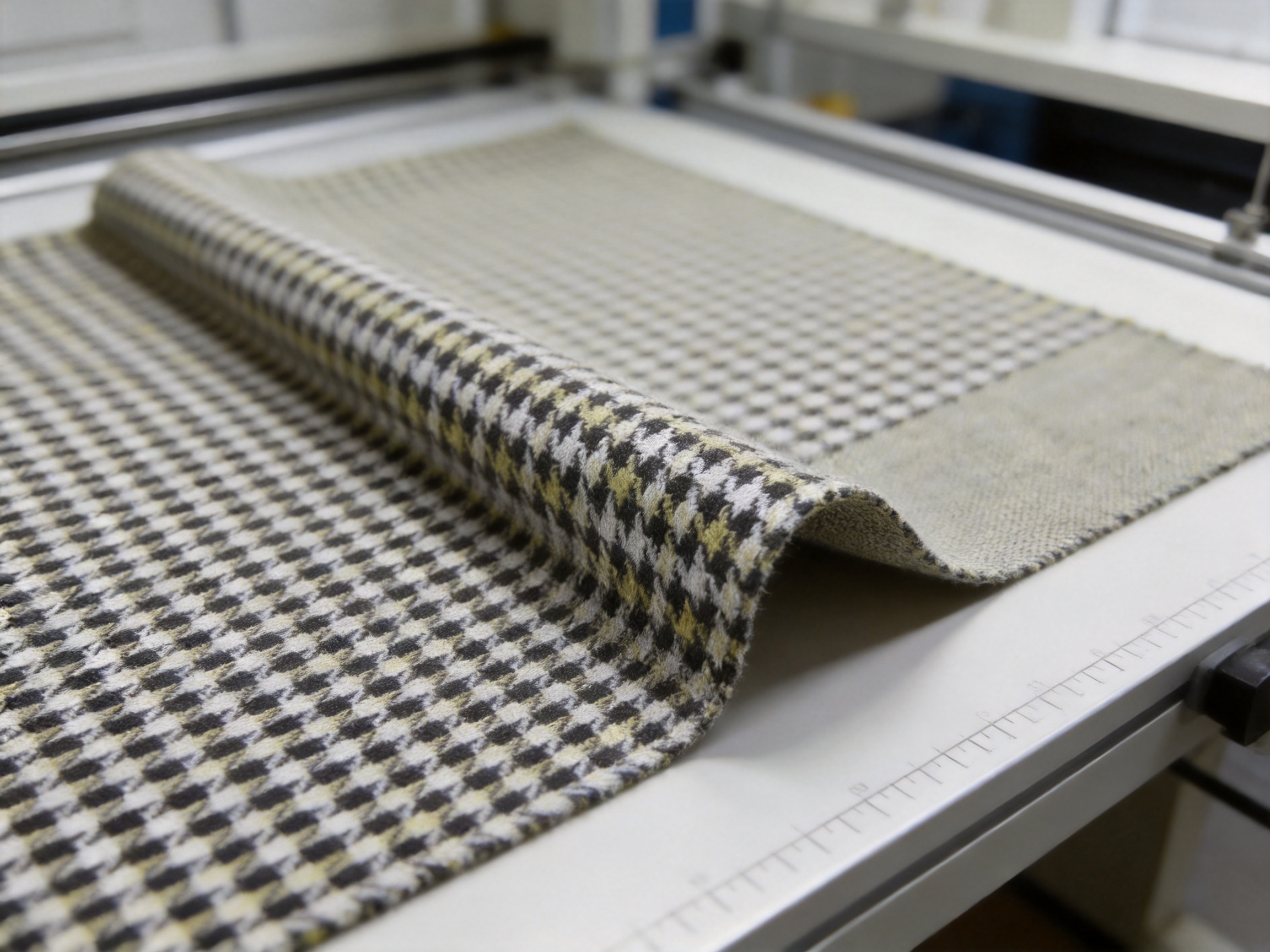
Manufacturing Expertise and Integrated Production
Product performance is influenced not only by design but also by manufacturing discipline. Hangzhou Jinfeng Textile Co., Ltd. operates in textile production, processing, post-dyeing, finishing, and sales of blended fabrics, including polyester and spandex-related materials. The company also manufactures, processes, and sells DTY polyester yarn.
This combination of activities gives the company a broad understanding of the textile supply chain. Yarn characteristics influence fabric appearance, hand feel, stretch, strength, dye behavior, and processing stability. Experience with polyester yarn production can therefore support informed decisions during fabric development and processing.
Raw Material and Yarn Considerations
Yarn selection is one of the foundations of fabric quality. Fiber composition, yarn count, filament arrangement, twist or texturing method, and uniformity can all influence the final textile. For blended fabrics, the relationship between different fiber types must also be considered because each component may respond differently to heat, dyeing, tension, and finishing.
DTY polyester yarn is commonly used where manufacturers need a combination of flexibility, resilience, bulk, and consistent processing behavior. Draw texturing can modify the character of filament yarn and contribute to a softer or more elastic textile effect. The precise outcome depends on production parameters and the final fabric construction.
Jinfeng’s product categories include polyester rayon fabric, knitted jacquard fabric, NTR knitted fabric, NR knitted fabric, and slightly intermingled draw textured yarn. This product range indicates experience across multiple textile structures and yarn-related processes. For buyers, a broad technical base can make communication easier when developing coordinated fabrics or sourcing materials for different product lines.
Jacquard Fabric Formation
Jacquard production requires controlled pattern programming and stable fabric formation. The design must be translated into a repeat that can be produced consistently across the width and length of the material. Yarn tension, machine settings, pattern repetition, and fabric density all influence the final appearance.
For houndstooth, accurate repeat control is especially important because the pattern relies on strong geometric relationships. Small inconsistencies can affect alignment, symmetry, or the visual sharpness of the broken-check motif. A disciplined manufacturing process helps maintain a uniform surface and supports better cutting and pattern matching during later use.
Dyeing and Post-Dyeing Processing
Color is central to houndstooth fabric because contrast defines the pattern. Post-dyeing and related processing stages must be managed carefully to achieve an attractive and consistent result. The fabric may require preparation, dye application, washing, drying, and stabilization steps according to its fiber composition and construction.
Processing conditions can influence shade, softness, width, dimensional stability, and surface appearance. Excessive tension may distort the pattern or reduce the desired hand feel, while inadequate stabilization may lead to unwanted dimensional change during cutting or use. Experienced processing teams therefore evaluate the relationship between color development and fabric performance rather than treating dyeing as an isolated operation.
Finishing for Handle and Usability
Finishing is the stage where the fabric’s tactile and practical qualities are refined. A suitable finish can enhance softness, improve surface uniformity, support dimensional stability, and prepare the material for apparel or interior use. The finish must be balanced carefully: too little treatment may leave the fabric harsh or unstable, while excessive treatment may alter breathability, stretch, or natural texture.
For jacquard houndstooth fabric, finishing also helps present the pattern effectively. The surface should retain sufficient definition for the geometric motif to remain clear, while the hand should remain pleasant and suitable for the intended application. Finishing parameters may be adjusted according to whether the fabric is destined for clothing, upholstery, curtains, or decorative products.
Manufacturing Strengths of the Supplier
Hangzhou Jinfeng Textile Co., Ltd. is located in Jingjiang Street Industrial Park, Xiaoshan District, Hangzhou City, Zhejiang Province. The company covers approximately 32.6 acres and has a plant area of approximately 18,000 square meters. These facilities provide a base for production, processing, finishing, storage, and related operational activities.
The company describes itself as an export-oriented enterprise integrating research and development, production, and sales. This structure can benefit buyers who need direct communication with a manufacturer rather than a fragmented sourcing chain. Technical questions, production planning, product selection, and order coordination can be handled through a more connected organization.
Research and Development Orientation
Textile markets change continuously. Customers seek new colors, patterns, textures, weights, stretch levels, and applications. An R&D-oriented approach allows a manufacturer to respond to these needs by adjusting fabric structures, yarn combinations, finishing methods, and product presentations.
For a classic design such as houndstooth, development does not have to mean abandoning tradition. It may involve exploring different repeat sizes, color combinations, surface effects, fabric weights, or end uses. This allows the material to serve conservative apparel collections as well as contemporary interiors.
Production and Sales Coordination
When production and sales functions are closely connected, customer feedback can be returned to the manufacturing side more efficiently. Buyers can communicate requirements related to width, stretch, weight, color, continuous length, packing, and application. The supplier can then use this information to coordinate the appropriate production and finishing process.
This is particularly valuable for project-based textile orders. Upholstery, curtain, and caravan projects may have specific quantity, continuity, or pattern-matching needs. Direct manufacturer communication can help clarify those requirements before production begins.
Export Experience
An export-oriented company must pay attention to communication, packaging, documentation, production scheduling, and customer expectations across different markets. International buyers often require clear product information, reliable order coordination, and consistent quality from one shipment to the next.
Jinfeng’s export-company structure supports its ability to serve customers at home and abroad. Buyers should still confirm the specific commercial details for each order, including minimum quantities, available widths, color options, lead time, packing format, shipping arrangements, and applicable testing documentation.
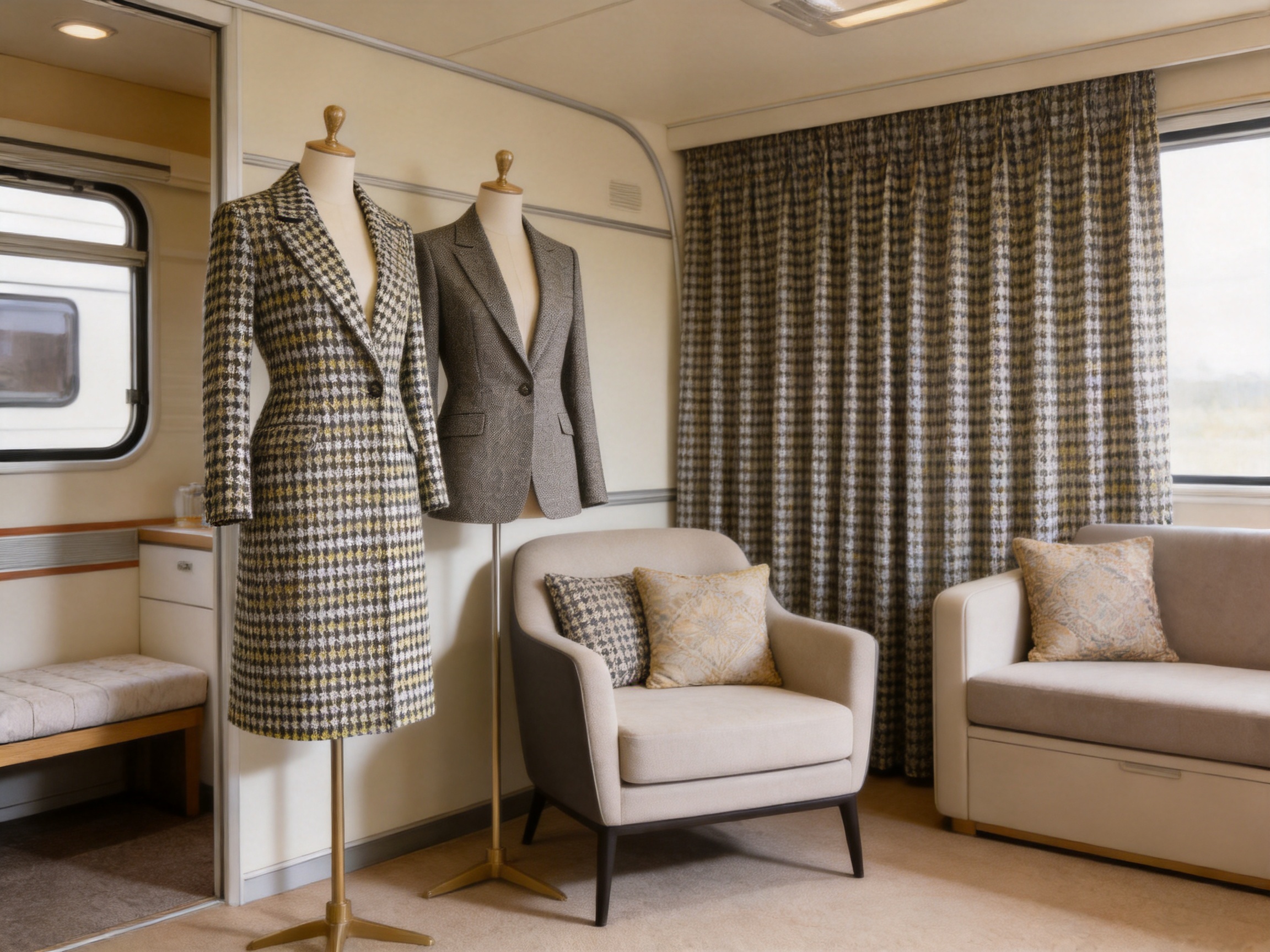
Comparison with Alternative Textile Options
Choosing a fabric requires comparison with realistic alternatives. Jacquard houndstooth fabric is not intended to replace every textile; rather, it provides a useful combination of pattern depth, substantial body, softness, stretch, and application flexibility.
| Evaluation Factor | Jacquard Houndstooth Fabric | Printed Lightweight Fabric | Plain Upholstery Fabric | Very Rigid Decorative Fabric |
|---|---|---|---|---|
| Pattern Character | Pattern integrated into the jacquard construction | Pattern applied to the surface | Usually plain or minimally patterned | May have a decorative surface but limited flexibility |
| Hand Feel | Soft with a thick, substantial handle | Often lighter and less structured | May be firm or coarse depending on construction | Can feel firm or stiff |
| Stretch | Stretches in two directions | Depends on fiber and construction | Often limited unless specifically engineered | Frequently limited |
| Apparel Suitability | Suitable for coats, blazers, and structured garments | Suitable for lightweight garments and lining-related uses | May be too heavy or coarse for many garments | Often difficult to tailor |
| Interior Suitability | Cushions, sofas, chairs, curtains, and caravan interiors | May require additional support or lining | Suitable for upholstery but may lack a distinctive pattern | Suitable for selected decorative uses |
| Visual Depth | Textured, dimensional jacquard appearance | Primarily surface-based appearance | Depends on texture and color | Can be visually strong but less adaptable |
| Project Flexibility | Works across apparel and interior projects | More dependent on weight and end use | More focused on furnishings | More limited by stiffness |
The comparison demonstrates why the product can appeal to buyers serving several markets. A printed fabric may offer a lower-weight solution for a particular garment, while a plain upholstery fabric may be appropriate where pattern is not required. However, jacquard houndstooth fabric offers a more distinctive balance for customers who want one material to provide comfort, structure, visual identity, and flexible use.
Design and Production Recommendations
To obtain the best results, designers and manufacturers should treat the fabric as a structured, stretchable textile rather than as a completely stable plain weave. The pattern, stretch direction, thickness, and end use should all be considered during product development.
Direction and Pattern Matching
Before cutting, identify the principal direction of stretch and the orientation of the houndstooth repeat. On coats and blazers, matching the pattern across center fronts, pocket flaps, collars, and side seams can create a carefully tailored appearance. On cushions and upholstered furniture, pattern matching can improve the sense of quality across adjoining panels.
Pattern matching may increase fabric consumption. Buyers should calculate the repeat, seam allowance, cutting direction, and required visual alignment before ordering. The option to order the required quantity in one continuous piece is helpful, but accurate planning remains essential.
Stabilization and Support
Although the fabric has a substantial body, some applications may benefit from lining, interfacing, backing, or other support. Coats and blazers may require tailored interlinings, depending on the desired silhouette. Cushions and seating may require appropriate inner structures to support the outer textile.
Support materials should be tested with the fabric because they can affect stretch, softness, drape, thickness, and sewing performance. A compatible lining can preserve comfort, while an overly rigid backing may suppress the fabric’s natural flexibility.
Seam and Sewing Considerations
Thick jacquard fabrics may require needle, thread, presser-foot, and seam-setting adjustments. Sewing trials can help determine whether seams lie flat, whether the pattern remains aligned, and whether the fabric feeds evenly through the machine. For stretch-sensitive designs, seam construction should accommodate movement without causing puckering or distortion.
Professional manufacturers should establish a sample approval process before bulk production. The sample should be evaluated for appearance, hand feel, seam strength, pattern matching, dimensional behavior, and compatibility with trims or hardware.
Care and Maintenance Planning
Care instructions should be based on the final fabric composition, dyeing process, finishing treatment, and intended product. Apparel and interior items may require different cleaning approaches. Buyers should request product-specific care guidance and conduct relevant testing before publishing consumer instructions.
For upholstery, maintenance planning should consider dust, friction, spills, sunlight, and frequency of use. For garments, cleaning and pressing requirements should be assessed in relation to lining, interfacing, closures, and other components. Clear care information helps protect the appearance and service life of the finished product.
Quality Control Priorities
Quality control should cover both appearance and performance. A visually attractive roll is not sufficient if the width, stretch, shade, or dimensional stability varies beyond the project’s tolerance. The inspection process should be aligned with the final use and the customer’s technical specifications.
Visual Inspection
Inspectors should review the fabric for pattern clarity, repeat consistency, shade uniformity, surface defects, contamination, broken yarns, and irregular finishing. Houndstooth designs require particular attention to geometric alignment and contrast. Any visible variation should be documented and evaluated against approved standards.
Width and Length Verification
Usable width and total length affect cutting efficiency and project costing. Measurements should be taken under controlled conditions because tension and relaxation can influence the apparent width of a stretchable material. Continuous-length orders should be checked to confirm that joins and interruptions are identified accurately.
Stretch and Recovery Testing
Because the fabric stretches in two directions, buyers may wish to test stretch percentage, recovery, and dimensional change after repeated extension. The appropriate test method depends on the intended end use. Apparel, cushions, and upholstery can place different demands on the material, so application-specific evaluation is advisable.
Color and Batch Control
Color consistency is essential for houndstooth because the pattern depends on contrast. Production lots should be compared with an approved standard under suitable lighting. If a project requires multiple rolls or shipments, buyers should clarify batch control requirements in advance.
Why the Material Appeals to International Buyers
International buyers often seek fabrics that can serve more than one market segment. A textile suitable only for a narrow application may increase inventory complexity. Jacquard houndstooth fabric offers a broader commercial proposition by combining fashion and interior potential in one recognizable design.
Its classic appearance supports collections that need a dependable pattern, while its soft and robust construction gives it relevance for products requiring comfort and substance. The two-direction stretch adds another layer of flexibility, allowing designers to consider shaped garments and selected curved surfaces. Continuous-piece supply further supports large and small project planning.
The manufacturer’s location in Hangzhou’s established textile region also provides access to a broader industrial ecosystem. Textile production, yarn processing, dyeing, finishing, logistics, and related services are important parts of the regional manufacturing environment. For overseas customers, working with a supplier that understands both production and export coordination can simplify sourcing.
Product Selection Checklist
Before placing an order, buyers should prepare a clear specification. The following points can help ensure that the material is suitable for the intended product:
1. Confirm the required application, such as coats, blazers, cushions, sofas, chairs, curtains, or caravan interiors.
2. Request the available composition, usable width, weight, stretch direction, and recommended care method.
3. Ask for a physical sample to assess softness, thickness, pattern scale, color, drape, and sewing behavior.
4. Confirm the minimum order quantity and whether the requested quantity can be supplied in one continuous piece.
5. Discuss pattern matching requirements and calculate additional consumption for repeats, seams, and directional cutting.
6. Verify color options, production lead time, packaging, inspection procedures, and shipping arrangements.
7. Conduct application-specific tests if the material will be used for high-contact furniture, commercial interiors, or other demanding environments.
8. Approve a pre-production sample before committing to a larger production quantity.
Q&A
What is jacquard houndstooth fabric?
It is a textile featuring the classic houndstooth broken-check pattern created through jacquard fabric construction. The design is integrated into the textile structure, giving it a dimensional and tactile appearance rather than relying only on a printed surface.
Is the fabric suitable for clothing?
Yes. Its soft hand, substantial body, and two-direction stretch make it suitable for fashion apparel such as coats and blazers. Designers should test the material with the intended lining, interfacing, seam construction, and garment pattern before bulk production.
Can it be used for upholstery?
Yes. The fabric is suitable for cushions, sofas, chairs, curtains, caravan interiors, and other upholstery or decorative projects. The specific application should be evaluated for friction, cleaning, sunlight, seam strength, and other performance requirements.
Does the fabric stretch?
Yes. The product stretches in two directions. The exact amount of stretch and recovery should be confirmed for each production lot or specification, particularly when the fabric will be used for fitted garments or shaped upholstery.
What are the main advantages over printed houndstooth fabric?
The jacquard construction provides an integrated pattern with greater visual depth and a more textile-based appearance. The material also combines softness, thickness, robustness, and two-direction stretch, offering a wider range of potential uses than many lightweight printed fabrics.
Can buyers order a specific quantity?
The fabric can be ordered in the quantity needed, subject to production and commercial requirements. It can be supplied in one continuous piece, which is useful for curtains, upholstery panels, large projects, and organized apparel cutting.
Is houndstooth suitable for modern interiors?
Yes. Although houndstooth has a classic heritage, its scale, color, and placement can be adapted to modern interiors. It can be used as a focal fabric on a chair or sofa, as an accent on cushions, or as a graphic curtain material in a contemporary room.
What should be tested before bulk purchasing?
Buyers should evaluate color, pattern repeat, usable width, thickness, softness, stretch, recovery, dimensional stability, seam behavior, and care performance. For upholstery, abrasion and cleaning suitability should also be considered according to the intended environment.
What manufacturing capabilities does the supplier provide?
Hangzhou Jinfeng Textile Co., Ltd. provides blended fabric production and processing, post-dyeing, finishing, sales, and DTY polyester yarn production, processing, and sales. The company also presents itself as an export-oriented enterprise integrating research and development, production, and sales.
Where is the supplier located?
The company is located at 1279 Shenda Road, Jingjiang Branch, Xiaoshan District, Hangzhou. Its facilities are located in Jingjiang Street Industrial Park in Xiaoshan District, Hangzhou City, Zhejiang Province.
Conclusion
Jacquard houndstooth fabric is a versatile textile for buyers who value classic design, tactile quality, and practical flexibility. Its jacquard construction gives the houndstooth pattern depth and structural presence. Its thick and robust handle supports tailored garments and interior products, while its soft surface improves comfort. Two-direction stretch provides additional options for clothing and selected shaped applications.
The fabric’s potential extends from coats and blazers to cushions, curtains, caravan interiors, sofas, and chairs. This wide application range can help designers, manufacturers, upholsterers, and project buyers simplify sourcing while developing products with a recognizable visual identity.
Its manufacturing foundation is supported by Hangzhou Jinfeng Textile Co., Ltd.’s experience in polyester, spandex-related, and other blended fabrics, knitted jacquard materials, post-dyeing, finishing, and DTY polyester yarn production. With an integrated R&D, manufacturing, processing, and sales structure, the company is positioned to support customers seeking coordinated textile supply and direct production communication.
For the best result, buyers should request samples, confirm technical specifications, evaluate the material according to the final use, and approve production standards before ordering. When properly selected and processed, jacquard houndstooth fabric can provide the visual sophistication, comfort, substance, and project flexibility required by contemporary apparel and interior markets.
References
1. International Textile Manufacturers Federation, general principles of textile production, quality management, and international sourcing.
2. Textile Institute, textile fabric construction, yarn behavior, finishing, and performance evaluation references.
3. Standard textile testing practices for fabric width, dimensional stability, stretch, recovery, color consistency, and surface inspection.
4. General technical references on jacquard pattern formation and patterned textile design.
5. General technical references on draw textured polyester yarn and filament-yarn processing.
6. Supplier-provided product information for jacquard houndstooth fabric and blended textile manufacturing capabilities.