
Knitted Jacquard Houndstooth Fabric for Classic Apparel with Modern Performance
Knitted jacquard houndstooth fabric is a distinctive textile that combines a timeless visual pattern with the comfort, flexibility, and dimensional character of knitted construction. The houndstooth motif has remained relevant for decades because it offers a rare balance: it is bold without being excessive, classic without looking outdated, and formal enough for refined garments while still being easy to adapt to casual fashion. When this pattern is produced through knitted jacquard technology rather than simple surface printing, the result is a fabric with richer texture, better pattern integrity, and a more premium hand feel.
This article focuses on knitted jacquard houndstooth fabric as a practical and stylish material for modern apparel brands, garment manufacturers, fabric buyers, and designers. It also explains how integrated textile manufacturing, including yarn preparation, knitting, dyeing, finishing, inspection, and export-oriented service, supports consistent quality and reliable supply. The fabric is especially suitable for garments such as dresses, coats, jackets, skirts, cardigans, trousers, casual sets, and tailored knitwear. Its black-and-white tonal checks create a strong visual identity, while the knitted structure offers comfort and movement that many woven houndstooth fabrics cannot match.
Knitted Jacquard Houndstooth Fabric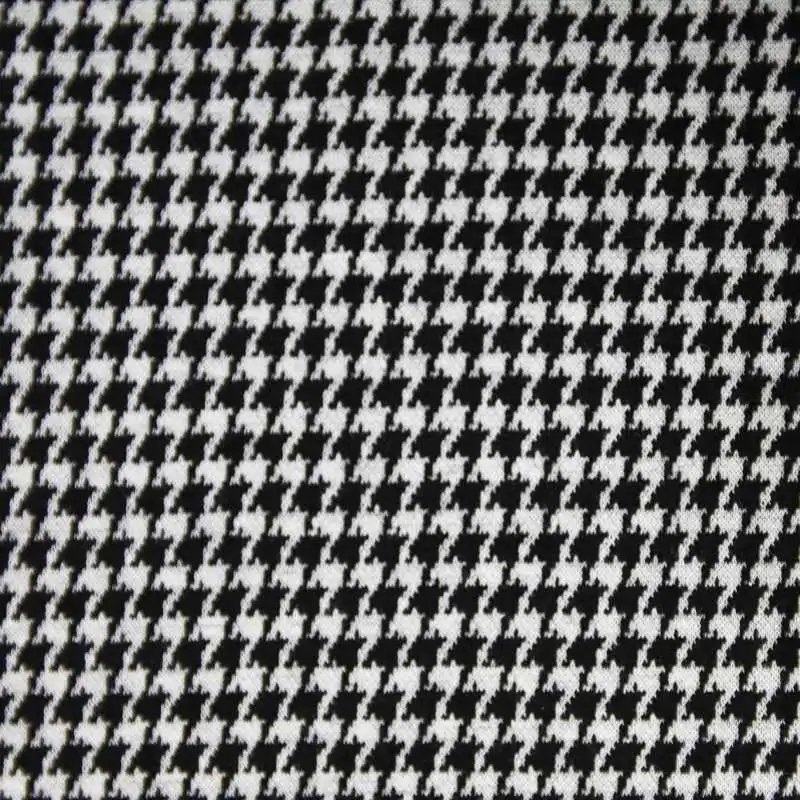
Product Overview
Knitted jacquard houndstooth fabric is produced by forming the houndstooth pattern directly into the fabric structure using jacquard knitting technology. Unlike printed fabrics, where the design is applied only to the surface, jacquard knitting integrates the pattern into the textile itself. This creates a more stable, dimensional, and durable effect. The product described here features a classic black-and-white houndstooth design, making it highly suitable for solid-colored clothing combinations and versatile fashion collections.
The fabric belongs to the knitted jacquard fabric category, a segment known for decorative structure, flexible application, and design adaptability. It reflects the advantages of knitted textiles, including softness, elasticity, breathability, and wearer comfort. At the same time, the jacquard technique gives it a refined appearance that can support both casual and formal styling. This dual nature makes it valuable for brands seeking fabrics that can cross seasonal, age, and market boundaries.
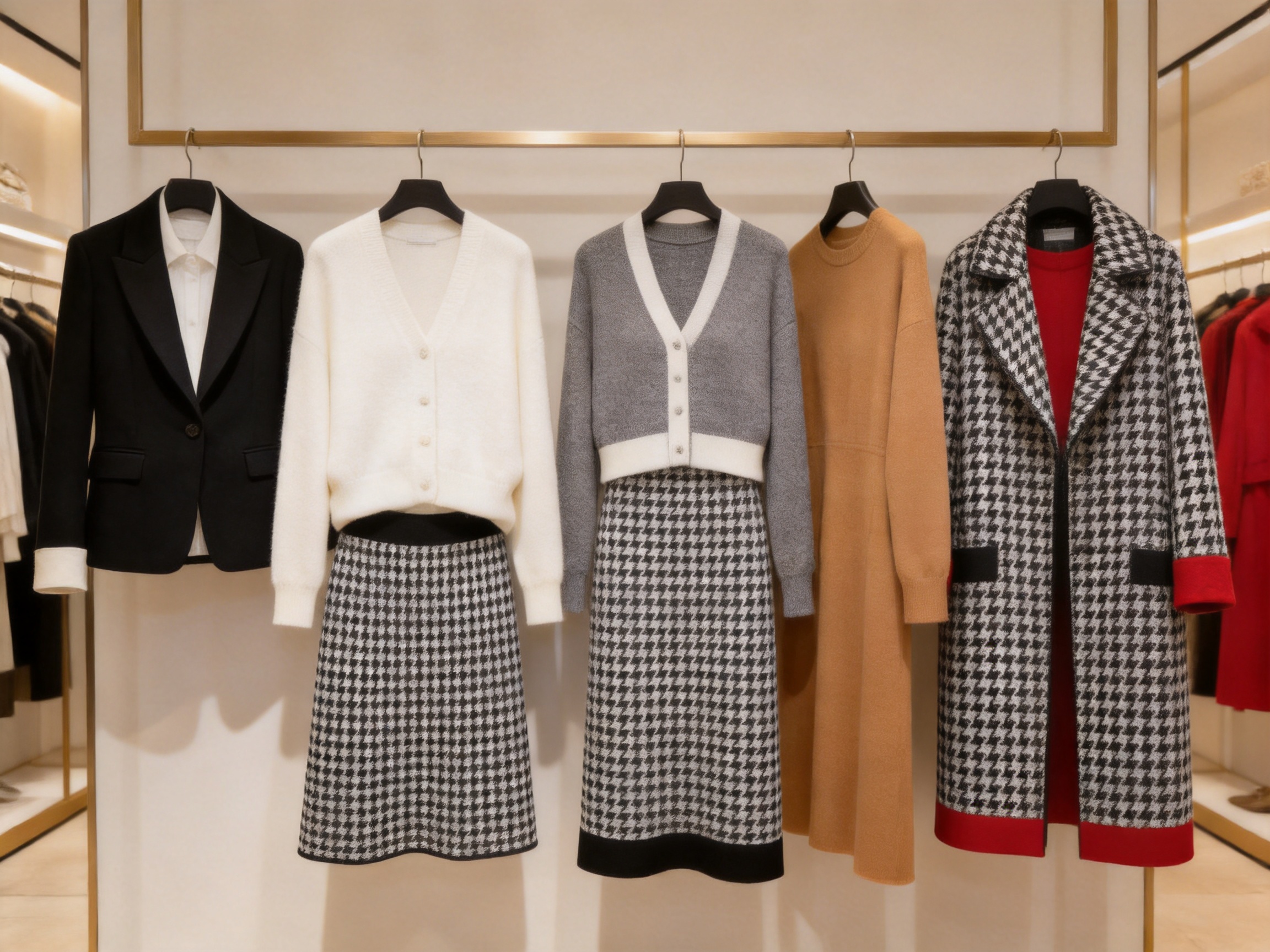
In apparel production, the fabric can be used as a statement material or as part of a coordinated design. A coat made from houndstooth jacquard knit can look structured and elegant, while a dress made from the same textile can feel comfortable and expressive. A cardigan or jacket can use the pattern to add visual energy without relying on heavy embellishment. Because the design itself carries strong recognition, garment makers can create compelling products with clean silhouettes and fewer additional details.
Why the Houndstooth Pattern Remains Popular
Houndstooth is one of the most enduring patterns in textile history. Its broken check appearance gives the eye a sense of movement while maintaining geometric order. This makes it more dynamic than a simple plaid and more structured than abstract prints. In black and white, it becomes especially powerful because the contrast highlights the repeated pattern clearly. Designers use it when they want clothing to communicate confidence, elegance, and heritage.
Another reason for its lasting popularity is its ability to work across many garment categories. It can be used in office wear, streetwear, outerwear, casual fashion, and high-street collections. It pairs well with solid colors such as black, white, gray, beige, camel, navy, red, and forest green. In fashion merchandising, this makes houndstooth fabric easy to coordinate with existing wardrobes and seasonal color palettes.
Knitted jacquard houndstooth fabric further expands the pattern’s usability. Traditional woven houndstooth can sometimes feel rigid, especially in heavier constructions. Knitted jacquard versions provide a softer and more flexible alternative. This makes the fabric attractive for modern consumers who want garments that look polished but feel comfortable during daily wear.
Advantages Over Ordinary Printed or Woven Alternatives
One of the key advantages of knitted jacquard houndstooth fabric is that the pattern is built into the fabric rather than simply printed on top. Printed houndstooth textiles can be cost-effective, but they may lack texture and may show fading or surface wear over time depending on printing quality and use conditions. Jacquard knitting provides a more substantial pattern expression, helping the fabric maintain a premium appearance.
Compared with many woven houndstooth fabrics, knitted jacquard fabric offers improved comfort. Knitted loops naturally provide more give and flexibility than interlaced woven yarns. This helps garments move with the body, which is particularly important for dresses, jackets, cardigans, skirts, and fitted garments. Consumers increasingly value clothing that supports daily mobility, and knitted jacquard fabric responds well to that trend.
The fabric also offers a stronger balance of visual quality and tactile appeal. A woven houndstooth may deliver sharp pattern definition, but it can sometimes feel formal or stiff. A printed knit may feel soft, but the pattern may appear flat. Knitted jacquard houndstooth fabric combines structure and softness: it shows a recognizable classic motif while maintaining the comfort associated with knitwear.
Another advantage is versatility in garment development. Buyers and designers can use this fabric for transitional clothing, fall and winter collections, urban casualwear, elegant separates, and fashion-forward knit styles. Because the pattern is already visually rich, garment design can remain efficient. Simple cuts can still produce attractive finished products, reducing reliance on complicated garment construction.
Manufacturing Strength Behind the Fabric
High-quality knitted jacquard houndstooth fabric depends not only on design but also on manufacturing control. A reliable textile supplier must manage yarn selection, fabric construction, color consistency, finishing quality, dimensional stability, and inspection standards. Hangzhou Jinfeng Textile Co., Ltd. operates as an integrated enterprise with experience in research and development, production, processing, post-dyeing, finishing, sales, and export service. This integrated model supports better control from raw material handling to finished fabric delivery.
The company is located in Xiaoshan District, Hangzhou, Zhejiang Province, an important textile manufacturing region with established industrial resources. Its production site covers 32.6 acres, with a plant area of approximately 18,000 square meters. Such a manufacturing base provides practical support for fabric development, processing coordination, quality management, and customer service. The company’s business scope includes blended fabrics such as polyester and spandex materials, as well as DTY polyester yarn production, processing, and sales.
This combination of yarn and fabric capabilities is important. In textile manufacturing, fabric quality begins with yarn quality. Drawn textured yarn, often known as DTY, contributes to elasticity, bulk, softness, and fabric coverage in many knitted and blended textile applications. A company familiar with DTY production and processing can better understand how yarn characteristics influence jacquard knitting performance, fabric hand feel, dimensional behavior, and finishing response.
Integrated manufacturing also allows more direct communication between development teams and production departments. When a customer requests a fabric with a certain appearance, softness, weight, or stability, the supplier can evaluate adjustments at multiple stages rather than treating each step as isolated. This helps create a more efficient development process and supports consistent product results.
How Jacquard Knitting Enhances Pattern Quality
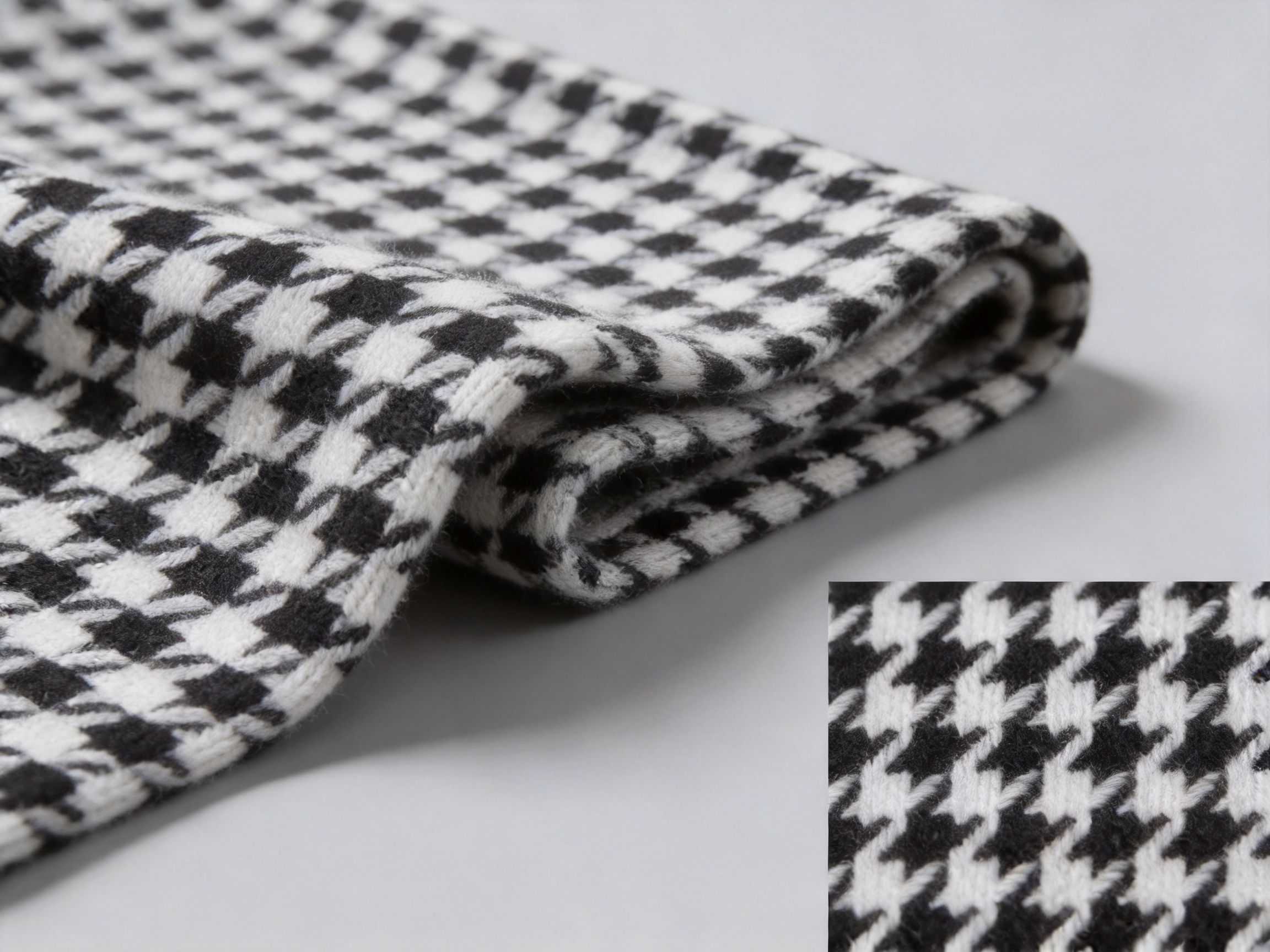
Jacquard knitting is a controlled technique that allows selected yarns or stitches to create complex patterns within a knitted structure. For houndstooth fabric, this is particularly valuable because the design depends on repeated geometric contrast. If the pattern is poorly controlled, the teeth may appear distorted, uneven, or blurred. Well-managed jacquard knitting produces a cleaner, more balanced pattern repeat.
The houndstooth design requires careful attention to scale. A pattern that is too small may lose visual impact, while one that is too large may limit garment versatility. Jacquard knitting makes it possible to develop different pattern sizes according to garment use. For example, a compact houndstooth may suit dresses and skirts, while a larger repeat may work well for coats or statement jackets.
Another benefit is texture. Jacquard construction can give the pattern a tactile presence, making the fabric more appealing than a flat print. This surface character helps garments look richer under different lighting conditions. The knitted base also allows the fabric to remain flexible, which is essential for comfortable clothing.
Material Comfort and Wearability
Comfort is one of the strongest selling points of knitted jacquard houndstooth fabric. Consumers often judge garments not only by appearance but by how they feel during wear. A visually beautiful fabric that feels rigid, scratchy, or restrictive may not perform well in the market. Knitted jacquard fabric addresses this concern through looped construction, softness, and body-friendly flexibility.
Depending on the yarn composition and finishing, the fabric can provide pleasant hand feel, moderate stretch, and comfortable drape. These qualities are important for apparel items worn close to the body, such as dresses and knit tops, as well as outer-layer garments that need to move easily over inner clothing. The fabric’s houndstooth design adds style, while the knit structure supports daily comfort.
For fashion buyers, this combination helps reduce the gap between runway appeal and practical use. Consumers may be attracted first by the classic black-and-white pattern, but they continue to value the garment because it is comfortable and easy to wear. This improves product satisfaction and supports repeat purchasing.
Applications in Apparel Design
Knitted jacquard houndstooth fabric is suitable for a wide range of clothing categories. Its adaptability is one of its most valuable commercial features. Designers can use it for statement pieces or as part of coordinated collections. The fabric can create a polished look without needing complicated decoration, which makes it efficient for garment manufacturing.
For dresses, the fabric offers both visual identity and comfort. A simple A-line dress, sheath dress, or long-sleeve knit dress can become distinctive because of the houndstooth pattern. The knitted structure allows better movement than many rigid woven fabrics, making the garment easier to wear in office, social, or casual settings.
For coats and jackets, the fabric delivers classic elegance. Houndstooth outerwear has long been associated with refined styling, but a knitted jacquard version can feel softer and less restrictive. It can be used for casual coats, fashion jackets, cropped outerwear, or structured cardigan-style garments. The black-and-white pattern pairs easily with solid inner layers.
For skirts and trousers, the fabric can create coordinated fashion items. A houndstooth skirt paired with a plain knit top offers a balanced outfit. Trousers made from suitable knitted jacquard fabric can provide a stylish alternative to plain bottoms. When pattern scale and fabric weight are properly selected, the material can support both comfort and garment shape.
For cardigans and knit sets, the fabric is especially appealing because jacquard knitting is already associated with decorative knitwear. A houndstooth cardigan can serve as a fashion highlight, while a matching skirt or top can form a coordinated set. This aligns with the growing popularity of knitwear sets and comfortable fashion dressing.
Technical and Commercial Characteristics
| Characteristic | Value for Apparel Buyers | Competitive Benefit |
|---|---|---|
| Jacquard-knitted houndstooth pattern | Creates a built-in design with a dimensional appearance | More refined than many surface-printed alternatives |
| Knitted construction | Supports comfort, flexibility, and ease of movement | More wearable than many rigid woven houndstooth fabrics |
| Classic black-and-white styling | Easy to coordinate with solid-colored garments | Broad appeal across casual and formal markets |
| Suitable for multiple garment types | Works for dresses, coats, jackets, skirts, cardigans, and sets | Helps brands develop coordinated collections |
| Integrated manufacturing support | Connects yarn, knitting, dyeing, finishing, and inspection control | Improves consistency and production reliability |
| Export-oriented service capability | Supports communication with domestic and international customers | Useful for buyers seeking stable supply partnerships |
The Role of DTY Polyester Yarn and Blended Textile Expertise
Although the featured product is a knitted jacquard houndstooth fabric, it benefits from a broader manufacturing environment that includes DTY polyester yarn and blended fabric expertise. DTY polyester yarn is widely used in knitted fabrics because it can provide bulk, elasticity, and smooth processing performance. When combined with other fibers or used in specific fabric constructions, it can help improve resilience, coverage, and surface uniformity.
Blended fabric experience is equally important. Modern apparel fabrics often need to balance multiple properties, such as softness, stretch, recovery, colorfastness, drape, warmth, breathability, and cost efficiency. A manufacturer that works with polyester, spandex, and other blended textile systems is better positioned to develop fabrics that meet different market requirements. This knowledge can be applied when adjusting knitted jacquard fabric characteristics for specific garment types.
For example, a buyer may require a houndstooth knit fabric suitable for structured outerwear, while another may need a softer fabric for dresses. The supplier’s understanding of yarn behavior, knitting density, finishing, and fabric stabilization can help guide appropriate development choices. This is a practical advantage over suppliers that provide only standard fabrics without flexible technical support.
Dyeing and Finishing as Quality Drivers
Dyeing and finishing play a crucial role in the final appearance and performance of knitted jacquard houndstooth fabric. Even when the knitting structure is well executed, poor finishing can lead to problems such as uneven hand feel, unstable dimensions, poor surface appearance, or inconsistent color tone. A manufacturer with post-dyeing and finishing capability can better control the final fabric result.
For black-and-white houndstooth fabric, color contrast is central to the design. The dark and light areas should remain visually clean and balanced. Proper dyeing and finishing help preserve the tonal definition of the pattern. Finishing also influences softness, smoothness, drape, shrinkage behavior, and garment cutting performance.
In commercial garment production, dimensional stability is especially important. Fabric that changes excessively after processing, cutting, sewing, or washing can cause size inconsistency in finished garments. Careful finishing helps reduce this risk. For buyers, stable fabric performance contributes to fewer production issues and better customer satisfaction.
Quality Control and Inspection
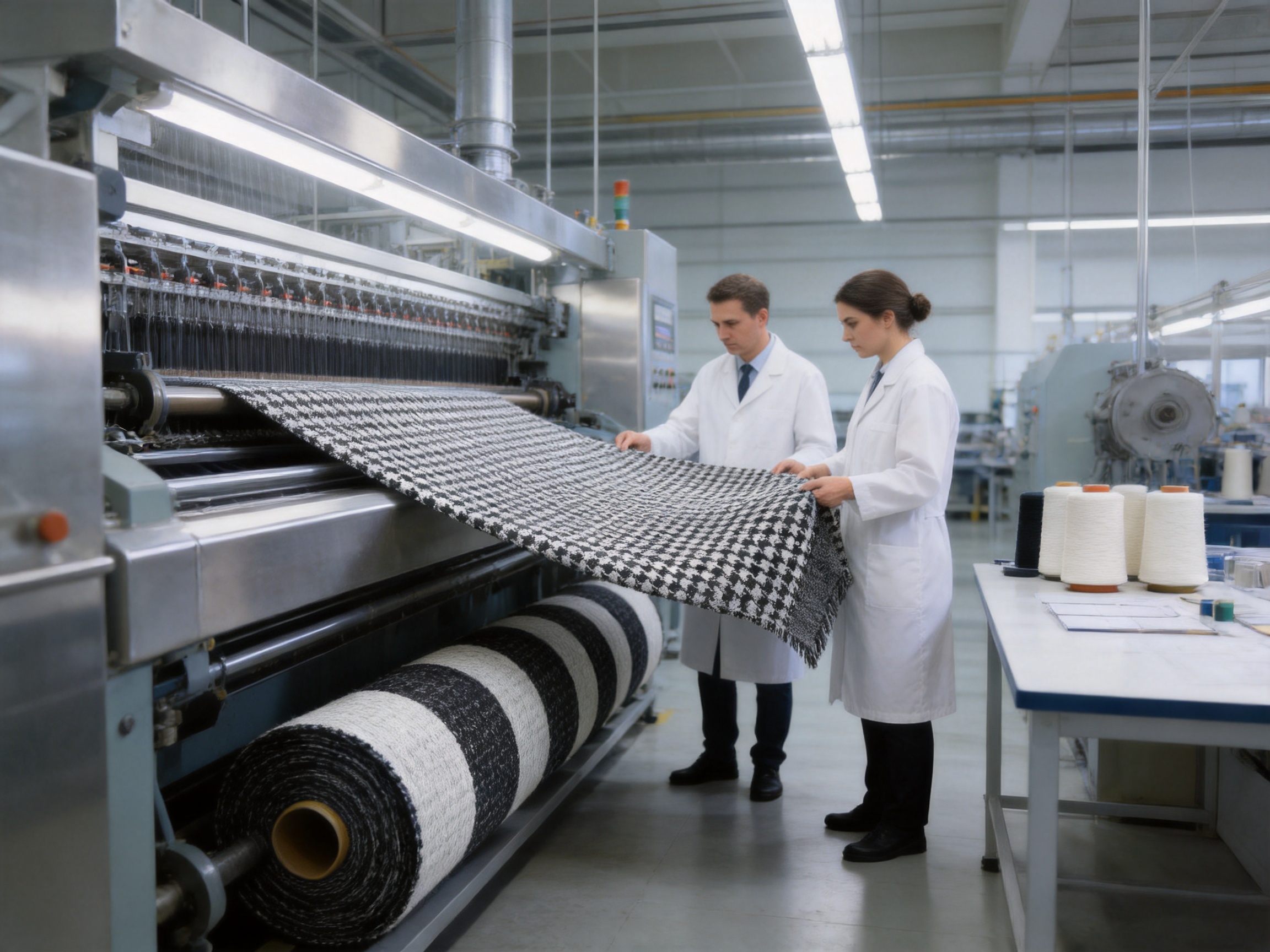
Consistent fabric quality is essential for apparel manufacturing. A beautiful sample is not enough; bulk production must match approved standards. Knitted jacquard houndstooth fabric requires inspection for pattern alignment, shade consistency, surface defects, fabric width, weight, hand feel, stretch, and finishing quality. These checks help ensure that the fabric delivered to customers can be used efficiently in garment production.
Pattern defects can be especially noticeable in houndstooth fabric because the geometric repeat makes irregularities easier to see. Quality control must therefore focus on maintaining clean and consistent pattern appearance. The fabric should not show obvious broken repeats, distorted checks, or irregular surface tension. Careful knitting machine management and inspection procedures help reduce such risks.
Surface quality is another key factor. Since houndstooth fabric is often used in visible fashion garments, issues such as stains, snags, holes, streaks, or excessive pilling potential can reduce product value. Professional inspection before shipment helps protect both the supplier’s reputation and the buyer’s production efficiency.
Design Flexibility for Fashion Collections
One reason knitted jacquard houndstooth fabric is valuable for apparel brands is its design flexibility. The black-and-white version is classic, but the same concept can inspire variations in color, scale, weight, and composition. Designers can create a refined office collection, a youthful streetwear line, or a comfortable knitwear series using different garment silhouettes.
The fabric also works well with contrast trims, solid panels, ribbed edges, metal buttons, hidden zippers, belts, and clean seam lines. In many cases, the pattern itself is strong enough that the garment does not require heavy decoration. This can simplify production while maintaining strong shelf appeal.
Seasonal adaptability is another advantage. In autumn and winter, houndstooth fabric naturally fits outerwear, layering pieces, and warm dresses. In transitional seasons, lighter knitted jacquard versions can be used for cardigans, skirts, and casual jackets. The pattern is not tied to a single fashion cycle, making it a reliable choice for repeat development.
Advantages for Garment Manufacturers
Garment manufacturers benefit from fabrics that are attractive, stable, and easy to convert into finished products. Knitted jacquard houndstooth fabric can help reduce design complexity because the textile already contains a strong pattern. This allows manufacturers to produce fashionable garments using relatively clean cuts, which may improve production efficiency.
The knitted structure can also simplify wearer fit in some garment categories. Compared with rigid woven fabrics, knit fabrics can accommodate movement and body variation more comfortably. This may be useful for brands that want garments with broader wearability. However, proper pattern-making remains important, especially because houndstooth repeats should be positioned carefully for a professional appearance.
For cutting and sewing, consistent fabric width, stable edges, and reliable shrinkage behavior are important. A supplier with finishing and inspection control can help garment factories plan production more confidently. When fabric behavior is predictable, factories can reduce waste, avoid rework, and maintain delivery schedules.
Advantages for Fabric Buyers and Brands
For fabric buyers, knitted jacquard houndstooth fabric offers commercial value because it is recognizable, versatile, and suitable for multiple market levels. The pattern has lasting appeal, which reduces the risk of rapid trend obsolescence. A buyer can use it in a seasonal collection, then adapt it again in later collections with modified silhouettes or color accents.
Brands can position garments made from this fabric in different style categories. A tailored jacket can look polished and professional. A knit dress can feel feminine and comfortable. A cardigan can appear relaxed yet stylish. A coat can project classic confidence. This range allows brands to use one fabric concept across multiple product lines.
The fabric also supports strong visual merchandising. On display racks, houndstooth stands out among plain fabrics. Online, the pattern communicates quickly in product images. In stores, the tactile quality of jacquard knit encourages customers to touch and evaluate the garment. These factors can contribute to better market response.
Responsible Production Thinking
Modern textile customers increasingly consider not only the appearance and price of fabric but also the reliability and responsibility of the production partner. Integrated production can support better traceability within the manufacturing process because more stages are managed under coordinated systems. While every buyer may have different compliance requirements, a supplier with organized production, processing, finishing, and sales departments is better prepared to respond to technical and quality documentation requests.
Efficient production also helps reduce unnecessary waste. Stable yarn preparation, controlled knitting, accurate dyeing, and effective finishing can decrease defective output. In apparel supply chains, fewer defects mean less reprocessing, fewer rejected rolls, and more efficient use of materials. This is not only commercially beneficial but also aligned with responsible manufacturing principles.
The company’s business philosophy of cooperation and win-win service reflects the importance of long-term customer relationships. In textile sourcing, long-term cooperation often leads to better product development, improved communication, and more stable quality expectations. Buyers benefit when suppliers understand their garment categories, target markets, and technical preferences over time.
How to Evaluate Knitted Jacquard Houndstooth Fabric Before Purchase
Before placing an order, buyers should evaluate several practical aspects of knitted jacquard houndstooth fabric. The first is pattern clarity. The houndstooth shape should be sharp enough for the intended garment style, and the repeat should look balanced. Buyers should examine the fabric from both close and normal viewing distances, because garments are seen in different contexts.
The second consideration is hand feel. The fabric should feel suitable for its end use. A coat fabric may need more body, while a dress fabric may require softer drape. Buyers should compare the fabric’s weight, thickness, stretch, and recovery to the garment design requirements.
The third factor is color consistency. Black-and-white houndstooth relies on contrast, so shade quality matters. Buyers should check whether the black appears rich and whether the white or light area remains clean. For bulk orders, lot-to-lot consistency should be discussed with the supplier.
The fourth factor is dimensional behavior. Knitted fabrics can respond to finishing, relaxation, and washing. Testing shrinkage and stability before mass garment production is recommended. This helps factories adjust patterns and production planning.
The fifth factor is supplier capability. A good fabric is supported by reliable manufacturing, communication, inspection, and delivery service. Buyers should consider whether the supplier has integrated production resources and experience in yarn, knitting, dyeing, finishing, and export business.
Care and Garment Performance Considerations
Care instructions for garments made from knitted jacquard houndstooth fabric should be determined according to the exact fiber composition, dyeing process, finishing treatment, and garment construction. In general, knitted jacquard garments should be handled with attention to shape retention and surface appearance. Garment manufacturers should perform care testing before final labeling.
Because the fabric contains a visible geometric pattern, garments should be cut and sewn carefully to maintain alignment where possible. Pattern matching at major seams can improve the perceived quality of finished garments. This is especially important for premium jackets, dresses, and coats. For more casual garments, designers may intentionally use pattern direction creatively, but this should be planned rather than accidental.
Storage and handling during garment production are also important. Fabric rolls should be protected from contamination, excessive tension, and improper stacking. Before cutting, knitted fabrics may require relaxation time to stabilize. These practical steps help ensure better finished garment quality.
Why This Fabric Fits Current Market Needs
Today’s fashion market favors products that combine style, comfort, and versatility. Consumers want clothing that looks presentable but does not feel restrictive. They also appreciate recognizable designs that can be worn in multiple situations. Knitted jacquard houndstooth fabric fits this demand well because it combines a classic visual pattern with the comfort of knit construction.
The fabric also supports the trend toward elevated everyday dressing. Many consumers no longer separate formal and casual wardrobes as strictly as before. They want pieces that can move from work to social occasions, from travel to daily errands, and from indoor to outdoor environments. A houndstooth knit jacket, dress, or cardigan can satisfy these needs by offering a polished appearance and comfortable wear.
For brands, the fabric provides an opportunity to develop products with strong identity. In competitive apparel markets, plain fabrics can be difficult to differentiate. A well-made houndstooth jacquard fabric gives garments immediate recognition. At the same time, because the pattern is classic, it does not feel like a short-lived novelty.
Company Strengths Supporting Global Customers
Hangzhou Jinfeng Textile Co., Ltd. serves customers through a combination of textile manufacturing capability and export-oriented business experience. The company’s operations include production and processing of blended fabrics, post-dyeing, finishing, sales, and DTY polyester yarn production and processing. This broad capability is valuable for customers looking for more than simple fabric trading.
The company’s location in Hangzhou provides access to a mature textile industry environment. Xiaoshan District is known for active manufacturing and supply chain resources, which helps support production coordination and logistics. The company’s plant scale and integrated services contribute to its ability to support domestic and overseas buyers.
For customers, a cooperative supplier is important. Fabric sourcing often involves technical discussion, sampling, adjustment, bulk production, inspection, and delivery coordination. A supplier committed to cooperation and win-win relationships can help reduce sourcing friction and support smoother business development.
Competitive Positioning
In the market, knitted jacquard houndstooth fabric competes with printed knits, woven houndstooth fabrics, plain dyed knits, and other patterned textiles. Its competitive position is strong because it offers a meaningful blend of design and comfort. Compared with plain fabrics, it provides stronger visual appeal. Compared with printed fabrics, it offers more structural depth. Compared with many woven houndstooth textiles, it can offer better flexibility and comfort.
The fabric is also commercially efficient because the pattern itself adds value to the finished garment. Brands can use simple silhouettes and still create attractive styles. This supports quicker design development and may help reduce unnecessary garment complexity. When supplied by a manufacturer with integrated production and finishing control, the fabric becomes a dependable choice for both fashion creativity and practical production.
Another competitive advantage is the company’s experience with DTY polyester yarn and blended textiles. This technical background allows better understanding of yarn behavior, knitting performance, and finishing outcomes. In a market where many suppliers compete mainly on price, technical knowledge and process control can become important differentiators.
Q&A Section
Q1: What makes knitted jacquard houndstooth fabric different from printed houndstooth fabric?
Knitted jacquard houndstooth fabric forms the pattern through the fabric structure itself, while printed houndstooth fabric applies the design onto the surface. Jacquard construction usually provides richer texture, stronger pattern depth, and a more premium appearance than many flat printed alternatives.
Q2: What garments can be made from this fabric?
The fabric is suitable for dresses, coats, jackets, skirts, cardigans, trousers, knit sets, and fashion separates. Its classic black-and-white pattern works well for both casual and formal designs.
Q3: Why is knitted construction beneficial for houndstooth fabric?
Knitted construction provides softness, flexibility, and comfort. This makes houndstooth garments easier to wear in daily life compared with many rigid woven versions, especially when movement and fit are important.
Q4: Is the fabric suitable for formal clothing?
Yes. The houndstooth pattern has a refined and classic appearance, making it suitable for formal and semi-formal clothing such as dresses, jackets, and coats. At the same time, the knitted structure also supports casual styling.
Q5: How does integrated manufacturing improve fabric quality?
Integrated manufacturing allows better coordination among yarn preparation, knitting, dyeing, finishing, inspection, and sales service. This helps control quality at multiple stages and supports more consistent bulk production.
Q6: What should buyers check before ordering this fabric?
Buyers should check pattern clarity, hand feel, stretch, weight, color contrast, dimensional stability, surface quality, and supplier production capability. Testing and sample approval are recommended before bulk garment manufacturing.
Q7: Why is DTY polyester yarn experience relevant to knitted jacquard fabric?
DTY polyester yarn knowledge is useful because yarn properties influence fabric softness, elasticity, coverage, and knitting performance. A manufacturer familiar with yarn production and processing can better manage fabric development and quality control.
Q8: Can the fabric support fashion collections across different seasons?
Yes. Heavier versions can suit autumn and winter coats or jackets, while lighter versions can be used for dresses, cardigans, skirts, and transitional garments. The houndstooth pattern remains relevant across many seasons.
Conclusion
Knitted jacquard houndstooth fabric is a strong choice for apparel brands and garment manufacturers seeking a textile that combines classic design, comfort, and commercial versatility. Its black-and-white pattern offers immediate visual recognition, while jacquard knitting gives the design structural depth and premium texture. Compared with ordinary printed houndstooth fabrics, it delivers a more integrated appearance; compared with many woven alternatives, it provides better comfort and flexibility.
The fabric’s value is strengthened by advanced and integrated manufacturing capabilities. With experience in DTY polyester yarn, blended fabrics, production processing, post-dyeing, finishing, sales, and export service, Hangzhou Jinfeng Textile Co., Ltd. can support customers with practical textile knowledge and coordinated production control. Its manufacturing base in Hangzhou provides the scale and resources needed to serve both domestic and international markets.
For designers, this fabric opens opportunities to create elegant dresses, stylish coats, comfortable jackets, refined skirts, and coordinated knitwear. For buyers, it offers a dependable pattern with long-term fashion relevance. For garment manufacturers, it provides a material that can turn clean silhouettes into attractive products. In a market where consumers expect both style and comfort, knitted jacquard houndstooth fabric stands out as a fabric with enduring appeal and modern performance.
References
1. Spencer, D. J. Knitting Technology: A Comprehensive Handbook and Practical Guide. Woodhead Publishing.
2. Kadolph, S. J. Textiles. Pearson Education.
3. Sinclair, R. Textiles and Fashion: Materials, Design and Technology. Woodhead Publishing.
4. Saville, B. P. Physical Testing of Textiles. Woodhead Publishing.
5. Collier, B. J., and Epps, H. H. Textile Testing and Analysis. Pearson Prentice Hall.