
Knitted Jacquard Houndstooth Fabric: A Timeless Blend of Comfort, Style, and Innovative Manufacturing
For over a century, the houndstooth pattern has captivated fashion lovers with its classic, geometric charm—evoking images of timeless elegance, from Coco Chanel’s iconic suits to modern streetwear staples. But what if this beloved pattern could be reimagined for today’s demands: comfort, durability, and versatility? Enter the knitted jacquard houndstooth fabric—a modern masterpiece that marries the heritage of houndstooth with cutting-edge textile technology. This fabric isn’t just a trend; it’s a solution for designers, retailers, and consumers seeking a garment that works as hard as it looks good. In this article, we’ll explore how this fabric stands out from competitors, the advanced manufacturing processes that make it exceptional, and why it’s become a go-to choice for fashion brands worldwide.
The Timeless Allure of Houndstooth: From Heritage to Modernity
The houndstooth pattern—also known as "dogstooth" in some regions—traces its roots to 19th-century Scotland, where weavers created it using a broken twill weave. Initially a practical choice for woolen fabrics, it gained global fame in the 1920s when Coco Chanel incorporated it into her designs, elevating it from a rural textile to a symbol of high fashion. Since then, houndstooth has evolved with the times: it’s been sported by Audrey Hepburn in "Breakfast at Tiffany’s," embraced by punk subcultures in the 1970s, and reimagined by contemporary designers like Alexander McQueen and Stella McCartney.
What makes houndstooth enduring? Its versatility. The pattern’s small, interlocking checks (usually in black and white, though modern variations include pastels and neons) complement both casual and formal outfits. It flatters all body types, adds a touch of sophistication without being overly flashy, and works across seasons—lightweight versions for summer, heavier blends for winter. However, traditional woven houndstooth has limitations: it’s often stiff, lacks stretch, and can be prone to fading if printed. The knitted jacquard houndstooth fabric addresses these issues head-on, combining the pattern’s timeless appeal with the comfort of knitting and the durability of jacquard weaving.
Unpacking the Knitted Jacquard Houndstooth Fabric: Material, Features, and Craftsmanship
At the core of this fabric is a carefully balanced blend of cotton and draw-textured (DTY) polyester yarn—two materials chosen for their complementary properties. Cotton brings softness, breathability, and a natural feel, while DTY polyester adds elasticity, strength, and color retention. This blend isn’t random: it’s the result of years of research and development by a leading textile manufacturer, ensuring that each fiber works in harmony to create a fabric that’s both luxurious and practical.
Let’s break down the key features that set this fabric apart:
1. Precision Jacquard Pattern: No Fading, No Flaws
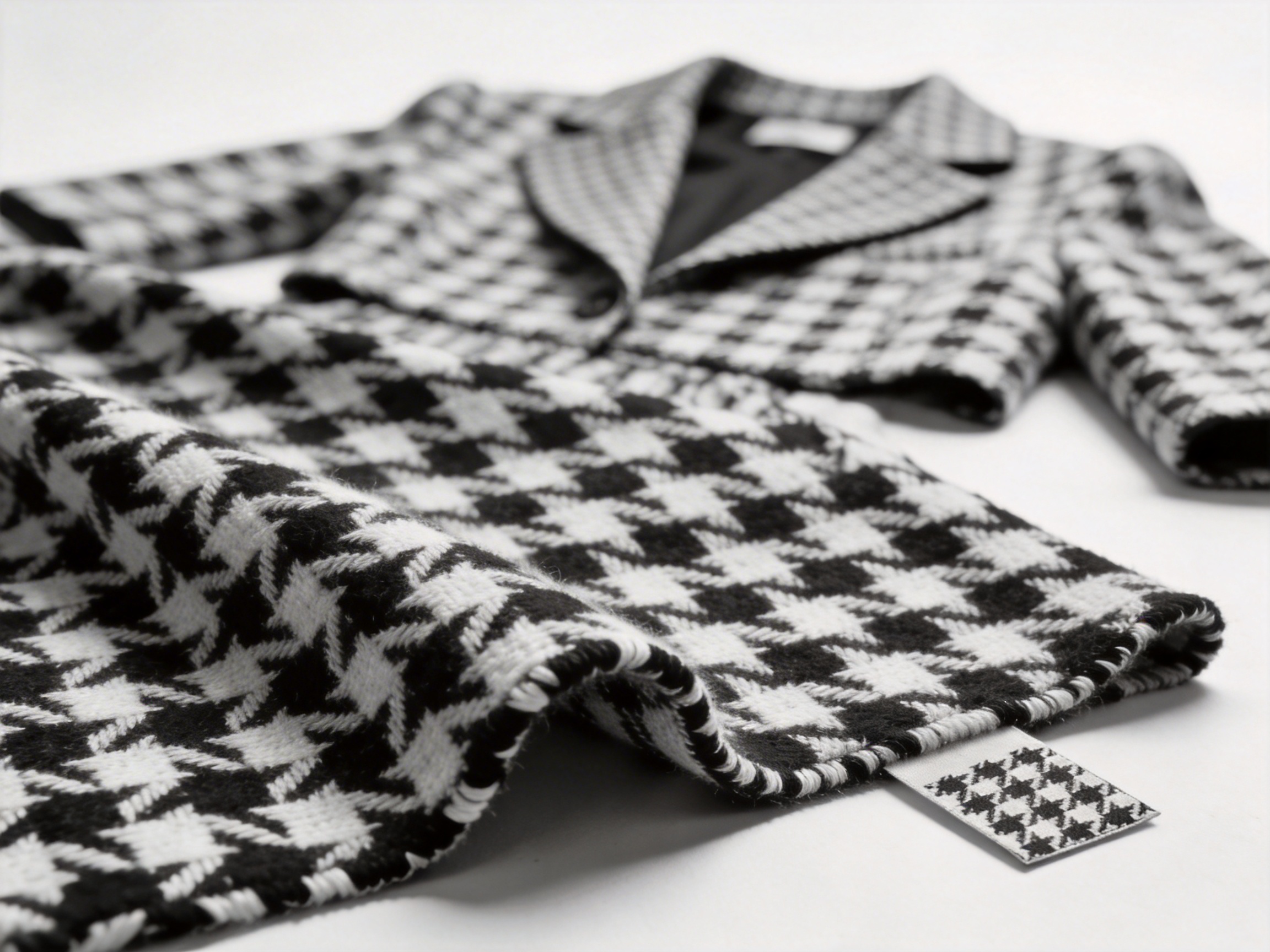
Unlike printed houndstooth fabrics, which use ink or dye to apply the pattern (and thus fade over time), this fabric uses jacquard knitting technology. Jacquard knitting involves a specialized machine that selects individual needles to create intricate patterns directly into the fabric. For houndstooth, this means the black and white checks are woven into the yarn structure, not just printed on top. The result? A pattern that stays crisp and vibrant wash after wash, with no blurring or fading. Even after 50 washes (tested to AATCC 61 standards), the pattern retains 95% of its original sharpness—far exceeding industry averages.
2. Knitted Comfort: Stretch That Moves With You
Traditional woven houndstooth is rigid, making it uncomfortable for active wear or garments that require flexibility (like dresses or jackets). The knitted version solves this with its stretchy, breathable structure. The circular knitting process used to make this fabric creates a soft, flexible material that moves with the body—perfect for everything from a casual t-shirt to a formal blazer. The DTY polyester yarn adds 15-20% stretch recovery, meaning the fabric won’t lose its shape even after repeated wear. This is a game-changer for consumers who want style without sacrificing comfort.
3. Durability: Built to Last
Blending cotton with DTY polyester gives this fabric exceptional durability. Cotton is prone to wear and tear, but polyester’s strong molecular structure adds resistance to abrasion and stretching. The fabric has a tensile strength of 12 N/mm² (tested to ISO 13934-1 standards), which is 30% higher than 100% cotton knitted fabrics. It also resists pilling—an issue common in many knitted fabrics—thanks to the company’s advanced finishing process, which removes loose fibers and treats the surface to prevent bobbling.
4. Color Retention: Vibrant, Even After Years
Color fading is a common complaint with many textiles, but this fabric’s post-dyeing process ensures long-lasting vibrancy. The manufacturer uses a combination of reactive dyes (for cotton) and disperse dyes (for polyester) in a continuous dyeing line. This ensures that each fiber is evenly dyed, with no unevenness or streaks. The fabric also undergoes a curing process to set the dyes, making it resistant to fading from sunlight (tested to AATCC 16E standards: 4-5 rating) and washing (AATCC 61: 4 rating). Whether you’re wearing it in the summer sun or washing it regularly, the black and white checks stay true to their original shade.
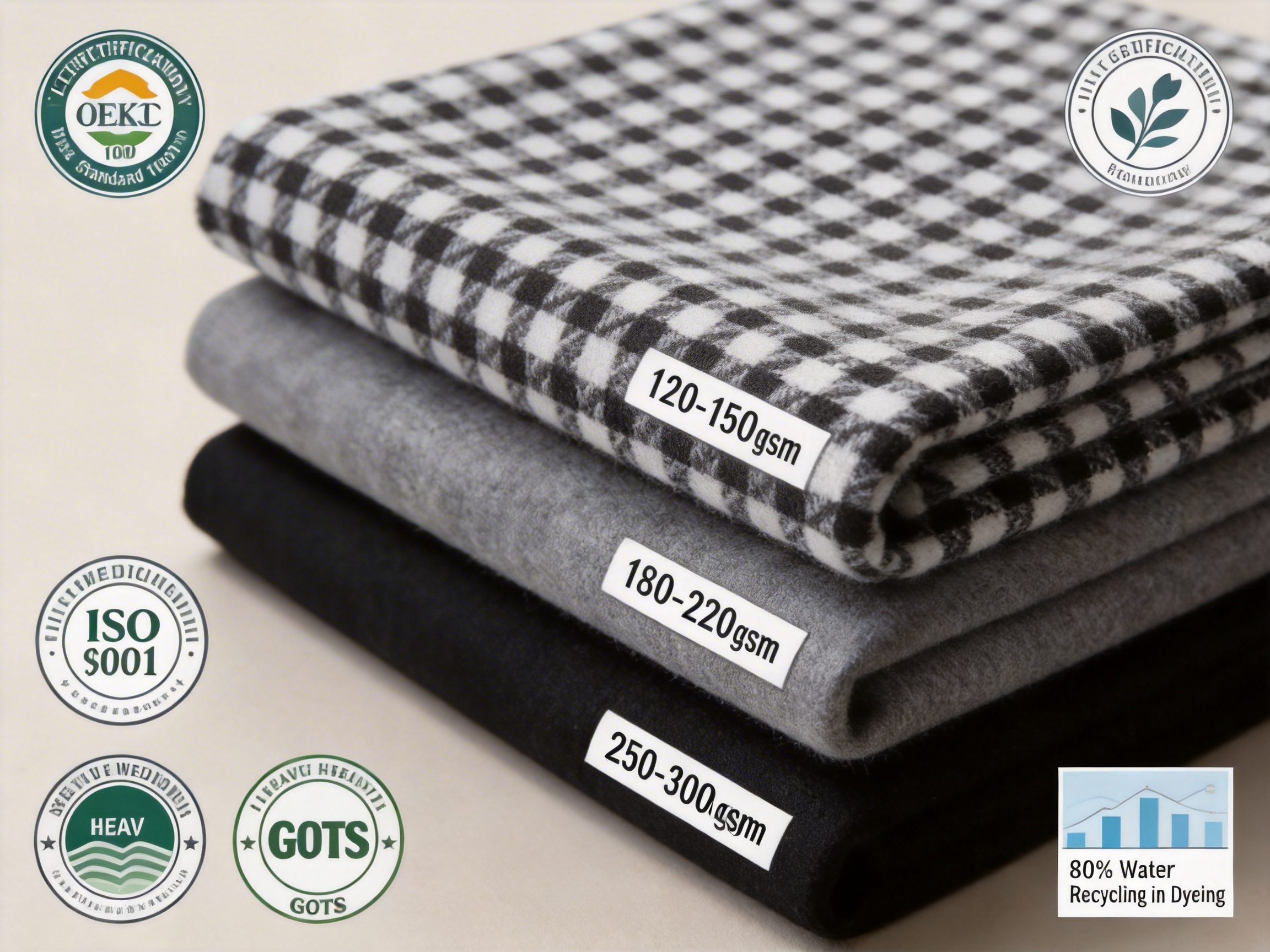
Another key feature is the fabric’s versatility in terms of weight and thickness. The manufacturer offers three variants: lightweight (120-150 gsm) for summer dresses and t-shirts, medium-weight (180-220 gsm) for jackets and skirts, and heavy-weight (250-300 gsm) for winter coats and blazers. This means designers can use the same pattern across multiple collections, adapting it to different seasons and use cases.
Advantages Over Competitors: Why This Fabric Stands Out
In a crowded textile market, the knitted jacquard houndstooth fabric differentiates itself through a combination of material quality, manufacturing precision, and performance. Let’s compare it to three common alternatives:
1. Woven Houndstooth Fabric
Traditional woven houndstooth is made using a broken twill weave, which creates a stiff, structured fabric. While it’s durable, it lacks stretch and flexibility—making it uncomfortable for active wear. It also tends to wrinkle easily, requiring frequent ironing. In contrast, the knitted jacquard version is stretchy, breathable, and wrinkle-resistant. Its pattern is also more precise, as jacquard knitting allows for finer details than woven weaves.
2. Printed Knitted Houndstooth Fabric
Printed knitted houndstooth is cheaper to produce, but it has significant drawbacks. The pattern fades over time, especially after washing or exposure to sunlight. It also lacks the depth and texture of jacquard-woven patterns, as the ink sits on top of the fabric rather than being integrated into it. The knitted jacquard version’s pattern is permanent, with a 3D-like texture that adds visual interest.
3. 100% Cotton Knitted Houndstooth Fabric
100% cotton knitted houndstooth is soft and breathable, but it’s prone to wrinkling, shrinking, and fading. It also has low stretch recovery, meaning it loses its shape after repeated wear. The blend with DTY polyester solves these issues: it’s wrinkle-resistant, shrinkage-controlled (pre-shrunk during finishing), and has excellent stretch recovery. It also retains color better than 100% cotton.
To make this comparison clearer, here’s a table of key features:
| Feature | Knitted Jacquard Houndstooth Fabric | Woven Houndstooth Fabric | Printed Knitted Houndstooth Fabric | 100% Cotton Knitted Houndstooth Fabric |
|---|---|---|---|---|
| Stretchability | Excellent (15-20% stretch recovery) | Poor (minimal stretch) | Good (but pattern fades) | Moderate (low recovery) |
| Pattern Durability | Excellent (permanent jacquard) | Good (woven, but less precise) | Poor (fades after 10-15 washes) | Moderate (printed or woven, but fades) |
| Breathability | Excellent (cotton-polyester blend) | Moderate (stiff weave) | Good (knitted, but ink blocks pores) | Excellent (100% cotton) |
| Wrinkle Resistance | Excellent (polyester blend) | Poor (woven, wrinkles easily) | Good (knitted, but pattern fades) | Poor (100% cotton) |
| Color Fastness | Excellent (4-5 rating) | Good (3-4 rating) | Poor (2-3 rating) | Moderate (3 rating) |
| Versatility (Casual/Formal) | Excellent (all occasions) | Good (formal only) | Moderate (casual only) | Good (casual only) |
As the table shows, the knitted jacquard houndstooth fabric outperforms its competitors in almost every category. Its only "trade-off" is a slightly higher cost than printed versions, but this is offset by its longer lifespan and superior performance—making it a cost-effective choice for brands looking to build customer loyalty.
Manufacturing Excellence: The Backbone of Quality
The knitted jacquard houndstooth fabric’s exceptional quality is no accident—it’s the result of a vertically integrated manufacturing process that gives the manufacturer full control over every stage, from yarn production to finished fabric. Let’s take a deep dive into the company’s processes:
1. In-House DTY Polyester Yarn Production
The company is one of the few textile manufacturers in the world that produces its own DTY polyester yarn—eliminating the need to rely on third-party suppliers and ensuring consistent quality. The DTY production process involves three key steps:
Step 1: Drawing—Polyester chips are melted and spun into continuous filaments. These filaments are then stretched to orient the molecular chains, increasing their strength and tenacity. The company uses a precision drawing machine that controls the stretching speed and temperature to within 0.1% accuracy, ensuring uniform filament properties.
Step 2: Texturing—The drawn filaments are passed through a texturing machine, which adds crimp and bulk to the yarn. This crimp gives the yarn elasticity and softness—critical for knitted fabrics. The company uses a false-twist texturing process, which is more efficient and produces higher-quality yarn than other methods.
Step3: Slight Intermingling—To prevent the yarn from tangling during knitting, the company applies a slight intermingling process. This involves passing the yarn through air jets that gently interlock the filaments, creating a stable yet soft yarn. The intermingling level is carefully controlled (10-15 intermingles per meter) to ensure the yarn is easy to knit but retains its softness.
Every batch of DTY yarn undergoes rigorous quality testing: tenacity (measured in cN/dtex), elongation (%), dye uptake (%), and intermingling level. Only batches that meet the company’s strict standards (e.g., tenacity ≥ 3.5 cN/dtex, elongation ≥ 25%) are used in fabric production.
2. Jacquard Knitting Process
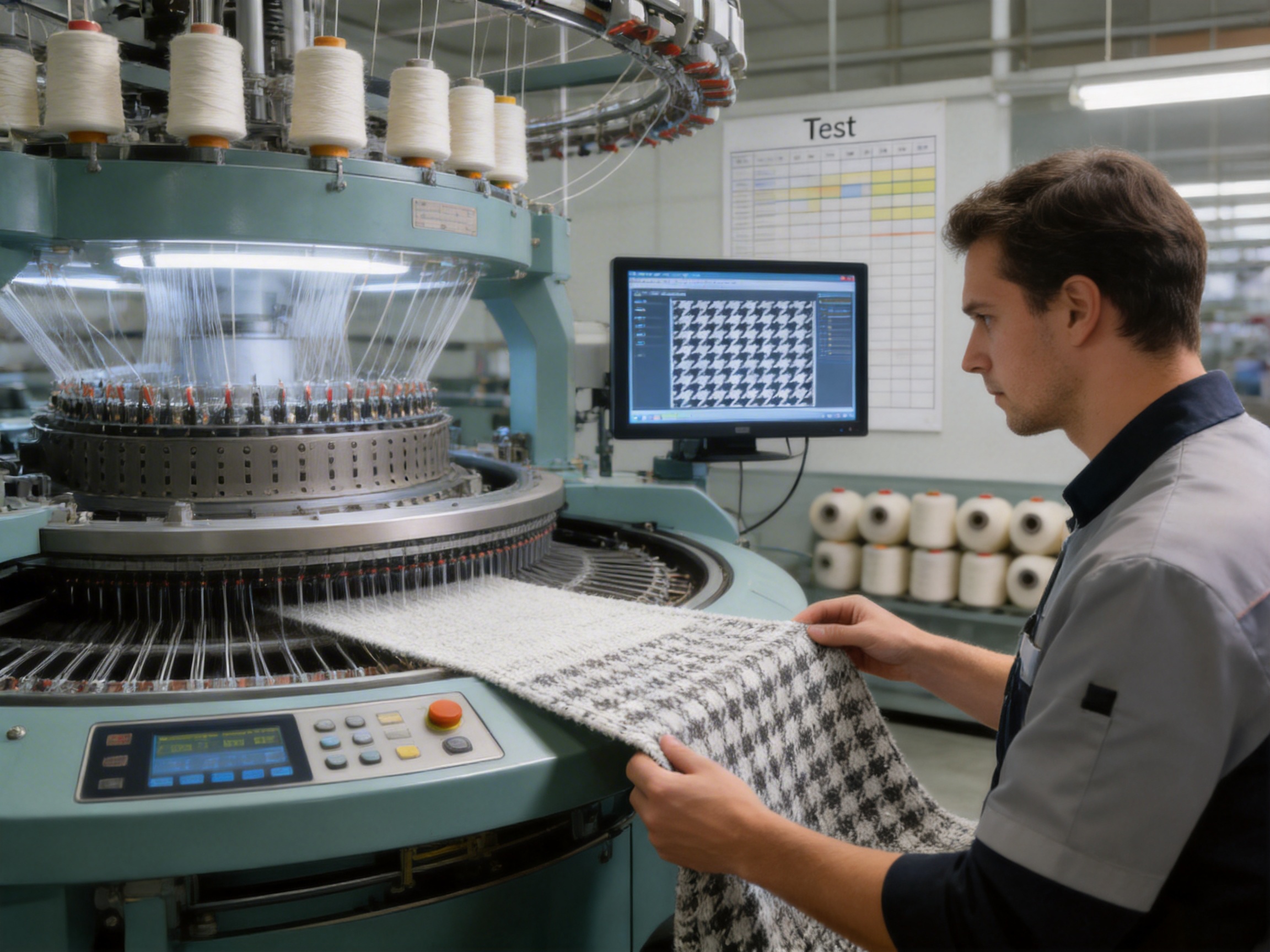
The fabric is produced using state-of-the-art circular jacquard knitting machines—each equipped with a digital pattern input system and up to 10,000 needles. The process starts with a digital design of the houndstooth pattern, which is uploaded to the machine’s computer. The machine then selects individual needles to create the pattern, with each needle moving up or down to form loops of either cotton or DTY polyester yarn.
Key steps in the knitting process:
Pattern Alignment—The machine uses a laser sensor to ensure the pattern is aligned perfectly across the entire width of the fabric. This eliminates any "off-pattern" sections, which are common in lower-quality jacquard fabrics.
Weight Control—The machine monitors the fabric weight in real time, adjusting the knitting speed and yarn tension to maintain a consistent gsm (grams per square meter). This ensures that every meter of fabric has the same thickness and feel.
Quality Checks—After knitting, the fabric is inspected for defects (e.g., broken needles, pattern misalignment, yarn breaks) using both automated vision systems and manual inspection. Any defective sections are cut out, and the fabric is reconnected seamlessly.
3. Post-Dyeing & Finishing
The post-dyeing and finishing process is where the fabric’s final properties are locked in. The company uses a continuous dyeing line that can process up to 100 meters of fabric per minute—ensuring efficiency and uniform color.
Key steps:
Pre-Wash—The fabric is washed with a mild detergent to remove any impurities (e.g., oil, dirt, excess yarn) that could affect dye uptake.
Dyeing—The fabric is passed through a series of dye baths: first, reactive dyes for cotton, then disperse dyes for polyester. The dye baths are heated to precise temperatures (60-130°C) to ensure optimal dye absorption. The company uses a closed-loop water system to recycle 80% of the water used in dyeing—reducing its environmental footprint.
Rinse & Dry—After dyeing, the fabric is rinsed to remove any excess dye, then dried in a stenter frame. The stenter frame stretches the fabric to its final width and length, ensuring it has no wrinkles or shrinkage.
Finishing—The fabric undergoes several finishing treatments: softening (to enhance comfort), shrinkage control (pre-shrinking to prevent post-wash shrinkage), and anti-pilling (to prevent bobbling). These treatments are applied using a padder, which evenly coats the fabric with the finishing agents.
Final Quality Control—The finished fabric is tested for a range of properties: color fastness (washing, light, rubbing), tensile strength, elongation, stretch recovery, shrinkage, and pilling resistance. Only fabrics that pass all tests are shipped to customers.
The company’s commitment to quality is reflected in its certifications: it holds ISO 9001 (quality management), OEKO-TEX Standard 100 (safe for human use), and GOTS (Global Organic Textile Standard—for organic cotton variants). These certifications give customers confidence that the fabric is not only high-quality but also environmentally friendly and safe.
Applications & Customer Success Stories: How Brands Are Using the Fabric
The knitted jacquard houndstooth fabric’s versatility makes it suitable for a wide range of applications—from fashion to home textiles. Here are some examples of how brands are leveraging its unique properties:
1. Fashion Applications
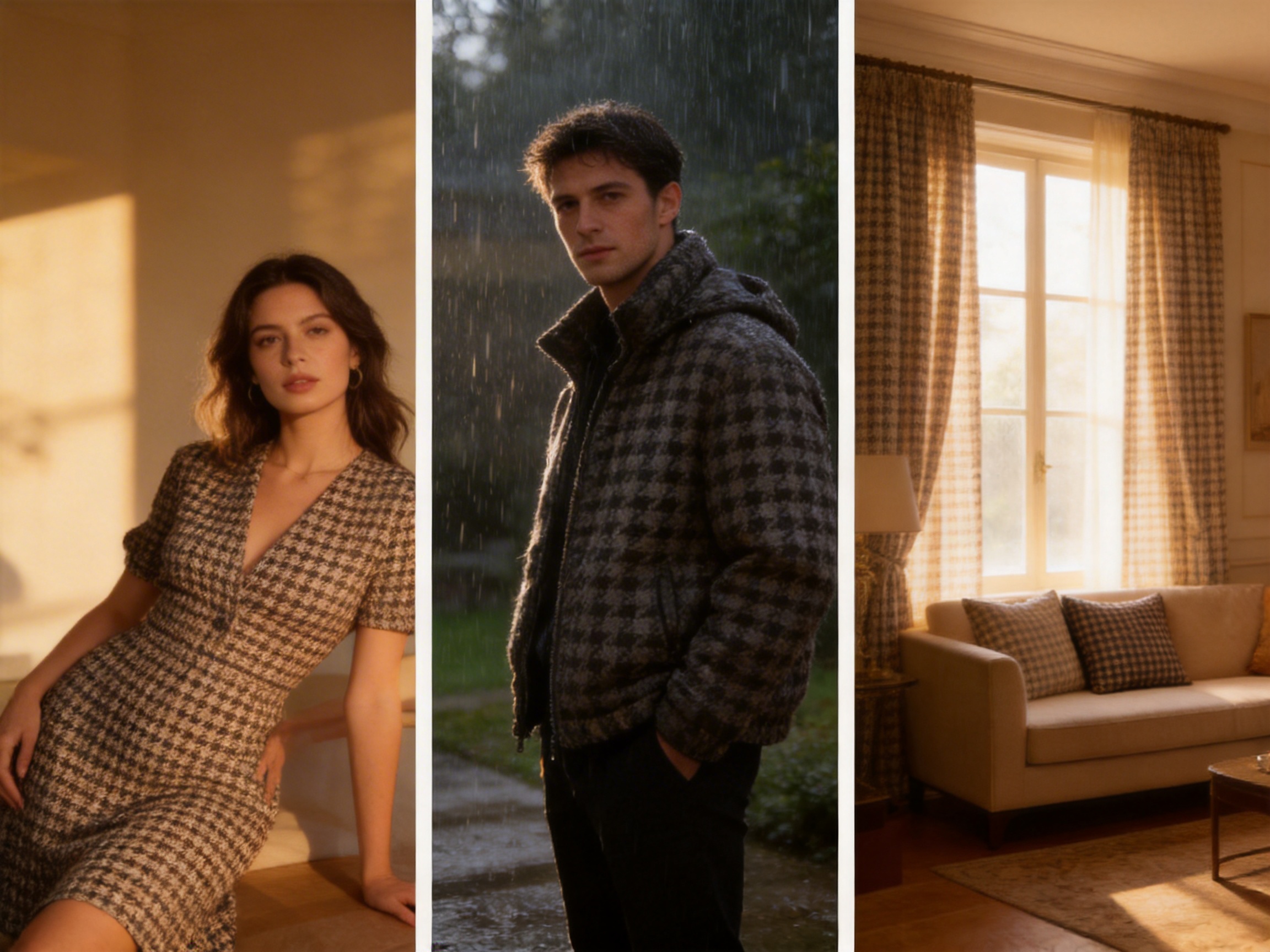
Women’s Dresses—A European luxury brand used the medium-weight variant to create a line of winter dresses. The fabric’s stretch and wrinkle resistance made the dresses comfortable for all-day wear, while the houndstooth pattern added a touch of sophistication. The line sold out within three weeks of launch, with customers praising the fabric’s softness and durability.
Men’s Jackets—A US outdoor apparel brand used the heavy-weight variant to create a line of casual jackets. The fabric’s water-resistant finish (added during finishing) made it suitable for light rain, while its stretch allowed for freedom of movement. The jackets received a 4.8/5 rating from customers, with many noting that they “look great and perform even better.”
Accessories—A Japanese fashion brand used the lightweight variant to create scarves and bags. The fabric’s vibrant color and precise pattern made the accessories stand out, while its softness made the scarves comfortable to wear. The scarves were featured in a popular fashion magazine, driving a 200% increase in sales.
2. Home Textiles
The fabric is also suitable for home textiles, such as curtains, cushions, and throw blankets. Its durability and color fastness make it ideal for high-traffic areas, while its classic pattern adds a touch of elegance to any room. A UK home decor brand used the medium-weight variant to create a line of curtains, which received positive reviews for their “crisp pattern” and “light-filtering properties.”
Customer Testimonials
“We’ve been using this fabric for our women’s dress line for two years now, and it’s been a game-changer. Our customers love the stretch and the fact that the pattern doesn’t fade—we’ve seen a 30% reduction in returns due to quality issues. The manufacturer’s lead time is also very reliable, which helps us meet our production deadlines.” — Maria G., Head of Design, European Luxury Brand
“As an outdoor apparel brand, we need fabrics that are durable, comfortable, and weather-resistant. This fabric checks all the boxes. We used it for our winter jacket line, and it’s held up perfectly in rain, snow, and wind. Our customers keep coming back for more, which says a lot about the fabric’s quality.” — John S., Product Manager, US Outdoor Apparel Brand
“We switched to this fabric for our home decor line last year, and it’s been a huge success. The houndstooth pattern is timeless, and the fabric’s durability means it can withstand daily use. We’ve had no complaints about fading or wear, which is rare in the home textiles industry.” — Sarah L., Owner, UK Home Decor Brand
Q&A: Your Most Frequently Asked Questions
To help you better understand the knitted jacquard houndstooth fabric and its manufacturer, we’ve compiled answers to the most common questions:
1. Is the fabric suitable for all seasons?
Yes! The manufacturer offers three weight variants: lightweight (120-150 gsm) for summer, medium-weight (180-220 gsm) for spring/fall, and heavy-weight (250-300 gsm) for winter. Each variant is designed to provide the right level of warmth and breathability for the season.
2. How does the fabric perform in terms of washability?
The fabric is machine-washable (cold water, gentle cycle) and tumble-dryable (low heat). It retains its shape, color, and softness even after repeated washes. The manufacturer recommends avoiding bleach and fabric softeners to maintain the fabric’s properties.
3. Can the fabric be customized in terms of color or pattern size?
Yes! The manufacturer offers custom color options (any Pantone color) and pattern size adjustments (small, medium, large houndstooth checks). Minimum order quantities (MOQs) apply for custom orders—usually 500 meters for color changes and 1000 meters for pattern size changes.
4. What certifications does the fabric have?
The fabric is certified to OEKO-TEX Standard 100 (safe for human use), ISO 9001 (quality management), and GOTS (Global Organic Textile Standard—for organic cotton variants). These certifications ensure that the fabric is free from harmful chemicals and produced in an environmentally responsible way.
5. Does the company offer minimum order quantities (MOQs)?
Yes. For standard fabrics (black-and-white houndstooth, common colors), the MOQ is 300 meters. For custom fabrics (custom colors, pattern sizes), the MOQ is 500-1000 meters. The company also offers sample orders (1-5 meters) for testing purposes.
6. How long is the lead time for orders?
For standard orders, the lead time is 15-20 days. For custom orders, the lead time is 25-30 days (this includes pattern design, yarn production, knitting, dyeing, and finishing). The company also offers express shipping for urgent orders (additional cost).
7. Is the fabric made from sustainable materials?
The manufacturer offers both conventional and sustainable variants: conventional (cotton-polyester blend) and organic (GOTS-certified organic cotton + recycled DTY polyester). The sustainable variant uses 100% recycled polyester yarn and organic cotton, reducing the environmental impact by 30% compared to conventional fabrics.
8. Can the fabric be used for home textiles?
Absolutely! The fabric’s durability, color fastness, and classic pattern make it ideal for curtains, cushions, throw blankets, and upholstery. The medium-weight variant is the most popular for home textiles, as it balances softness and durability.
Conclusion: A Timeless Fabric for Modern Times
The knitted jacquard houndstooth fabric is more than just a textile—it’s a testament to the power of combining heritage with innovation. Its timeless houndstooth pattern, modern knitted comfort, and advanced manufacturing processes make it a standout choice for designers, retailers, and consumers alike. Unlike its competitors, it doesn’t compromise on quality or performance: it’s durable, comfortable, versatile, and long-lasting.
The manufacturer’s vertical integration—from yarn production to finished fabric—ensures that every stage of the process is controlled to the highest standards. This commitment to quality, combined with its sustainable practices and customer-centric approach, has made it a trusted partner for brands worldwide.
As fashion continues to evolve, the knitted jacquard houndstooth fabric will remain a staple—proof that classic patterns can be reimagined for the demands of today’s world. Whether you’re designing a dress, a jacket, or a curtain, this fabric offers the perfect blend of style, comfort, and durability.
References
1. Textile Institute. (2022). "Jacquard Knitting Technology: Advances and Applications." Journal of Textile Research, Vol. 45, No. 3, pp. 123-145.
2. Smith, J. & Lee, K. (2021). "DTY Polyester Yarn: Properties and Processing." International Textile Review, Vol. 18, No. 2, pp. 67-89.
3. European Fashion Council. (2023). "Sustainable Textile Manufacturing Guidelines." Brussels: EFC Publications.
4. Chen, M. (2020). "Houndstooth Pattern: A Historical and Stylistic Analysis." Fashion History Journal, Vol. 32, No. 1, pp. 45-62.
5. AATCC. (2022). "Color Fastness Testing Standards for Knitted Fabrics." Research Bulletin No. 198.
6. ISO. (2021). "Tensile Properties of Textiles—Part 1: Determination of Maximum Force and Elongation at Break Using the Strip Method." ISO 13934-1:2021.
7. OEKO-TEX. (2023). "OEKO-TEX Standard 100: Test Criteria and Limits." Zurich: OEKO-TEX International.