
Grid Jacquard Pattern Fabric for Modern Knitwear, Fashion Apparel, and Wholesale Textile Development
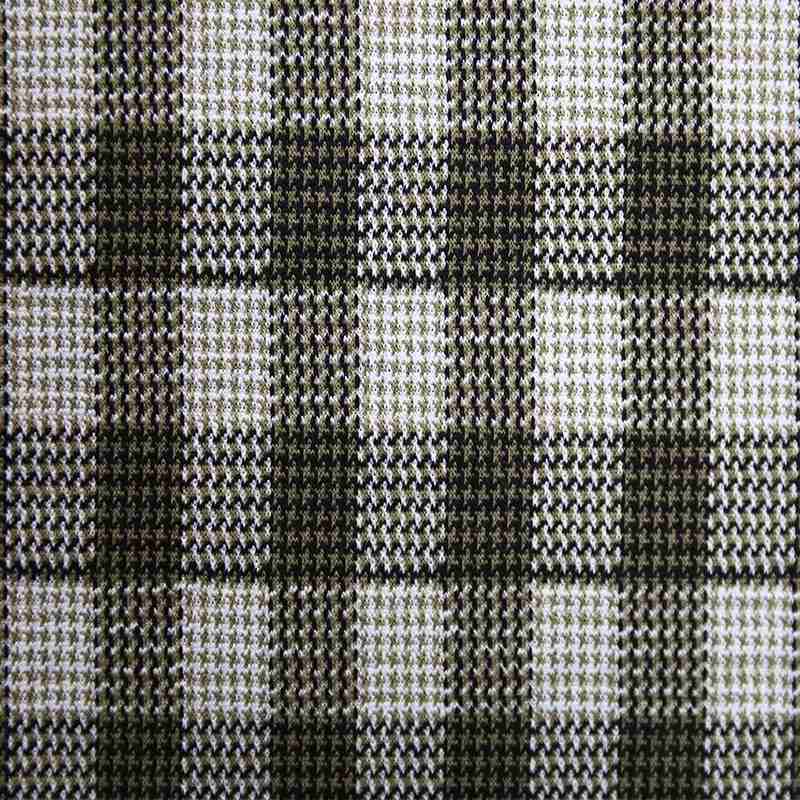
Grid jacquard pattern fabric is a refined knitted textile designed for apparel makers, fabric wholesalers, garment studios, and product developers seeking a balance of decorative structure, comfort, stretch, and production reliability. As a knitted jacquard fabric, it offers a visual pattern created directly through the knitting structure rather than only by surface printing. This gives the fabric a richer dimensional effect, better durability of design, and a more premium appearance suitable for sweaters, fashion tops, casual garments, coordinated sets, and many other apparel applications.
The fabric is made with a blend that may include viscose, polyamide or nylon-related fibers, polyester components, and spandex. This combination allows the fabric to deliver softness, resilience, stretch, shape recovery, and improved wear performance. The grid jacquard pattern brings a clean geometric style, while the knitted construction keeps the fabric flexible and comfortable against the body. The patterned side is slightly convex, and the reverse side is concave, creating a tactile surface with both visual depth and hand-feel character.
Compared with ordinary plain knitted fabrics, this grid jacquard fabric provides stronger design identity. Compared with printed fabrics, the pattern is integrated into the structure, helping the design remain expressive after repeated wear and care. Compared with many single-fiber jacquard materials, the blended composition offers broader performance advantages, including better elasticity, softer touch, improved drape, and more adaptable garment use. For wholesalers and apparel producers, these qualities help create differentiated products that can stand out in competitive markets.
Product Overview
Grid jacquard pattern fabric belongs to the knitted jacquard fabric category. It is engineered through specialized knitting processes that allow geometric patterns to appear as part of the fabric construction. The grid motif is neat, versatile, and easy to match with multiple garment silhouettes. It can support classic sweater styles, contemporary casualwear, fashion cardigans, light jackets, body-conscious tops, skirts, loungewear, and design-driven apparel collections.
The fabric is available in various colors, making it useful for both seasonal collections and staple programs. Neutral colors can create a refined and minimalist look, while bright or contrast shades can make the grid pattern more expressive. Because jacquard knitting creates a structured pattern, the fabric does not rely solely on printed decoration. This gives the final garment a more substantial and crafted appearance.
A notable feature of the fabric is its reversible character. The front side presents a slightly raised grid texture, while the reverse side shows a concave structure. The two sides may be used creatively by garment designers, depending on the desired surface effect. This reversibility can increase design options, reduce fabric waste in development, and support unique garment details such as contrast panels, cuffs, collars, trims, pockets, or reversible apparel concepts.
The minimum order quantity can begin from 500g, which is especially helpful for sample development, small-batch testing, color evaluation, and prototype production. This flexibility is important for wholesalers and apparel brands that need to test new patterns before committing to larger production volumes. It also benefits independent designers and product development teams seeking quick material validation.
Core Specification Table
| Item | Specification | Commercial Value |
|---|---|---|
| Product Type | Grid jacquard pattern knitted fabric | Provides structural pattern and premium visual texture |
| Category | Knitted jacquard fabric | Suitable for fashion apparel, knitwear, and wholesale fabric supply |
| Material Composition | Viscose, polyamide or nylon-related fibers, polyester components, and spandex | Balances softness, durability, elasticity, and comfort |
| Surface Character | Slightly convex patterned side with concave reverse side | Adds dimensional effect and tactile appeal |
| Design Feature | Grid jacquard structure | Clean geometric style suitable for many garment categories |
| Color Options | Various colors available | Supports seasonal collections and customized product programs |
| Reversibility | Usable front and reverse effects | Expands garment design possibilities |
| Minimum Order Quantity | 500g | Convenient for sampling, development, and small trial orders |
| Typical Uses | Sweaters, tops, cardigans, casualwear, fashion garments, wholesale apparel fabrics | Broad application range for buyers and manufacturers |
Why the Grid Jacquard Structure Matters
The grid jacquard pattern is not merely a decorative feature. It is part of the fabric architecture. In jacquard knitting, yarns are controlled to form patterns through interlacing, floating, selection, and structural variation. This means the design has depth, texture, and continuity. The grid appears with a dimensional quality that cannot be fully replicated by simple surface printing.
In many jacquard fabrics, unused yarns may float over each other to continue the pattern. These floats contribute to the visual and structural character of the textile. Properly managed floats help create a clear design while maintaining fabric stability. When produced with advanced knitting control and finishing processes, the fabric can remain attractive, wearable, and suitable for repeated use.
A grid pattern is especially valuable because it is both classic and modern. It can be interpreted in minimalist, sporty, vintage, casual, elegant, or urban styles. It works well with plain trims, solid-color panels, ribbed edges, zipper details, buttons, and layered silhouettes. This flexibility makes the fabric commercially practical for wholesalers, as one fabric can serve many customer segments.
For garment brands, the grid jacquard offers a strong identity without being overly restrictive. It is distinctive enough to be recognized, but not so specific that it becomes difficult to style. This balance is important in apparel markets, where buyers often seek fabrics that can support multiple designs and repeat orders.
Material Advantages and Wear Comfort
The use of viscose, polyamide or nylon-related fibers, polyester components, and spandex gives the fabric a balanced performance profile. Viscose can contribute a soft touch, breathable feel, and smooth drape. Polyamide or nylon-related fibers can improve abrasion resistance, resilience, and strength. Polyester components, especially when supported by the company’s experience in drawn textured yarn production, can add durability, shape stability, and dependable fabric performance. Spandex provides stretch and recovery, helping garments fit more comfortably and retain their shape.
This blend is particularly useful for knitted apparel because knitwear must move with the body. A fabric that is too rigid may feel uncomfortable, while a fabric that is too loose may lose shape. The grid jacquard fabric offers an effective middle ground: it has structure from the jacquard design, softness from the blended yarn selection, and elasticity from spandex. This makes it suitable for garments that require both appearance and comfort.
Compared with many ordinary jacquard fabrics that may feel heavy or stiff, this fabric can provide a softer and more wearable hand. Compared with plain knit fabrics, it offers stronger design impact and better visual value. Compared with low-grade synthetic knits, the blended construction can provide a more refined texture and more versatile performance. These qualities make it appealing for both everyday garments and upgraded fashion products.
Another advantage is its suitability for different climates and wearing occasions. In sweater applications, it can provide warmth and texture. In lighter fashion garments, the stretch and drape can create stylish comfort. In casualwear, the geometric design brings visual interest without sacrificing practicality. In wholesale fabric programs, this versatility helps reduce inventory risk because the same fabric can be marketed for several end uses.
Visual and Tactile Appeal
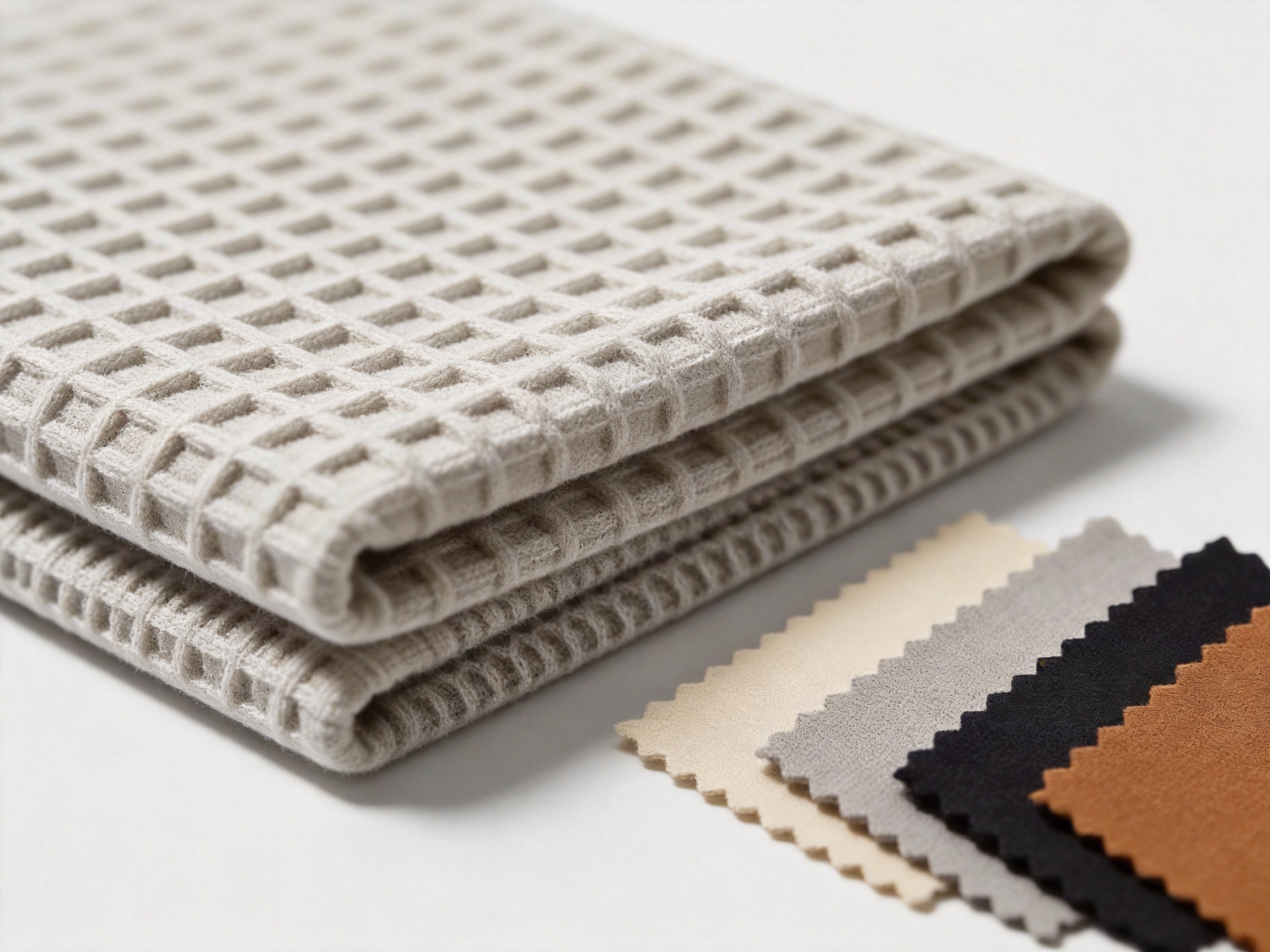
The surface of the fabric is one of its strongest selling points. The slightly convex patterned side gives the grid design a raised appearance, making the textile look more dimensional and premium. The reverse side is concave, creating a different but related visual effect. This dual-sided character allows designers to experiment with the fabric in ways that plain or printed materials cannot easily support.
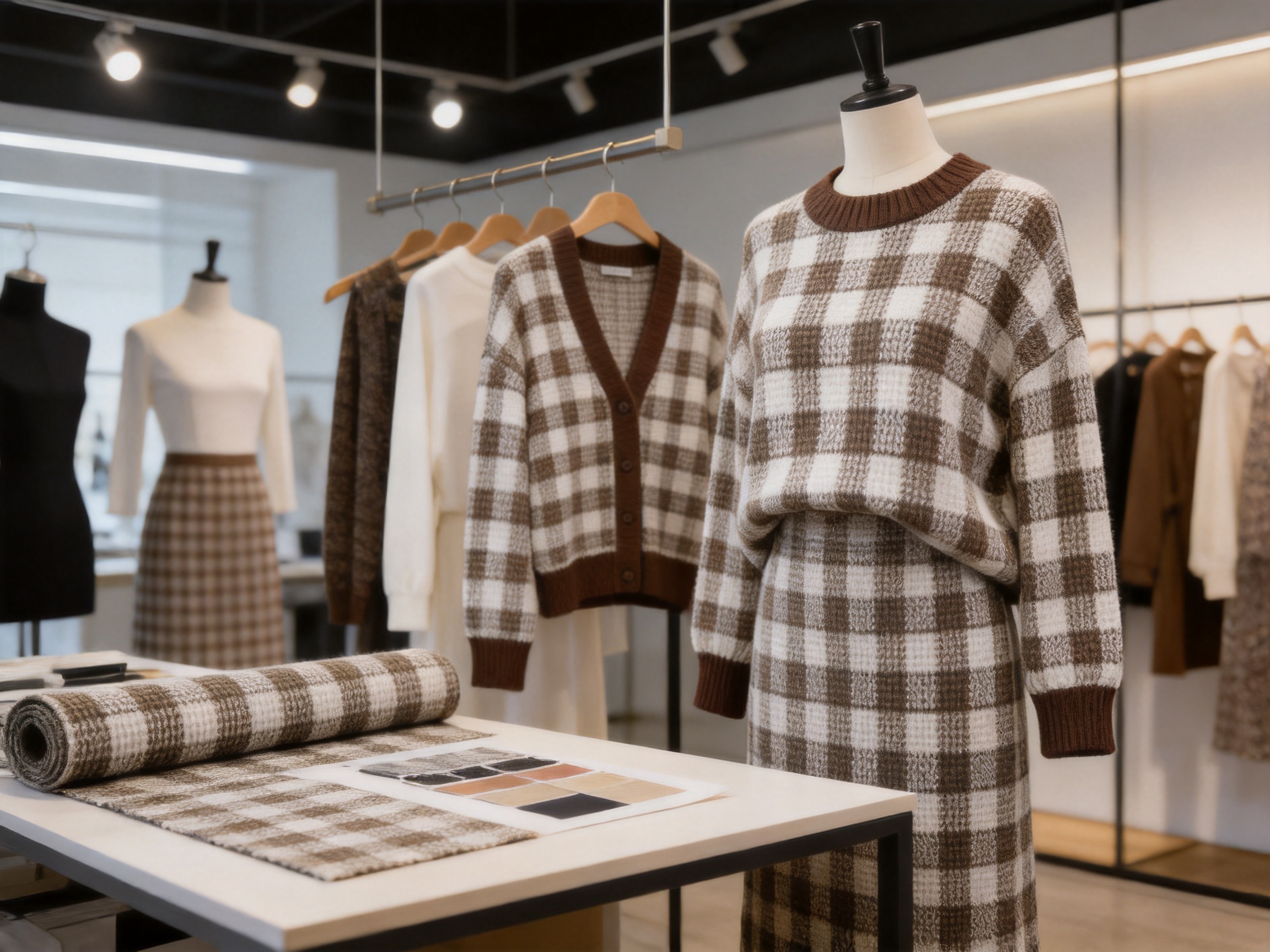
When used in sweaters, the grid jacquard pattern can create a clean and structured look. It can be used for full-body garments or as a partial design element. For example, designers may use the jacquard grid on the front panel of a sweater while using plain knit fabric for sleeves or back panels. It can also be used for cardigans, where the pattern adds visual weight and style to the garment body.
For tops and fashion separates, the grid design can create a polished appearance while maintaining knit comfort. The fabric can work in fitted or relaxed silhouettes, depending on garment construction and fabric weight. The stretch component supports movement, while the jacquard texture makes the garment look more developed and intentional.
The fabric also provides opportunities for reversible or contrast-detail garments. Since the reverse side has its own concave character, it can be shown intentionally in cuffs, hems, necklines, pocket flaps, and design panels. This gives apparel developers more creative options from a single fabric, improving design efficiency and material value.
Advantages Over Common Competing Fabrics
In textile sourcing, buyers often compare jacquard knits with printed knits, plain knits, woven jacquards, and lower-cost synthetic fabrics. Grid jacquard pattern fabric offers advantages in several important areas.
Compared with Printed Knitted Fabric
Printed knitted fabric can be visually attractive, but the design sits mainly on the surface. Over time, printing may fade, crack, or become less vivid depending on ink quality, washing conditions, and fabric stretch. A jacquard pattern, by contrast, is formed through the yarn and stitch structure. This gives the design a more integrated and lasting character. The dimensional grid also provides texture that printing alone cannot achieve.
Compared with Plain Knitted Fabric
Plain knitted fabrics are useful and economical, but they may lack distinctive style. In competitive apparel markets, plain fabrics often require additional decoration, trims, printing, embroidery, or special dyeing to increase value. Grid jacquard fabric already contains a strong design feature, helping garment makers create more attractive products with fewer extra processes. This can improve development efficiency and support higher perceived value.
Compared with Woven Jacquard Fabric
Woven jacquard fabrics can be elegant and structured, but they are often less elastic and may feel less comfortable in body-hugging or casual garments. Knitted jacquard fabric provides more flexibility and stretch, making it better suited for sweaters, tops, casualwear, and active-inspired fashion. The addition of spandex improves fit and comfort, while the knit construction supports natural body movement.
Compared with Low-Grade Synthetic Knits
Low-grade synthetic knits may offer low initial cost, but they can suffer from poor hand feel, weak recovery, unstable dimensions, rough texture, or limited fashion appeal. A better-engineered jacquard blend offers improved softness, resilience, and visual richness. For buyers who care about customer satisfaction and repeat purchase potential, fabric quality is often more valuable than the lowest possible price.
Manufacturing Strength Behind the Fabric
The manufacturer behind this fabric operates as an integrated textile enterprise with capabilities in research, development, production, processing, post-dyeing, finishing, and sales. Its experience includes blended fabrics such as polyester and spandex materials, as well as drawn textured polyester yarn production, processing, and sales. This integrated background gives the company stronger control over quality, consistency, and supply than suppliers that only trade finished fabric.
Advanced manufacturing strength is especially important for jacquard knitted fabric. The clarity of the grid pattern depends on yarn quality, knitting precision, tension control, machine calibration, dyeing uniformity, and finishing stability. If any stage is poorly managed, the result may include distorted patterns, uneven fabric width, poor hand feel, unstable shrinkage, color variation, or weak stretch recovery. Integrated production helps reduce these risks by allowing better coordination across the manufacturing chain.
The company’s production environment includes a substantial plant area and textile processing capacity. With manufacturing space, technical equipment, and export-oriented service experience, it can support wholesale orders, custom requirements, sampling needs, and ongoing business cooperation. Its business philosophy emphasizes cooperation and win-win development, which is valuable for long-term buyers seeking reliable supply rather than one-time transactions.
The company is located in a textile-related industrial area in Hangzhou, Zhejiang Province, a region with strong manufacturing resources and textile expertise. This location supports access to skilled labor, supply chain partners, dyeing and finishing knowledge, logistics channels, and export services. For international buyers, these advantages can translate into smoother communication, more stable production planning, and stronger order execution.
Yarn Knowledge and DTY Expertise
One of the important strengths supporting this fabric is the manufacturer’s experience with drawn textured yarn, commonly known as DTY. DTY polyester yarn is widely used in knitted and woven fabrics because it provides bulk, elasticity, softness, and improved textile performance. Knowledge of DTY production helps a fabric manufacturer understand yarn behavior at a deeper level, including crimp, tension, elongation, shrinkage, and dyeing response.
This knowledge is valuable in producing grid jacquard fabrics because jacquard patterns require stable yarn performance. If yarn tension is inconsistent, the grid may become uneven. If yarn shrinkage varies, the pattern may distort after dyeing or finishing. If yarn texture is not properly controlled, the hand feel may become rough or unstable. Experience in yarn processing helps the manufacturer select and manage yarns more effectively for the final fabric.
DTY-related expertise also supports blended fabric development. Polyester components can be engineered for better softness, bulk, and resilience. When combined with viscose, polyamide or nylon-related fibers, and spandex, the result can be a fabric that balances natural-like comfort with synthetic durability and elastic recovery. This is a meaningful advantage over fabric suppliers that rely entirely on purchased yarns without deep processing knowledge.
For buyers, yarn expertise means more than technical capability. It can also mean better problem-solving. If a customer needs a specific hand feel, stretch level, color effect, or finishing result, a manufacturer with yarn and fabric knowledge can adjust materials and processes more intelligently. This supports customization, quality improvement, and long-term product development.
Knitting Process and Pattern Precision
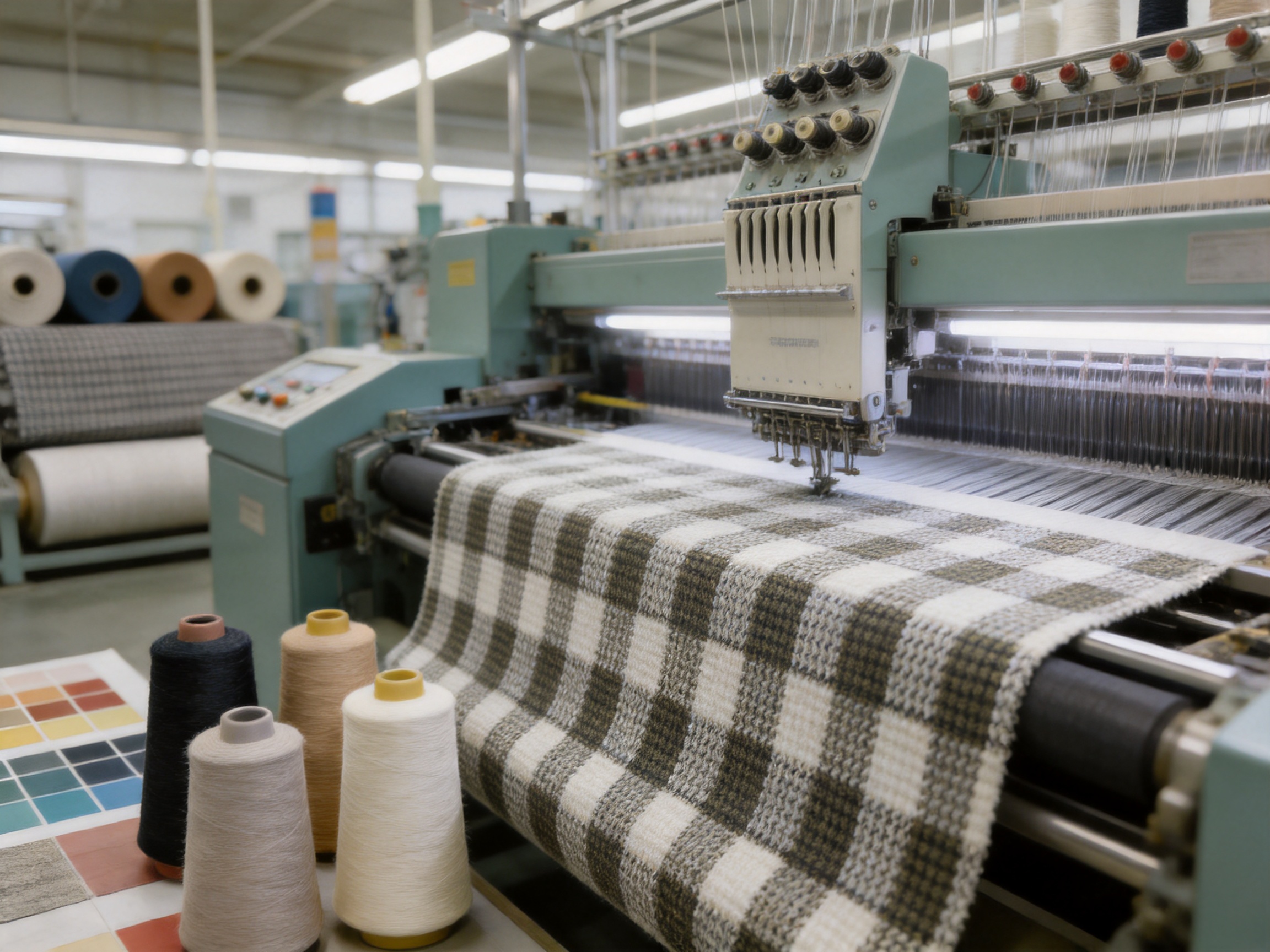
Producing grid jacquard pattern fabric requires careful control of knitting machinery and technical parameters. The grid pattern must be clear, aligned, and consistent across the fabric width and length. Stitch selection, yarn feeding, tension control, loop formation, and machine speed all influence the final result. A reliable manufacturer must maintain technical discipline throughout the production process.
In jacquard knitting, the fabric structure is built through selective yarn placement. The machines create pattern areas by controlling how yarns appear on the front or reverse side. The unused threads may float in controlled ways to continue the design. These floats must be managed to prevent excessive snagging, uneven thickness, or pattern distortion. Proper technical control helps the fabric remain attractive and practical for garment manufacturing.
The slightly convex front surface and concave reverse surface indicate a deliberate structural effect. This is not a random texture but a product of controlled jacquard formation. The tactile contrast between front and back increases the fabric’s value and gives designers more creative freedom.
Pattern precision also affects cutting and sewing. A well-produced grid helps garment makers align panels more easily, improving finished appearance. Poorly controlled fabric may create mismatched lines, skewed grids, or irregular repeats. This can increase waste and reduce garment quality. Therefore, manufacturing precision directly benefits apparel factories and wholesalers.
Dyeing and Color Management
Because the fabric is available in various colors, dyeing and color management are important parts of production. Blended fabrics can be more challenging to dye than single-fiber textiles because different fibers may absorb dye differently. The manufacturer’s experience in post-dyeing and finishing helps achieve more uniform color effects and better fabric hand.
Color consistency matters for wholesale buyers. When ordering fabric for multiple garment batches, buyers need dependable shade control. Even small color differences can affect garment matching, customer perception, and brand quality. Advanced dyeing management helps reduce shade variation and supports repeat orders.
The grid structure can also interact with color in interesting ways. Dark colors may emphasize the texture through shadow and depth. Light colors may create a clean, refined look. Contrast color development can make the grid more prominent, while tone-on-tone color programs can make it more subtle and elegant. This range gives buyers flexibility in building collections for different markets.
Post-dyeing finishing can further improve the fabric’s surface, softness, stability, and usability. Finishing may influence hand feel, width setting, shrinkage control, elasticity, and overall appearance. For jacquard knits, finishing must preserve the pattern while improving comfort and garment performance. A strong finishing process helps ensure that the fabric is ready for cutting, sewing, and commercial production.
Finishing Quality and Garment Performance
Finishing is a key stage that separates ordinary fabric from commercially reliable fabric. Even when the knitting structure is attractive, poor finishing can lead to unstable dimensions, rough hand feel, curling edges, poor recovery, or uneven surface. Proper finishing helps the grid jacquard fabric achieve a more balanced hand, stable width, and better garment suitability.
The spandex component requires careful finishing control. Excessive heat or improper handling can affect elasticity and recovery. A manufacturer experienced in polyester, spandex, and blended fabrics is better positioned to manage these conditions. The goal is to maintain stretch comfort while preventing deformation or loss of shape.
Finishing can also improve the fabric’s drape. For garments such as cardigans, tops, and sweaters, drape influences how the garment hangs on the body. A fabric that is too stiff may look bulky, while a fabric that is too limp may lose the structure of the grid. Balanced finishing helps preserve texture while supporting wearable comfort.
For wholesalers, finishing quality reduces customer complaints. Stable fabric is easier to sell and easier for garment factories to use. It supports more predictable cutting, sewing, pressing, and final garment measurement. This is especially important for repeat customers who expect consistent performance from order to order.
Applications in Sweaters and Knitwear
Sweaters are one of the most natural applications for grid jacquard pattern fabric. The textured surface creates visual warmth and structure, while the knit construction provides comfort. The grid design can be used for classic pullover sweaters, button-front cardigans, turtleneck styles, crewneck designs, V-neck garments, cropped sweaters, oversized silhouettes, and fashion-forward knitwear.
For autumn and winter collections, the grid pattern can create a cozy yet refined appearance. It offers more detail than a plain sweater without requiring complex embroidery or heavy decoration. In spring or transitional collections, lighter colors and softer finishing can make the fabric suitable for layering pieces.
The fabric can also be used for coordinated knit sets, including tops with skirts, cardigans with matching tanks, or casual two-piece outfits. The geometric grid helps create a cohesive collection identity. Because the fabric is available in multiple colors, brands can develop several colorways around the same structure.
In sweater production, stretch and recovery are important. The spandex component helps the garment move with the wearer, while the jacquard structure adds body and visual form. This balance makes the fabric attractive for both fitted and relaxed styles.
Applications Beyond Sweaters
Although the fabric is commonly used for sweaters, its potential extends far beyond knitwear basics. Fashion designers can use it for fitted tops, tunics, dresses, skirts, casual jackets, decorative panels, cuffs, waistbands, and layered garments. The reversible surface also allows for creative use in details and trims.
For casualwear, the grid pattern offers a clean and modern look. It can be used in relaxed tops, jogger-style sets, lounge cardigans, or urban-inspired garments. For women’s fashion, the texture can add elegance to simple silhouettes. For youth fashion, brighter colors can create a lively and expressive style. For wholesale fabric markets, this adaptability increases sales opportunities.
The fabric can also be used in sample collections for boutique garment makers. Since the minimum order quantity may begin from 500g, small teams can test designs without taking excessive material risk. Once a style is validated, larger orders can be developed with better confidence.
For apparel manufacturers, the fabric offers a strong balance of fashion and practicality. It is decorative enough to create value, yet flexible enough to be sewn into many garment categories. This combination is one reason jacquard knitted fabrics remain popular in modern apparel development.
Wholesale Value and Market Positioning
Wholesalers need fabrics that are attractive, reliable, and easy to explain to buyers. Grid jacquard pattern fabric meets these needs because its advantages are visible and tactile. Customers can immediately see the pattern, feel the texture, and understand the difference from ordinary plain fabric. The reversible feature and blended composition add further selling points.
From a market perspective, the fabric can be positioned as a value-added knit. It is not merely a basic commodity fabric; it provides design structure, stretch comfort, and multi-use potential. This allows wholesalers to target garment factories, fashion studios, small brands, online apparel sellers, and retailers seeking differentiated materials.
The low minimum order quantity also supports market testing. Wholesalers can introduce the fabric in sample books, showroom displays, and limited inventory programs. Customers can evaluate colors, garment concepts, and production feasibility before scaling up. This flexibility is particularly useful in fashion markets where trends change quickly.
Reliable production strength further improves wholesale value. Buyers do not want to promote a fabric that cannot be supplied consistently. The manufacturer’s integrated production and processing capability helps support repeat availability, color development, and order coordination. This creates confidence for wholesalers who must serve many downstream customers.
Quality Control Considerations
Quality control for grid jacquard pattern fabric includes inspection of yarn quality, knitting consistency, pattern clarity, fabric width, gram weight, elasticity, color uniformity, surface defects, and finishing stability. Each of these factors influences the final garment.
Pattern clarity is especially important. The grid should appear neat and consistent, without distorted lines or irregular repeats. Surface defects such as holes, broken yarns, oil stains, needle marks, or uneven tension can reduce fabric value. Stretch recovery should be tested to ensure the fabric returns properly after extension. Dimensional stability should be considered to reduce shrinkage or distortion during garment care.
Color quality must also be controlled carefully. For dyed jacquard knits, shade consistency across the batch is essential. Buyers may request lab dips, sample yardage, or bulk confirmation before full production. A manufacturer experienced in dyeing and finishing can better support this process.
For garment factories, fabric inspection before cutting is recommended. Proper relaxation time should be allowed for knitted fabrics, especially those containing spandex. Cutting layouts should consider pattern direction, grid alignment, and fabric stretch. These steps help ensure that the finished garment reflects the quality of the fabric.
Design Development Suggestions
Designers using grid jacquard pattern fabric can maximize its value by respecting the pattern and texture. Simple silhouettes often work well because the fabric itself already contains visual interest. Clean seams, balanced proportions, and thoughtful pattern placement can make the final garment look refined.
For sweaters, designers may combine the grid jacquard with ribbed cuffs, collars, and hems. For cardigans, buttons or zipper closures can create different style directions. For tops, the fabric may be used in full body panels or combined with plain fabrics for contrast. For skirts or dresses, lining and stretch control may be considered depending on garment structure.
Color selection is another important factor. Neutral colors such as black, gray, navy, beige, and ivory can make the fabric suitable for timeless garments. Fashion colors can create seasonal appeal. Tone-on-tone development can emphasize texture subtly, while high-contrast color combinations can make the grid more graphic and bold.
The reverse side can be used as a design detail. Designers may expose the concave reverse on cuffs, sleeve panels, collars, or garment interiors. This can create a premium look and show that the garment has been thoughtfully developed.
Sustainability and Responsible Production Perspective
Modern textile buyers increasingly consider responsible production, durability, and efficient material use. While every fabric must be evaluated according to its exact production conditions, grid jacquard pattern fabric has several qualities that can support more responsible apparel development.
First, the structural pattern may reduce the need for extra printing or decorative processes. Because the design is knitted into the fabric, garments can achieve visual interest without additional surface treatments. Second, the reversible character can support creative pattern use and may reduce waste in design development. Third, durable and comfortable fabrics can contribute to longer garment life, which is an important aspect of responsible consumption.
The manufacturer’s integrated operations can also support better process coordination. When production, dyeing, finishing, and sales are managed within a connected system, there may be more opportunity to control quality, reduce rework, and improve order planning. Efficient production is beneficial not only for cost but also for resource use.
For buyers with specific sustainability requirements, it is advisable to discuss fiber options, dyeing methods, finishing standards, testing reports, and certification possibilities directly with the supplier. The fabric’s blended nature provides room for product development depending on market needs.
Business Cooperation Benefits
For international and domestic buyers, cooperation with a capable textile manufacturer can bring several advantages. A supplier with research and development capability can support new product ideas. A supplier with production capacity can handle practical order execution. A supplier with dyeing and finishing experience can help refine color, hand feel, and performance. A supplier with export experience can assist with communication and commercial coordination.
The manufacturer of this grid jacquard fabric operates with a business philosophy based on cooperation and mutual benefit. This is important because fabric sourcing is rarely a one-step process. Buyers often need sampling, adjustment, quotation, production scheduling, quality confirmation, packing, and after-sales communication. A cooperative supplier can make the entire process smoother.
The company’s experience in blended fabrics and DTY polyester yarn also gives it a broader product foundation. Buyers who source grid jacquard fabric may also need related materials, yarns, or blended fabrics for other programs. Working with a diversified textile manufacturer can simplify sourcing and support long-term product planning.
For wholesalers, stable partnership is especially valuable. A fabric that sells well must be replenished reliably. Color repeats, quality consistency, and production lead times all affect downstream customer satisfaction. Integrated manufacturing strength helps support these needs.
How to Evaluate This Fabric Before Purchase
Buyers evaluating grid jacquard pattern fabric should consider several practical factors. First, check the hand feel. The fabric should feel comfortable, not harsh or overly rigid. Second, examine the pattern clarity. The grid should be clean, consistent, and visually balanced. Third, test stretch and recovery by gently extending the fabric and observing how well it returns. Fourth, check both front and reverse sides to understand design possibilities.
Color evaluation is also essential. Buyers should review color samples under proper lighting and consider whether the shade suits the intended garment market. If repeat orders are planned, shade control should be discussed. For garment production, fabric width, weight, shrinkage, and care behavior should be tested before bulk cutting.
It is also useful to sew sample garments. A fabric may look excellent as yardage but behave differently when cut and sewn. Sample garments reveal drape, seam behavior, fit, stretch, pattern alignment, and final appearance. Because the minimum order quantity can be low, buyers can conduct practical trials before large-scale sourcing.
Communication with the supplier should include target use, required color, expected quantity, delivery schedule, testing needs, and any special finishing requirements. Clear communication helps the manufacturer recommend appropriate solutions and reduces misunderstandings during production.
Care and Handling Recommendations
Care instructions should always be confirmed according to the final composition and finishing method, but several general principles apply to knitted jacquard fabrics with blended fibers and spandex. Gentle washing is usually recommended to preserve elasticity and surface texture. Excessive heat should be avoided because it may affect spandex performance and fabric shape. Garments should be dried and stored in ways that prevent stretching or distortion.
During garment manufacturing, knitted fabrics should be relaxed before cutting. This helps reduce measurement changes after production. Cutting should consider fabric direction and grid alignment. Sewing tension should be adjusted to avoid puckering or seam distortion. For stretch garments, suitable stitches and threads should be selected to maintain comfort and durability.
For finished garments, labels should provide clear care guidance to consumers. Proper care helps maintain the fabric’s appearance, texture, and fit. Since the grid jacquard pattern is structural, it can remain visually attractive when handled correctly.
Q&A Section
What is grid jacquard pattern fabric?
Grid jacquard pattern fabric is a knitted fabric with a geometric grid design formed through jacquard knitting. The pattern is part of the fabric structure, giving it a textured and dimensional appearance.
What materials are used in this fabric?
The fabric may include viscose, polyamide or nylon-related fibers, polyester components, and spandex. This blend supports softness, durability, stretch, and comfortable wear.
Is the fabric suitable for sweaters?
Yes. Sweaters are one of its main applications. The fabric provides texture, warmth, visual interest, and stretch comfort, making it suitable for pullovers, cardigans, and other knitwear styles.
Can the fabric be used for garments other than sweaters?
Yes. It can be used for tops, casualwear, skirts, dresses, cardigans, light jackets, panels, trims, and fashion apparel. Its grid design and reversible texture make it versatile.
What makes this fabric different from printed fabric?
Printed fabric has a design applied mainly to the surface, while jacquard fabric has the design created through the knitting structure. This gives the grid pattern more depth, texture, and durability.
Why is the fabric described as reversible?
The patterned side is slightly convex, while the reverse side is concave. Both sides have usable visual character, allowing designers to use the fabric creatively in garment construction.
What is the minimum order quantity?
The minimum order quantity can begin from 500g, which is useful for sample development, small-batch testing, and trial orders.
Why is the manufacturer’s DTY yarn experience important?
DTY yarn experience helps the manufacturer understand yarn texture, elasticity, shrinkage, and stability. This supports better fabric quality, more consistent jacquard patterns, and improved performance.
What are the key advantages for wholesalers?
Wholesalers benefit from the fabric’s visible texture, versatile applications, multiple color options, low sample quantity, reversible design, and reliable production support.
How should buyers evaluate the fabric before bulk orders?
Buyers should review hand feel, pattern clarity, stretch recovery, color quality, fabric width, weight, shrinkage, and sample garment performance before placing large orders.
Conclusion
Grid jacquard pattern fabric is a strong choice for buyers seeking a textile that combines visual design, tactile texture, stretch comfort, and broad garment versatility. Its geometric pattern is knitted into the structure, offering a richer and more durable effect than ordinary printed designs. The slightly convex front and concave reverse create a distinctive two-sided character, while the blended fiber composition supports softness, resilience, and wearability.
For apparel makers, the fabric provides design value without unnecessary complexity. For wholesalers, it offers strong market appeal and multiple selling points. For fashion developers, it creates opportunities in sweaters, tops, cardigans, casualwear, and creative reversible details. The low minimum order quantity supports sampling and market testing, while the manufacturer’s integrated production strength supports long-term cooperation.
Behind the fabric is a textile manufacturer with capabilities in research, development, production, post-dyeing, finishing, blended fabric processing, and DTY polyester yarn expertise. These strengths contribute to more stable quality, better color and finishing control, and more reliable supply. In a competitive textile market, such integration provides a meaningful advantage.
By combining jacquard pattern precision, blended material performance, advanced manufacturing processes, and flexible commercial service, grid jacquard pattern fabric stands out as a practical and stylish solution for modern apparel and wholesale textile programs.
References
Spencer, D. J. Knitting Technology: A Comprehensive Handbook and Practical Guide. Woodhead Publishing.
Gong, R. H., and Wright, R. M. Fancy Yarns: Their Manufacture and Application. Woodhead Publishing.
Sinclair, R. Textiles and Fashion: Materials, Design and Technology. Woodhead Publishing.
Cook, J. G. Handbook of Textile Fibres: Man-Made Fibres. Woodhead Publishing.
Horrocks, A. R., and Anand, S. C. Handbook of Technical Textiles. Woodhead Publishing.
Kadolph, S. J. Textiles. Pearson.