
White Slightly Intermingled DTY: Performance, Manufacturing Quality, and Textile Applications
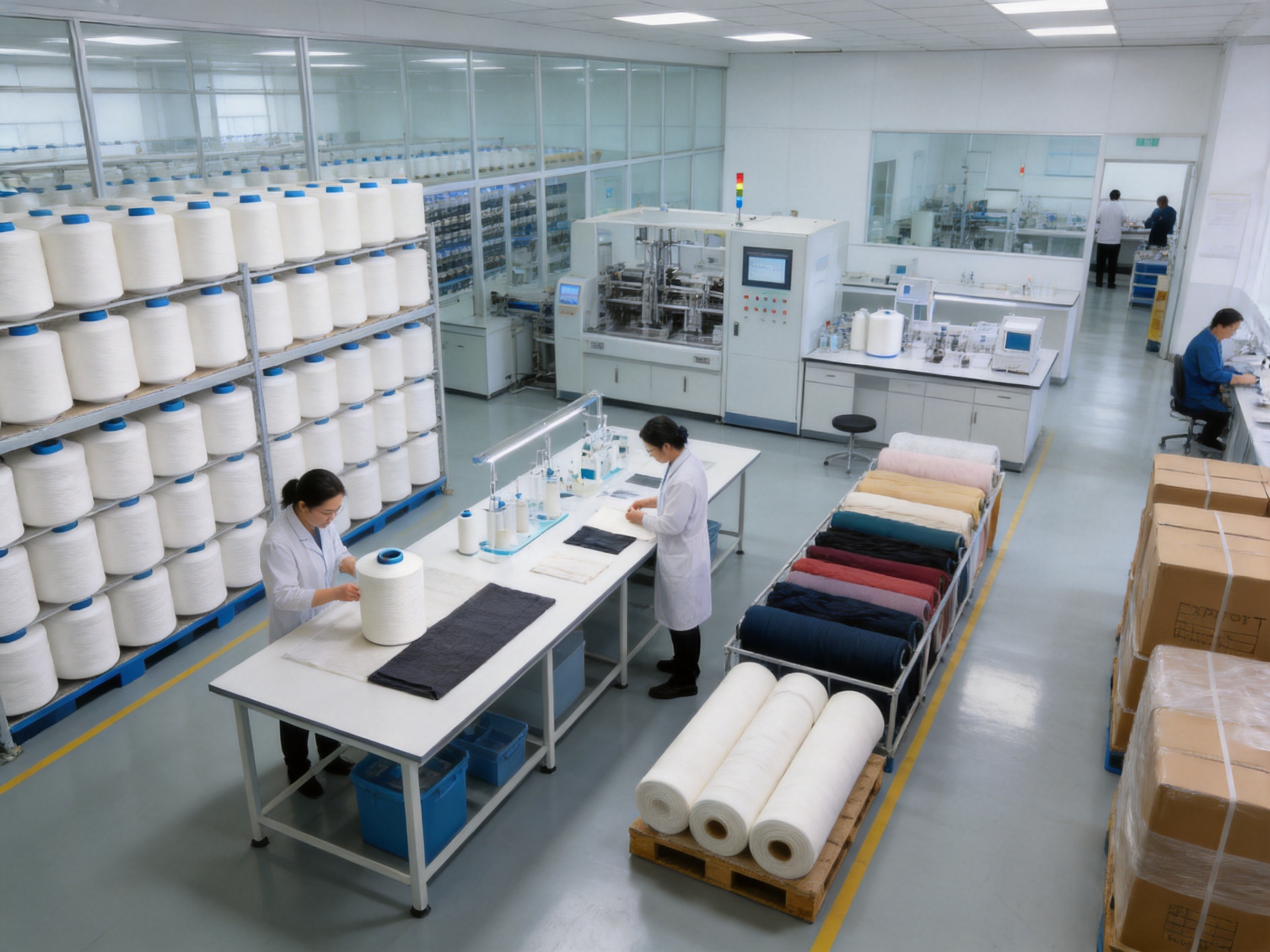
White Slightly Intermingled Draw Textured Yarn, commonly called Slightly Intermingled DTY, is a polyester yarn developed for manufacturers that need a practical balance of bulk, softness, dimensional stability, processability, and reliable visual appearance. It is produced through a draw-texturing process in which a pre-oriented yarn is drawn and false-twisted at high speed. The resulting yarn combines the useful characteristics of textured yarn with the fullness and controlled elasticity associated with low-elastic textile materials.
This type of yarn is used in the production of fabrics for apparel, home textiles, lining materials, decorative textiles, knitted structures, and blended fabric constructions. Its white appearance provides a clean and versatile base for direct use, dyeing, printing, coating, or blending with other fibers. Because polyester is durable, adaptable, and comparatively easy to process, white Slightly Intermingled DTY can serve as an efficient raw material for textile manufacturers seeking consistency across repeated production runs.
The product is manufactured and supplied by Hangzhou Jinfeng Textile Co., Ltd., a textile enterprise based in Xiaoshan District, Hangzhou, Zhejiang Province. The company combines production, processing, post-dyeing, finishing, research and development, and export sales. Its manufacturing base covers approximately 32.6 acres, with a plant area of about 18,000 square meters. This integrated structure supports close coordination between yarn production and fabric development, enabling the company to respond to different requirements in polyester yarn and blended textile production.
Understanding White Slightly Intermingled DTY
Draw Textured Yarn is a type of polyester yarn that has been modified from its original filament form through mechanical and thermal processing. The purpose of texturing is to change the physical behavior and appearance of a straight filament yarn. Instead of remaining smooth and highly uniform like an untreated filament, the textured yarn gains greater bulk, a different surface character, improved covering power, and a more fabric-friendly hand.
Slightly Intermingled DTY includes a controlled degree of intermingling. Intermingling introduces points of cohesion among individual filaments, helping the yarn behave as a more unified bundle during winding, warping, knitting, weaving, and other downstream operations. The degree of intermingling is described as slight because the product is designed to maintain the flexibility and surface benefits of textured yarn without creating an excessively compact or rigid structure.
The white color is especially useful for textile manufacturers. It offers a neutral foundation for later color development and allows the yarn to be used in light-colored products without requiring a dark-base correction. Depending on the production plan, the yarn may be used in its original white condition or processed through dyeing and finishing operations to produce a wide range of colors, shades, patterns, and fabric effects.
In practical textile terms, White Slightly Intermingled DTY is intended to provide a combination of:
• A textured polyester structure
• Low and controlled elasticity
• Increased yarn bulk compared with a straight filament yarn
• Useful cohesion between filaments
• A clean white appearance
• Suitability for knitted, woven, and blended fabric production
• Compatibility with thermal-insulating textile constructions
These characteristics make it suitable for buyers who require a functional polyester yarn rather than a basic, unmodified filament. The yarn can support both everyday textile production and specialized fabric development where bulk, coverage, comfort, and handling performance are important.
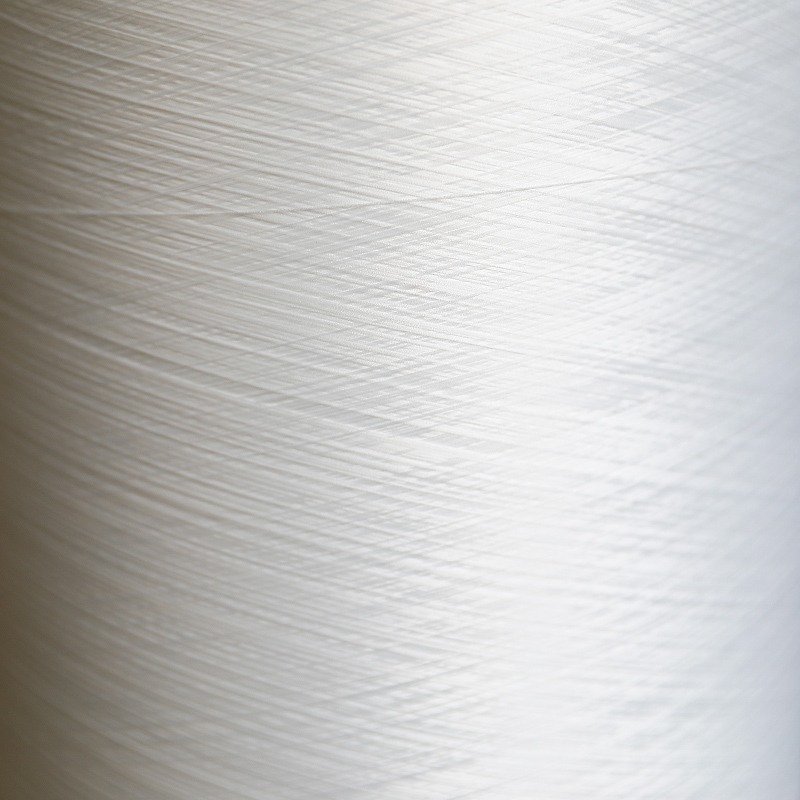
White Slight Intermingled DTY
How the Draw-Texturing Process Works
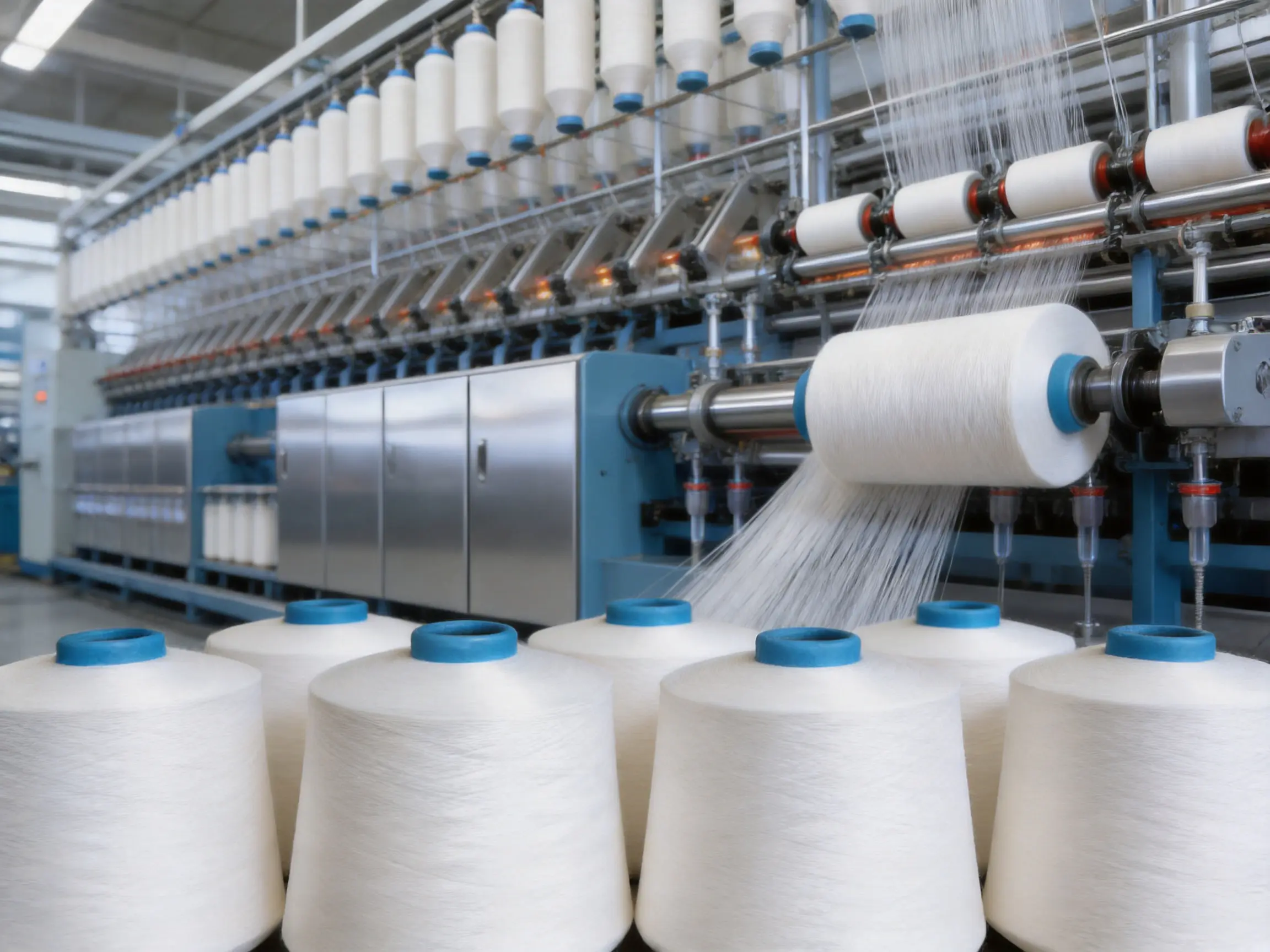
The performance of DTY is closely related to the way it is manufactured. The process begins with a pre-oriented yarn, often known as POY. A pre-oriented yarn contains continuous polyester filaments that have already received a degree of orientation during spinning but still have sufficient potential for further drawing and texturing. This makes it a suitable feedstock for producing a textured yarn.
During draw texturing, the yarn is drawn to improve molecular orientation and adjust its physical properties. Drawing can influence strength, elongation, stability, and the overall balance of the finished yarn. It is not simply a matter of stretching the yarn. The process must be controlled so that the yarn achieves the intended combination of dimensional behavior and textile performance without damaging the individual filaments.
False twisting is then applied at high speed. Unlike permanent twisting, false twisting temporarily twists the yarn during processing and helps create a textured configuration. When the yarn passes through the heating and cooling stages associated with the texturing process, the configuration of the filaments is set into a more stable form. This gives the yarn a crimped, fuller, and more flexible character than the original pre-oriented yarn.
The high-speed spinning and draw-texturing sequence requires accurate control of yarn tension, temperature, speed, contact points, winding conditions, and package formation. Small changes in these factors can affect the final yarn’s bulk, elasticity, uniformity, appearance, and downstream processability. For this reason, stable machinery, trained operators, appropriate process settings, and careful inspection are essential to reliable DTY production.
After texturing, the yarn can receive slight intermingling. Intermingling creates periodic cohesion points between filaments. These points help reduce filament separation during subsequent processing while preserving the flexible character of the yarn. The result is a yarn that can be handled more efficiently in knitting and weaving operations and can provide more consistent coverage in the finished fabric.
The production sequence may be summarized as follows:
| Production stage | Main purpose | Influence on the final yarn |
|---|---|---|
| Pre-oriented yarn preparation | Provide a suitable polyester filament feedstock | Establishes the foundation for drawing and texturing |
| Drawing | Adjust molecular orientation and yarn performance | Supports strength, stability, and controlled elongation |
| False twisting | Create a textured filament configuration | Improves fullness, flexibility, and surface character |
| Heating and cooling | Set the textured form | Helps stabilize the yarn structure |
| Slight intermingling | Join individual filaments at controlled points | Improves cohesion and handling during processing |
| Winding and inspection | Prepare the product for storage and shipment | Supports package quality and production consistency |
The exact processing conditions depend on the yarn specification, intended fabric, machine type, and customer requirements. Buyers should confirm details such as denier, filament count, intermingling level, package format, tensile properties, elongation, and applicable quality standards before placing a production order.
Key Performance Advantages
Controlled Low Elasticity
One of the central characteristics of Slightly Intermingled DTY is its low-elastic nature. This means the yarn offers more controlled stretch behavior than highly elastic yarn categories. For many textile applications, this balance is valuable because excessive elasticity can make fabric cutting, sewing, knitting, dimensional control, and finishing more difficult.
Controlled elasticity helps manufacturers create fabrics that retain a stable shape while still offering a degree of comfort and flexibility. It can be especially useful in applications where a fabric must move with the wearer or accommodate normal handling without becoming excessively extensible. The final performance depends on yarn specifications and fabric construction, but the low-elastic DTY structure provides a practical starting point for stable textile development.
Bulk and Fabric Fullness
Texturing gives the yarn greater bulk than a smooth, straight filament yarn of comparable linear density. A bulkier yarn can provide improved covering power and a fuller hand. It may also help textile manufacturers achieve a desired fabric appearance with an efficient yarn input, depending on the fabric design and construction parameters.
Bulk is important in fabrics intended to feel soft, substantial, warm, or comfortable. It can contribute to a more attractive surface and can help reduce a thin or overly flat appearance. For knitted fabrics, bulk may support a rounded hand and improved visual depth. For woven fabrics, it may contribute to coverage and a more developed surface texture.
Thermal-Insulation Potential
The product is described as an excellent choice for thermal insulation. Textured yarn structures can create a fuller textile layer and may help retain air within the fabric construction. Since still air is a relatively poor conductor of heat, fabrics with suitable bulk and structure may offer useful thermal comfort characteristics.
The actual insulation performance is determined by more than the yarn alone. Fabric weight, thickness, porosity, knitting or weaving pattern, finishing, garment design, moisture behavior, and the presence of other fibers all influence thermal performance. Nevertheless, the bulk and textured configuration of Slightly Intermingled DTY make it a practical material for developing fabrics where warmth and comfort are desired.
Improved Filament Cohesion
Slight intermingling helps hold the filaments together at controlled points. This can support more stable yarn handling during knitting, weaving, winding, and other operations. A yarn with appropriate cohesion is less likely to behave as a collection of completely separate filaments during processing.
Filament cohesion can also contribute to improved consistency in fabric formation. When the yarn passes through guides, needles, heddles, feeders, or other textile machine components, a cohesive structure can help reduce irregular separation. The precise benefit depends on the intermingling level and the operating conditions, but controlled cohesion is an important advantage over a yarn with no inter-filament organization.
Versatile White Base
White polyester yarn is a flexible raw material for downstream production. It can be used for white or pale fabrics, dyed into selected colors, printed with patterns, or incorporated into blends. Its neutral color gives designers and manufacturers more freedom when developing seasonal collections, technical textiles, interior products, and customized orders.
A white base can also simplify product planning by allowing one yarn family to support multiple color programs. Instead of holding a large inventory of pre-colored yarns for every shade, a manufacturer may use white yarn as a starting material for later color development, subject to the requirements of the selected dyeing process and the intended end use.
Advantages Compared with Alternative Yarn Options
Textile manufacturers select yarn according to the balance of performance, appearance, processing efficiency, cost, and end-use requirements. White Slightly Intermingled DTY has a distinct position between smooth filament yarns, highly elastic yarns, and more heavily textured structures.
Compared with a smooth polyester filament yarn, Slightly Intermingled DTY offers greater texture and bulk. A smooth filament may be appropriate when a sleek surface, low friction, or a bright filament effect is the main objective. However, it may not provide the same fullness, covering power, or soft textile hand. DTY can therefore be advantageous when the fabric needs a more developed surface and a less rigid filament character.
Compared with a highly elastic yarn, low-elastic DTY provides more restrained stretch behavior. Highly elastic products are useful for close-fitting garments, activewear, compression products, and other applications that require substantial extension and recovery. However, a buyer seeking dimensional control and moderate flexibility may prefer the more balanced behavior of DTY.
Compared with a completely untextured yarn, DTY can offer a more comfortable and fabric-oriented hand. Texturing may help the yarn blend into the structure of a fabric rather than presenting a purely smooth filament appearance. This can be important for knitted apparel, casual clothing, linings, household textiles, and decorative materials.
Compared with an excessively bulky or heavily textured product, Slightly Intermingled DTY can provide a more controlled construction. Some applications need fullness without an exaggerated surface or excessive stretch. The “slight” intermingling and low-elastic design can help maintain a balance between texture, handling, and stability.
| Comparison factor | Smooth polyester filament | Highly elastic yarn | White Slightly Intermingled DTY |
|---|---|---|---|
| Surface character | Generally smooth and sleek | May be smooth or highly elastic | Textured and fuller |
| Elastic behavior | Usually controlled and limited | High or specialized stretch | Low and controlled elasticity |
| Bulk | Lower relative bulk | Varies by construction | Enhanced bulk from texturing |
| Filament cohesion | Depends on yarn design | Depends on yarn design | Supported by slight intermingling |
| Color flexibility | Available in many forms | Depends on fiber and processing | White base suitable for later development |
| Typical value proposition | Clean appearance and smooth handling | Stretch and recovery | Bulk, comfort, stability, and versatility |
This comparison does not mean that one yarn is universally superior. The correct choice depends on the product specification. White Slightly Intermingled DTY is advantageous when the buyer needs a middle ground: more texture and fullness than a smooth filament, but more dimensional control than a highly elastic yarn.
Applications in Knitted Fabrics
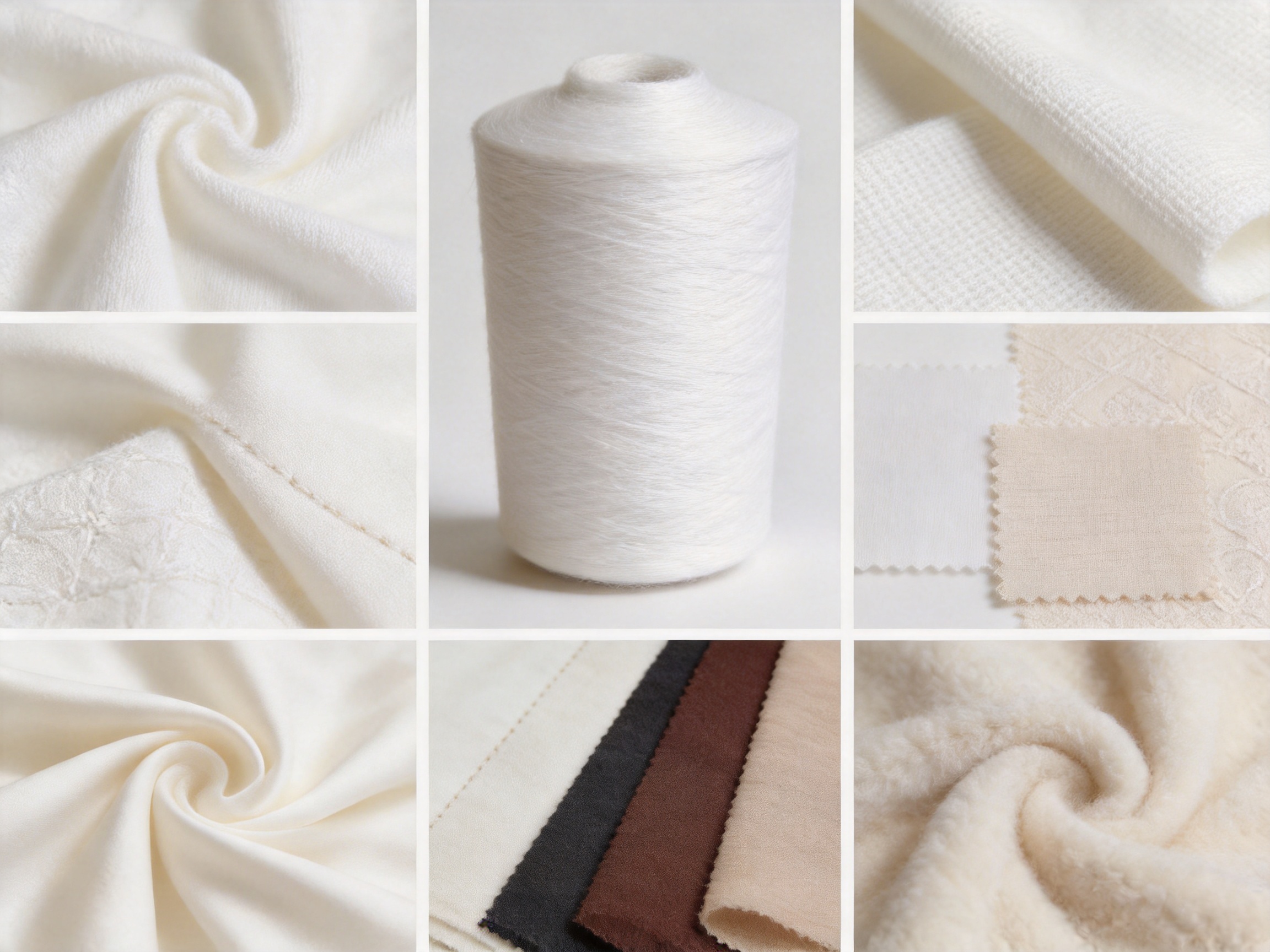
Knitting is one of the most natural application areas for textured polyester yarn. The yarn’s bulk and flexibility can support fabric structures with a soft hand, attractive coverage, and a comfortable surface. It may be used in circular knitting, warp knitting, or other knitted constructions, provided that the yarn specification is compatible with the machine and fabric design.
In knitted apparel, the yarn may be considered for tops, dresses, skirts, sports-casual garments, lightweight outer layers, sleepwear, and fashion fabrics. The appropriate use depends on denier, filament count, fabric weight, finishing, and the desired drape. Its white form can be dyed or combined with other yarns to create solid colors, mélange effects, stripes, jacquards, and textured surfaces.
For knitted fabrics intended to provide warmth, the yarn’s bulk may help create a thicker and more comfortable textile layer. Designers can combine it with suitable stitch structures to increase thickness, trap air, or produce a raised surface. The yarn can also be used in fabrics where a soft appearance and moderate elasticity are more important than high stretch recovery.
Production trials are recommended before large-scale knitting. Machine gauge, feeder tension, take-down settings, needle condition, yarn path, and fabric density can affect the result. A yarn that performs well in one knitting structure may require adjustments in another. Close communication between the yarn supplier and fabric producer can reduce trial time and help establish appropriate settings.
Applications in Woven and Blended Fabrics
Although DTY is widely associated with knitting, it can also be incorporated into woven fabrics where a fuller yarn appearance and controlled elasticity are desired. It may be used in warp or weft systems depending on the specification and weaving preparation. The yarn’s handling behavior, cohesion, and package quality are important considerations during warping and weaving.
In woven fabric, Slightly Intermingled DTY can contribute to surface softness, coverage, and visual texture. It may be selected for apparel fabrics, lining materials, decorative textiles, lightweight furnishings, and other applications requiring polyester durability together with a less rigid filament feel.
The yarn can also be combined with cotton, rayon, spandex, or other textile materials. Blending allows manufacturers to balance different properties. Polyester may contribute strength, dimensional stability, drying performance, and durability, while another fiber may contribute moisture absorption, natural hand, drape, or stretch. The final result depends on blend ratio, yarn arrangement, fabric structure, dyeing, finishing, and intended use.
Hangzhou Jinfeng Textile Co., Ltd. produces, processes, dyes, finishes, and sells blended fabrics involving polyester, spandex, and related textile materials. This broader product capability is valuable to buyers that do not want to manage every stage through separate suppliers. It can also support closer alignment between yarn selection and final fabric development.
Use in Jacquard and Decorative Textile Structures
Textured polyester yarn can be useful in jacquard fabrics and other decorative constructions where surface depth, pattern definition, and variation in texture are important. A fuller yarn may help emphasize certain areas of a design, especially when combined with different colors, yarn counts, stitch structures, or weave effects.
In knitted jacquard, the yarn can be combined with other polyester yarns, rayon, or specialty yarns to create visual contrast. Its white color can serve as a base for dyeing or can remain as part of a light-colored pattern. In woven jacquard, the yarn may contribute to a more developed surface and a pleasant tactile effect.
Designers should evaluate abrasion, snagging, pilling, colorfastness, and dimensional stability according to the intended end use. Textured yarn is often selected for its comfort and appearance, but the final fabric must still satisfy the performance expectations of the market. Proper finishing and suitable fabric construction are important parts of the development process.
Manufacturing and Processing Strengths
Integrated Production Capability
Hangzhou Jinfeng Textile Co., Ltd. integrates research and development, production, processing, post-dyeing, finishing, and sales. This structure provides an important operational advantage. Buyers can discuss yarn and fabric requirements with a company that understands both the raw material and the downstream textile result.
An integrated supplier can help identify whether a fabric issue originates from yarn selection, knitting or weaving settings, dyeing, finishing, or fabric construction. It can also make product communication more direct. Instead of transferring technical information through several independent companies, the buyer can work with one textile partner across multiple stages of development.
Dedicated Industrial Site
The company is located in Jingjiang Street Industrial Park in Xiaoshan District, Hangzhou City, Zhejiang Province. Its approximately 32.6-acre site and 18,000-square-meter plant provide space for manufacturing and related textile operations. A dedicated industrial base supports organized production flows, equipment management, material storage, quality inspection, and order coordination.
Facility size alone does not determine product quality, but it can support production capacity and process organization when combined with effective management. For international buyers, a stable factory base is also relevant to order planning, communication, shipment scheduling, and repeat production.
Experience with Polyester and Blended Materials
The company specializes in polyester yarn production, processing, and sales, as well as blended fabric production and related finishing. Its product categories include polyester rayon fabric, knitted jacquard fabric, NTR knitted fabric, NR knitted fabric, and Slightly Intermingled DTY yarn.
This product range indicates experience with both yarn and fabric systems. Such experience is helpful when developing a material that must satisfy more than one requirement at the same time. For example, a buyer may need a yarn with specific bulk, a knitted fabric with a particular hand, and a finished product with a defined appearance. Understanding the relationship between these stages can improve development efficiency.
Post-Dyeing and Finishing Support
Dyeing and finishing can significantly influence the final appearance and performance of polyester and blended fabrics. Finishing may affect softness, fullness, drape, surface smoothness, dimensional stability, color presentation, and comfort. A supplier with post-dyeing and finishing capabilities can coordinate these stages with the original yarn and fabric construction.
For buyers, this may reduce the risk of incompatibility between the yarn and the selected finishing route. It also allows the manufacturer to adjust the textile result according to the intended market. The same yarn can produce very different fabric impressions depending on dyeing, heat setting, brushing, compacting, coating, or other finishing treatments.
Quality Considerations for Buyers
When purchasing White Slightly Intermingled DTY, buyers should define the technical requirements before confirming an order. Important parameters may include yarn count or denier, filament number, intermingling level, elongation, strength, shrinkage, oil content, moisture content, package weight, winding format, color consistency, and appearance.
Package quality is also important. A well-formed package should unwind smoothly and maintain stable tension during use. Poor winding can lead to snarling, tension variation, broken filaments, machine stoppages, and fabric defects. Buyers should therefore evaluate not only laboratory data but also package performance in actual knitting or weaving trials.
Visual inspection should consider uniformity, contamination, broken filaments, fuzziness, oil marks, color variation, and package deformation. For white yarn, cleanliness and color consistency are particularly important. A clean white base supports dyeing and helps avoid unwanted shade differences in pale or bright fabrics.
Laboratory testing should be matched to the intended application. A yarn for lightweight apparel may require a different balance of properties from one used in a heavier knitted fabric or a decorative textile. Testing should be conducted under controlled conditions and, where possible, repeated across multiple packages and production lots.
| Quality area | Why it matters | Suggested evaluation approach |
|---|---|---|
| Linear density | Influences fabric weight, coverage, and production planning | Test representative samples from multiple packages |
| Strength and elongation | Affect machine performance and fabric durability | Use standardized tensile testing procedures |
| Intermingling | Influences filament cohesion and yarn handling | Check cohesion at specified intervals and compare with the order requirement |
| Package formation | Influences unwinding and production efficiency | Inspect hardness, edges, shape, and unwinding behavior |
| Whiteness and cleanliness | Influence dyeing, printing, and light-colored fabric appearance | Conduct visual and instrumental inspection where appropriate |
| Thermal behavior | Influences heat setting, dyeing, and finishing results | Evaluate under the intended downstream process |
| Fabric performance | Confirms suitability for the final product | Conduct knitting or weaving trials followed by finishing tests |
It is also advisable to request a sample before purchasing a large quantity. A sample enables the buyer to evaluate the yarn on the actual machine, with the actual fabric structure and finishing route. This practical trial is often more informative than relying exclusively on general product descriptions.
Processing Recommendations
Textile manufacturers should store polyester yarn in a clean, dry, and temperature-stable environment. Packages should remain protected from dust, oil, moisture, direct sunlight, and physical damage. Sudden changes in temperature and humidity can influence yarn handling and should be avoided where possible.
Before use, the yarn should be allowed to reach the normal conditions of the production room if it has been transported through a substantially different environment. This helps reduce tension variation and improves consistency during processing. Packages should be handled carefully to prevent edge damage and deformation.
During knitting or weaving, operators should monitor yarn tension, guide condition, machine speed, and the yarn path. Excessive tension may alter the fabric’s appearance and reduce the expected bulk. Inadequate tension control may create loops, barre, streaks, uneven density, or other defects. The correct settings depend on the yarn specification and machine configuration.
Heat treatment should be carefully controlled. Polyester responds to temperature, residence time, tension, and cooling conditions. Excessive heat or unsuitable tension can affect shrinkage, texture, hand, and dimensional stability. Fabric producers should establish conditions through controlled trials rather than applying a general setting without validation.
Dyeing and finishing should also be selected according to the polyester structure and the presence of other fibers. Blended fabrics may require specialized dye systems or staged processing because different fibers accept color differently. A qualified technical team should confirm the process route, colorfastness expectations, and finishing compatibility before production.
Sustainability and Resource Efficiency Considerations
Polyester is a synthetic fiber with a long service life and broad processing versatility. Durable textiles can remain functional through repeated use, which may support longer product lifecycles. The textured structure of DTY can also help manufacturers achieve a desired fabric hand or coverage without relying solely on heavier fabric constructions.
Sustainability performance must be evaluated across the full product lifecycle. Important factors include the origin of the polymer, energy used in spinning and texturing, water and chemical consumption during dyeing, production waste, product durability, and end-of-life options. Buyers should request relevant information from the supplier when environmental declarations, recycled content, certifications, or restricted-substance compliance are required.
White yarn can support flexible inventory management because it may be dyed or finished for different product programs. Better planning can reduce the need to maintain numerous pre-colored yarn inventories. However, actual resource savings depend on the selected dyeing route, order volumes, production efficiency, and waste-control practices.
Manufacturers seeking sustainable product claims should distinguish clearly between general polyester characteristics and verified environmental performance. Any claim concerning recycled content, carbon emissions, water savings, biodegradability, or certification should be supported by appropriate documentation.
Why Work with an Experienced Textile Supplier
The selection of a yarn supplier affects more than the purchase price of the raw material. It can influence product development speed, production reliability, defect rates, delivery planning, communication efficiency, and the ability to customize the final fabric. An experienced supplier should be able to discuss the relationship between yarn specifications and fabric results.
Hangzhou Jinfeng Textile Co., Ltd. operates as a self-employed export company integrating research and development, production, and sales. This structure is relevant to international customers because export orders require clear documentation, coordinated logistics, product communication, and consistent follow-up.
The company’s stated business philosophy emphasizes cooperation and mutual benefit. In practical terms, a cooperative textile supplier should be prepared to discuss sample development, production requirements, quality expectations, packaging, lead times, and after-sales communication. These factors can be as important as the initial technical specification.
Customers can also benefit from discussing alternative products within the same supply network. If a project begins with White Slightly Intermingled DTY but later requires a polyester-rayon blend, knitted jacquard fabric, NTR knitted fabric, or NR knitted fabric, a supplier with several related categories may offer a more efficient development path.
Product Development for Different Markets
The same yarn may be used in different market segments when its construction is adapted through fabric design and finishing. For apparel, the priorities may include softness, drape, color, comfort, and resistance to ordinary wear. For home textiles, buyers may focus on appearance retention, easy care, dimensional stability, and tactile fullness. For decorative products, surface effect and color presentation may have greater importance.
In colder-weather products, designers may use the yarn in fabrics that emphasize thickness and air retention. In lightweight products, the yarn may be selected for its ability to create a fuller appearance without producing an excessively heavy fabric. The final balance is controlled through yarn count, stitch or weave density, blend ratio, finishing, and garment or product construction.
For export markets, the product may need to comply with specific chemical, labeling, flammability, colorfastness, or restricted-substance requirements. These requirements vary according to country, product category, and intended consumer use. Buyers should communicate all applicable standards before sampling and production.
Purchasing Checklist
A well-prepared purchasing inquiry allows the supplier to recommend a suitable specification more efficiently. The inquiry should identify the intended use, fabric construction, machine type, required color, expected order volume, package format, and delivery destination.
Buyers should also state whether the yarn will be used directly, dyed, blended, knitted, woven, or finished through a special process. If the yarn is being developed for a new fabric, information about target fabric weight, hand, stretch, appearance, and thermal comfort can help the supplier provide more useful guidance.
The following checklist can support initial communication:
• Product name: White Slightly Intermingled DTY
• Intended application: knitted, woven, blended, jacquard, apparel, or home textile
• Required yarn count and filament specification
• Desired level of intermingling
• Required elasticity, strength, and shrinkage performance
• Package size and winding requirements
• White color and cleanliness expectations
• Dyeing, printing, or finishing plan
• Required testing reports or compliance documents
• Sample quantity and production quantity
• Packaging and shipping requirements
• Delivery schedule and destination
Clear information at the beginning helps reduce misunderstandings and makes it easier to compare samples, quotations, and production results.
Frequently Asked Questions
What is White Slightly Intermingled DTY?
White Slightly Intermingled DTY is a white polyester Draw Textured Yarn produced by drawing and false-twisting a pre-oriented yarn, followed by controlled intermingling of the filaments. It is designed to provide bulk, a textured hand, low elasticity, and improved filament cohesion.
What does DTY stand for?
DTY stands for Draw Textured Yarn. The name refers to the combination of drawing and texturing processes used to modify the original polyester filament yarn.
What is the purpose of slight intermingling?
Slight intermingling creates cohesion points between individual filaments. This helps the yarn behave as a more unified bundle during downstream processing while preserving flexibility and the benefits of texturing.
Is this yarn highly elastic?
No. The product is described as a low-elastic yarn. It offers controlled elasticity rather than the high stretch associated with specialized elastic yarns. The actual fabric stretch depends on the yarn specification and fabric construction.
Can the yarn be dyed?
White polyester DTY can generally serve as a base for dyeing and other color-development processes. The selected dyeing method should be confirmed according to the yarn specification, blend composition, equipment, and required colorfastness.
Can it be used in knitted fabric?
Yes. The yarn is suitable for consideration in knitted fabric production. Its bulk, flexibility, and textured structure can support comfortable and fuller knitted constructions. A machine trial is recommended to confirm the appropriate tension and production settings.
Can it be used in blended fabrics?
Yes. It can be combined with materials such as rayon, cotton, spandex, or other textile fibers, depending on the required performance. The blend ratio and finishing route should be developed according to the final product requirements.
Is it suitable for thermal-insulating fabrics?
It is described as an excellent choice for thermal insulation because its textured and bulky structure can support air retention in a suitable fabric construction. Actual insulation performance must be verified through fabric testing because thickness, density, finishing, and blend composition also have significant effects.
What information should be included in a quotation request?
A quotation request should include the required yarn count, filament number, intermingling level, package format, order quantity, destination, intended application, color requirements, delivery schedule, and any testing or compliance standards. Providing fabric information can also help the supplier recommend the appropriate specification.
Why is a production sample important?
A sample allows the buyer to evaluate unwinding, machine performance, fabric appearance, hand, dyeing response, and finishing compatibility. It also helps identify any required adjustments before a larger order is manufactured.
Where is the manufacturer located?
Hangzhou Jinfeng Textile Co., Ltd. is located at 1279 Shenda Road, Jingjiang Branch, Xiaoshan District, Hangzhou, Zhejiang Province. The company operates from Jingjiang Street Industrial Park.
Does the company supply only yarn?
No. In addition to DTY polyester yarn production, processing, and sales, the company manufactures and processes blended fabrics and provides post-dyeing and finishing services. Its product categories include polyester rayon fabric, knitted jacquard fabric, NTR knitted fabric, NR knitted fabric, and Slightly Intermingled DTY.
Conclusion
White Slightly Intermingled DTY is a versatile polyester yarn for textile manufacturers seeking a controlled combination of bulk, texture, low elasticity, filament cohesion, and color flexibility. Its draw-texturing process transforms pre-oriented yarn into a fuller and more fabric-oriented material, while slight intermingling supports practical handling during knitting, weaving, and other production stages.
Compared with smooth filament yarn, it offers a more developed surface and fuller hand. Compared with highly elastic yarn, it provides more restrained stretch and improved dimensional control. These characteristics make it suitable for knitted fabrics, woven fabrics, jacquard structures, blended textiles, apparel, decorative products, and thermal-comfort applications.
The manufacturing strength behind the product is equally important. Hangzhou Jinfeng Textile Co., Ltd. combines DTY polyester yarn production with blended fabric processing, post-dyeing, finishing, research and development, and export sales. Its industrial site and integrated textile capabilities provide a foundation for coordinated product development and international order fulfillment.
For the best results, buyers should confirm the precise yarn specification, conduct production trials, evaluate package and fabric performance, and communicate all applicable compliance requirements. When matched correctly with the fabric structure and finishing process, White Slightly Intermingled DTY can provide a reliable and adaptable foundation for high-quality polyester and blended textile products.
References
1. Textile Institute, Textile Terms and Definitions, reference material on yarn formation, texturing, and fabric construction.
2. International Organization for Standardization, general textile testing principles for yarn linear density, tensile properties, dimensional behavior, and color performance.
3. American Association of Textile Chemists and Colorists, technical methods concerning polyester dyeing, colorfastness, and textile evaluation.
4. General technical literature on polyester fiber spinning, pre-oriented yarn, draw texturing, false twisting, and intermingling processes.
5. Manufacturer-provided product and company information for White Slightly Intermingled DTY, polyester yarn production, blended fabric processing, dyeing, and finishing.