High-Performance Double-Sided Mesh for Pants Fabric
Modern pants fabrics must do much more than cover the body. They need to stretch, recover, breathe, resist distortion, support attractive styling, and remain comfortable through repeated wear and washing. Double-sided mesh for pants fabric is designed for exactly this demanding balance. As an NR knitted fabric with a double-sided knitted jacquard structure, it combines visual versatility, dimensional stability, comfort, and practical sewing performance in one material. Its reversible construction allows both sides of the fabric to function as face surfaces, giving designers more freedom to create garments that are stylish, body-hugging, and durable.
This article focuses on the performance value of double-sided mesh for pants fabric, especially its advantages in apparel manufacturing and its suitability for pants, leggings, athleisure bottoms, fitted trousers, casual sportswear, and fashion-forward knitted garments. It also explains how advanced yarn preparation, knitting, dyeing, finishing, inspection, and quality control contribute to a stable fabric that can compete strongly in domestic and international markets.
Hangzhou Jinfeng Textile Co., Ltd. manufactures and supplies knitted fabrics, blended fabrics, and DTY polyester yarn products. Located in Xiaoshan District, Hangzhou, the company integrates research, production, processing, dyeing, finishing, and sales. With a production base covering 32.6 acres and a plant area of about 18,000 square meters, it has developed manufacturing strengths that support consistent fabric quality, flexible product development, and practical wholesale supply for garment brands and fabric buyers.
Double-sided Mesh For Pants Fabric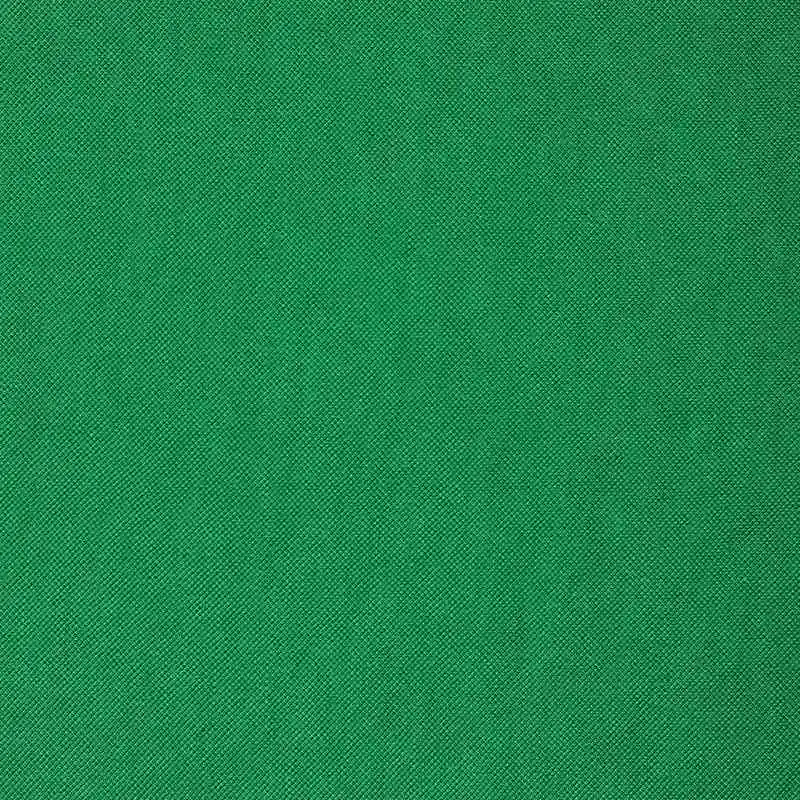
Product Overview: What Is Double-Sided Mesh for Pants Fabric?
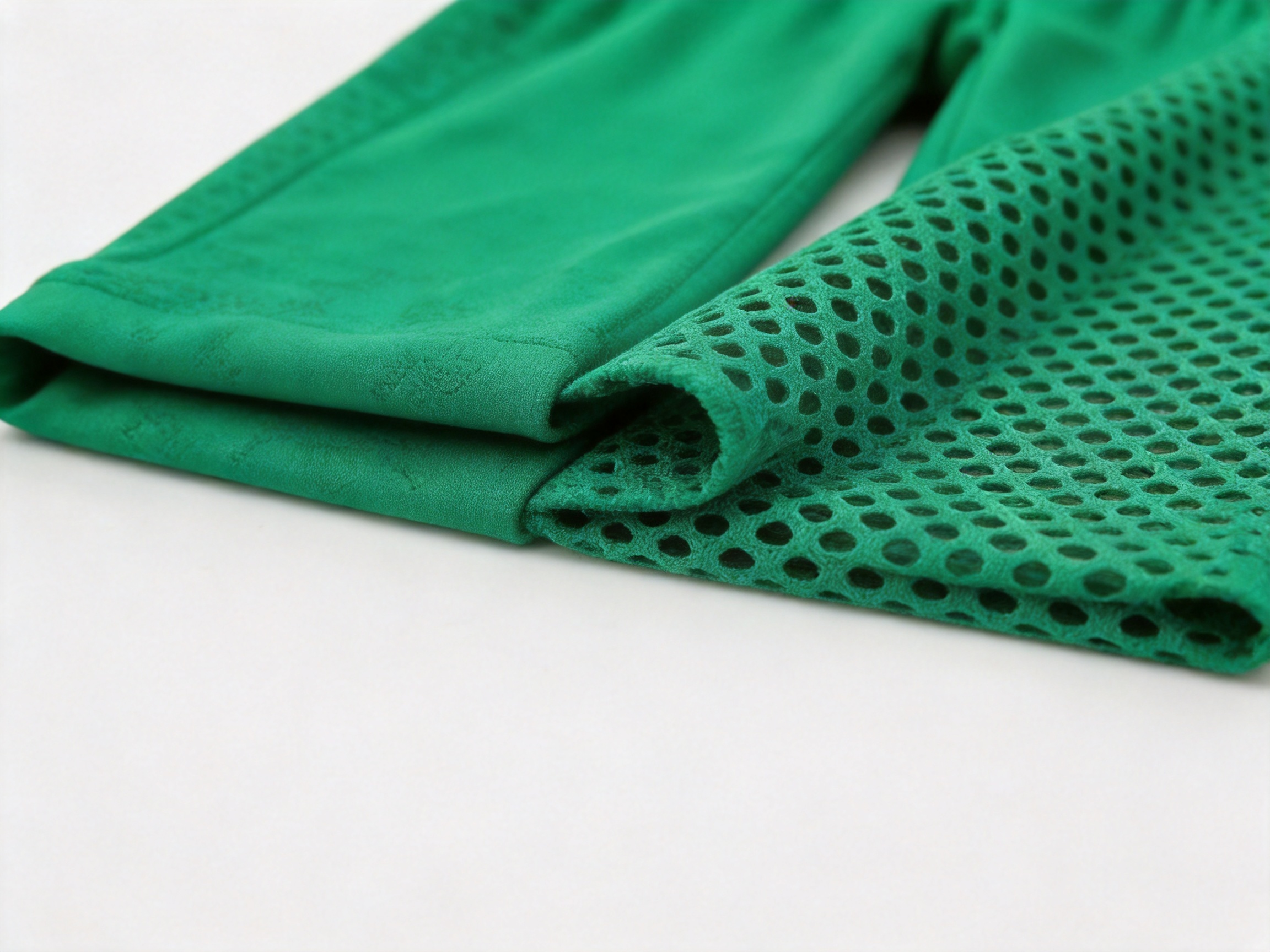
Double-sided mesh for pants fabric is a knitted jacquard textile that has two usable face sides. Unlike ordinary single-face knitted fabrics, which are designed with one primary surface and one technical back side, a double-sided construction can present a clean, attractive, and functional appearance on both surfaces. This makes it especially valuable when designers want reversible garments, contrast details, folded edges, cuffs, waistbands, pocket structures, or panels that reveal the opposite side as a design element.
The fabric belongs to the NR knitted fabric category and is produced through a jacquard knitting method. Jacquard technology allows patterns, mesh effects, textures, and structural variations to be built directly into the fabric rather than printed only on the surface. This gives the material a richer hand feel, better durability of pattern expression, and improved styling potential. For pants fabric, this matters because the material is constantly moving, stretching, rubbing, and recovering during daily activity.
The double-sided mesh character provides breathability and a visually refined texture. Mesh does not necessarily mean thin or fragile; in a well-engineered knitted fabric, mesh structures can be designed to manage air flow while maintaining strength and coverage. This is important for pants because the fabric must not be transparent in normal use, yet should still provide ventilation and comfort. When the yarn count, knitting density, jacquard pattern, and finishing process are properly controlled, double-sided mesh can offer both coverage and comfort.
The fabric is especially suitable for body-hugging styles. Body-hugging garments require elasticity, recovery, smooth contact, and a stable surface. If a fabric stretches but does not recover, pants can bag at the knees, sag at the seat, or lose shape after wear. If a fabric is stiff or abrasive, it can feel uncomfortable during motion. Double-sided knitted jacquard fabric is designed to address these concerns by combining knitted flexibility with structured pattern stability.
Why Double-Sided Construction Matters for Pants
Pants place unique mechanical demands on fabric. The knees bend repeatedly, the seat area experiences pressure and stretching, the waistband must maintain shape, and the inner thigh areas face friction. In many garments, ordinary fabrics may look good at first but lose form after repeated movement. A double-sided knitted construction helps improve the overall balance of fabric behavior because both surfaces are intentionally formed, not treated as a hidden technical side.
One key benefit is reversible usability. Designers can use either side as the visible surface, which reduces limitations in design development. A garment may use one side for the main body and the other side for side panels, decorative inserts, turn-up hems, waistbands, or pocket details. This helps create contrast without requiring an additional fabric. For apparel manufacturers, using one fabric in multiple visual ways can simplify sourcing and improve production efficiency.
Another benefit is fabric balance. In some single-faced structures, tension may differ between the front and back, increasing the risk of curling, twisting, or uneven shrinkage. A double-sided structure can help balance the fabric if the knitting process and finishing conditions are properly managed. Balanced fabric is easier to cut, sew, and assemble, which reduces waste in garment factories.
Double-sided mesh also supports better tactile comfort. Because both sides are designed as face surfaces, the inner side that touches the skin can be smoother, cleaner, and more comfortable than the rougher back side of some decorative fabrics. For pants, this is especially important because the garment remains in contact with the body for long periods. Comfort is not only a luxury; it affects whether consumers choose to wear the garment frequently.
Core Advantages Over Ordinary Competing Fabrics
Compared with standard single jersey, plain rib, ordinary mesh, or basic printed knits, double-sided mesh for pants fabric provides a stronger combination of appearance, function, and production adaptability. Its advantages are especially clear in categories where garments must satisfy both fashion and performance expectations.
First, the fabric offers greater design flexibility. A printed fabric can show color or pattern, but the visual effect remains mostly surface-based. A jacquard knitted mesh fabric builds texture and pattern into the fabric structure itself. This creates depth and durability. The pattern does not depend entirely on a coating or print layer, so it can better maintain its character through wear and washing.
Second, the fabric supports reversible styling. Competitors using ordinary single-face fabric usually need lining, facing, or additional contrast materials to achieve a similar two-sided effect. Double-sided mesh can reduce fabric complexity and support cleaner design. This can be advantageous for brands seeking streamlined product development and distinctive garment details.
Third, the fabric is well suited to body-hugging silhouettes. Pants used for casual wear, yoga-inspired fashion, athletic leisure, or fitted everyday trousers need stretch comfort and shape stability. Double-sided knitted jacquard fabric can be engineered to provide controlled flexibility without feeling loose or flimsy. This makes it more suitable than woven fabrics that lack elasticity or ordinary low-density knits that may deform.
Fourth, the fabric provides breathability through mesh structure. Pants fabric cannot simply be heavy and dense; consumers expect comfort across different climates and activity levels. The mesh feature helps air movement and moisture comfort while the jacquard knit preserves structure. This combination gives the fabric a competitive advantage over compact synthetic knits that may feel hot or sticky.
Fifth, the fabric can improve manufacturing efficiency. A stable double-sided knit can reduce curling during cutting, improve sewing handling, and allow designers to use both surfaces creatively. When sourced from a manufacturer with integrated yarn, knitting, dyeing, finishing, and inspection capabilities, buyers can also benefit from more consistent production control.
Product Performance Table
| Feature | Performance Value | Benefit for Pants Manufacturing |
|---|---|---|
| Double-sided construction | Both sides can function as face surfaces | Supports reversible details, contrast panels, folded hems, and flexible garment design |
| Knitted jacquard structure | Pattern and texture are built into the fabric | Improves visual depth and durability compared with surface-only decoration |
| Mesh effect | Allows controlled air flow and lighter comfort | Helps reduce stuffiness in fitted pants and athleisure garments |
| NR knitted fabric category | Designed for practical knitted apparel applications | Suitable for pants, fitted bottoms, casual wear, and fashion sportswear |
| Body-hugging suitability | Flexible, comfortable, and shape-supportive | Helps garments move with the body while retaining appearance |
| Integrated manufacturing support | Yarn processing, knitting, dyeing, finishing, and inspection can be coordinated | Improves consistency, delivery reliability, and customization potential |
Material Engineering and Yarn Foundation
The performance of any knitted fabric begins with yarn. If yarn quality is unstable, even advanced knitting equipment cannot fully correct irregularities. For double-sided mesh for pants fabric, yarn selection and preparation influence elasticity, surface smoothness, strength, dyeing uniformity, and hand feel. Polyester yarn, blended yarn, and related DTY polyester yarn technologies are important because they can support both durability and comfort.
Drawn textured yarn, commonly known as DTY, is widely used in knitted fabrics because it offers bulk, elasticity, and a softer feel compared with flat filament yarn. Texturing gives the yarn crimp and volume, allowing the fabric to feel fuller and more comfortable. For pants fabric, DTY polyester yarn can contribute to resilience, wrinkle resistance, and dimensional stability. It also supports consistent dyeing when properly processed.
Slight intermingled drawn textured yarn can be especially useful in fabric production because intermingling helps hold filaments together, improving yarn handling during knitting. This can reduce filament breakage, improve knitting stability, and contribute to a smoother fabric surface. Intermingling must be controlled carefully: too little may lead to poor cohesion, while too much may affect softness and fabric drape. A skilled manufacturer manages this balance according to the intended fabric style.
Blended fabric production also provides opportunities to fine-tune properties. Polyester may contribute strength and durability, rayon can improve softness and moisture comfort, and spandex can enhance stretch and recovery when used in appropriate constructions. The exact blend and structure depend on the buyer’s requirements, target garment category, cost position, and finishing expectations. The benefit of integrated production is that yarn and fabric parameters can be adjusted together rather than treated as separate problems.
Advanced Knitting Process
Knitting is the stage where the fabric’s identity is formed. For double-sided knitted jacquard fabric, the knitting process must create two functional surfaces while maintaining balanced tension, consistent pattern definition, and stable mesh formation. This requires appropriate machine selection, technical pattern setting, yarn feeding control, needle management, and continuous inspection during production.
Jacquard knitting allows selective loop formation and texture control. Instead of producing a simple plain surface, the machine can create patterned areas, mesh openings, relief textures, and contrasting structures. In a double-sided fabric, the technical challenge is greater because both surfaces must meet visual and functional standards. The reverse side cannot be neglected, since it may become the outside of the garment or appear in folded details.
Machine parameters such as gauge, yarn tension, stitch length, take-down tension, and production speed affect the final fabric. If stitch length is too loose, the fabric may lack stability; if it is too tight, the fabric may feel rigid and lose comfort. If tension varies, the mesh pattern may appear uneven or the fabric may skew. Skilled technicians monitor and adjust these factors to match the required specification.
For pants applications, knitting density must be carefully planned. A fabric that is too open may lack coverage, while a fabric that is too compact may lose breathability. The goal is to combine controlled mesh ventilation with enough opacity and body to support garment construction. This is one of the main reasons why double-sided mesh for pants fabric should be sourced from a manufacturer experienced in both yarn behavior and knitted fabric performance.
Dyeing and Color Consistency
Dyeing is more than adding color. It determines shade accuracy, color fastness, fabric hand, and commercial consistency between production lots. In pants manufacturing, color consistency is particularly important because panels are cut and assembled together; shade variation can become obvious in finished garments. Buyers also require repeatable colors for reorders and seasonal programs.
Polyester-based materials typically require disperse dyeing under controlled temperature and pressure conditions. If rayon or other fibers are included in a blended fabric, dye selection and process design must account for different fiber dyeing behaviors. A reliable dyeing process requires accurate recipe control, water quality management, temperature stability, proper leveling agents when needed, and systematic after-treatment.
For double-sided jacquard fabric, dyeing must preserve pattern clarity and maintain a balanced hand on both surfaces. Over-processing can make the fabric harsh, while insufficient treatment may result in poor fastness or uneven shade. Since pants are frequently washed and exposed to friction, color fastness to washing and rubbing is an important performance requirement. Good dyeing control helps the fabric remain attractive after repeated wear.
Post-dyeing quality checks should include shade matching, width measurement, weight testing, shrinkage evaluation, and surface inspection. When a manufacturer integrates dyeing and finishing with fabric production, communication between departments can reduce delays and help correct issues efficiently. This integration is a practical strength for wholesale fabric buyers who need stable quality and predictable delivery.
Finishing Process and Hand Feel Development
Finishing transforms knitted fabric from a raw greige material into a finished textile ready for garment production. For double-sided mesh for pants fabric, finishing must achieve the desired hand feel, dimensional stability, width, weight, appearance, and surface condition. It is one of the most important stages for converting structural potential into commercial value.
Heat setting is often important for polyester and spandex-containing knitted fabrics. It helps stabilize dimensions, control shrinkage, set width, and reduce deformation. If heat setting is poorly controlled, fabric may become unstable during washing or garment production. If temperatures are too high or exposure is excessive, elasticity and hand feel may be affected. Therefore, finishing technicians must control temperature, speed, overfeed, and tension carefully.
Softening treatments can improve touch and wear comfort. Pants fabric must feel pleasant against the skin, especially when used for fitted garments. However, softeners must be selected and applied with care. Excessive softening may reduce moisture management, affect sewing performance, or cause surface issues. The goal is to create a smooth, comfortable hand without sacrificing stability.
Compacting or relaxation processes may be used to reduce residual shrinkage and improve fabric balance. Knitted fabrics naturally contain internal tensions from knitting, dyeing, and finishing. Controlled relaxation helps the fabric achieve a more stable state before cutting. This improves garment size consistency and reduces customer complaints related to shrinkage or twisting after washing.
Surface finishing may also enhance the appearance of the jacquard mesh structure. The fabric should look clean, even, and refined on both sides. Since both surfaces can be visible in garment designs, inspection must be stricter than for fabrics with only one important face side. A well-finished double-sided fabric communicates quality immediately through its touch, drape, and visual regularity.
Manufacturing Strengths Behind the Fabric
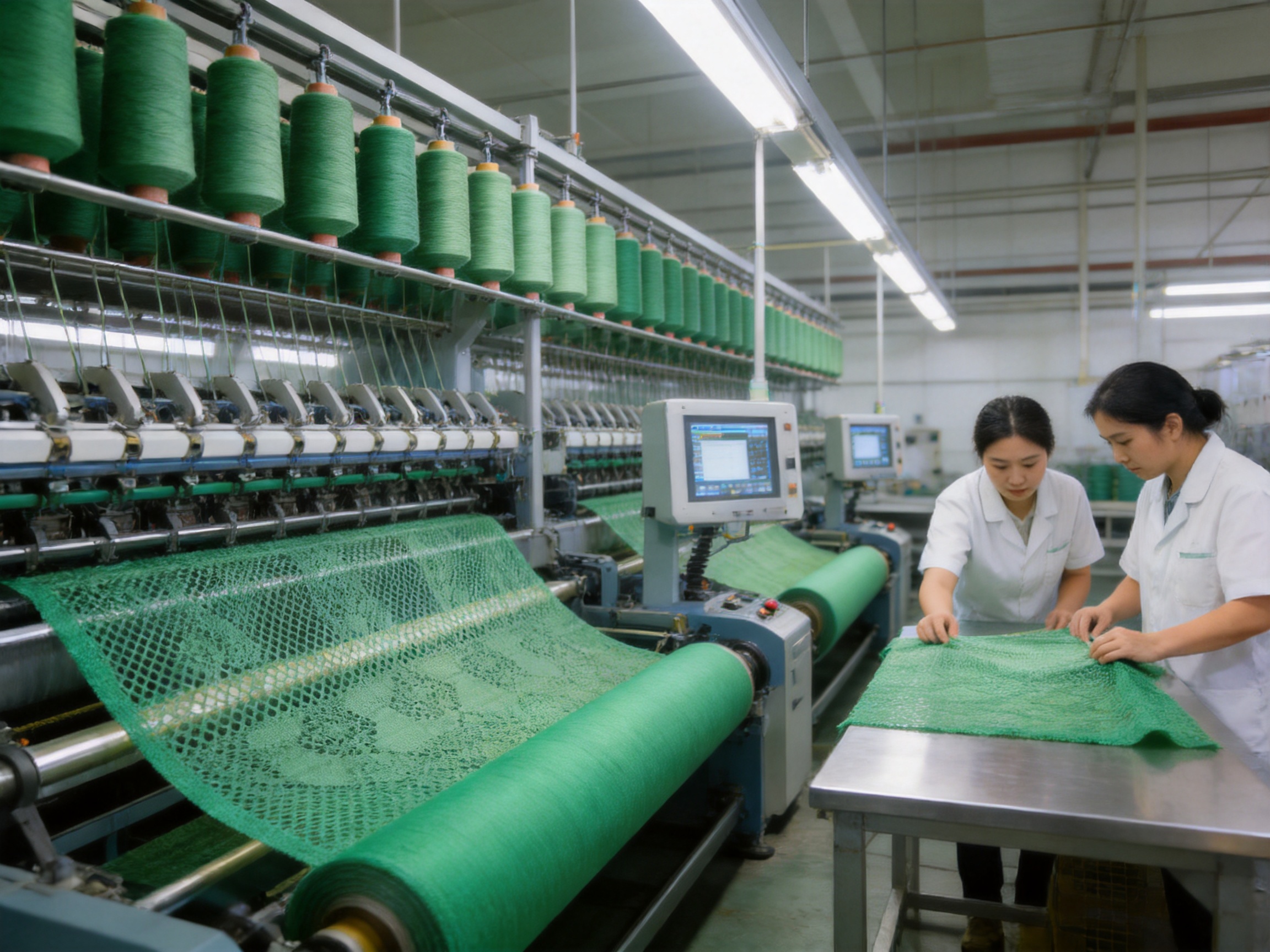
Hangzhou Jinfeng Textile Co., Ltd. has manufacturing strengths that support the development and supply of double-sided mesh for pants fabric. The company’s production scope includes polyester, spandex, and blended fabric processing, post-dyeing, finishing, and sales, as well as DTY polyester yarn production, processing, and sales. This combination allows the company to connect yarn quality with fabric performance rather than depending entirely on outside coordination.
The company is located in Jingjiang Street Industrial Park, Xiaoshan District, Hangzhou City, Zhejiang Province. Its production base covers 32.6 acres, with a plant area of around 18,000 square meters. This production scale supports organized manufacturing, storage, equipment placement, inspection, and order management. For fabric buyers, factory scale matters because it affects production capacity, process control, and the ability to handle repeat orders.
Integrated operations from research and development to production and sales help shorten communication paths. When buyers request adjustments in weight, width, texture, color, softness, or pattern, technical teams can evaluate the request through both yarn and fabric perspectives. This is especially valuable for jacquard knitted fabrics, where a small change in yarn or stitch setting can significantly affect the final result.
The company’s export-oriented business model also supports international buyers. Export supply requires attention to packaging, documentation, quality consistency, and communication. Fabric buyers outside China often need clear specifications, sample confirmation, production tracking, and stable after-sales service. A manufacturer accustomed to export business can better support these requirements.
The business philosophy of cooperation and mutual benefit is relevant in textile sourcing because fabric development is often collaborative. Buyers may begin with a concept, sample, or performance target, and the supplier must translate that idea into a producible textile. A cooperative manufacturer can help refine specifications, suggest practical alternatives, and provide stable production after approval.
Applications in Pants and Fashion Bottoms
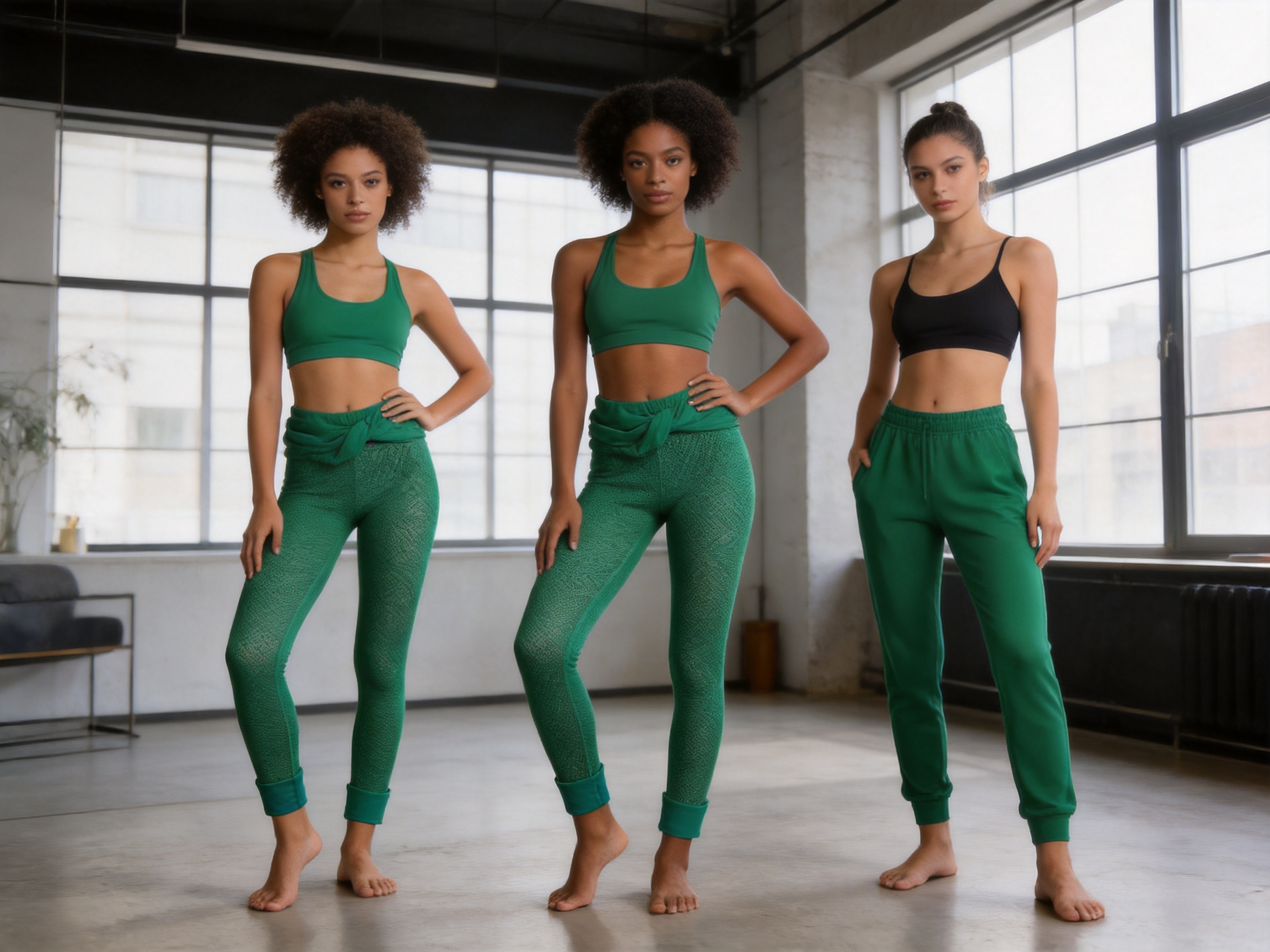
Double-sided mesh for pants fabric is especially suitable for garments where movement, comfort, and style must coexist. It can be used in body-hugging pants, athleisure bottoms, fitted casual pants, leggings-style garments, sports-inspired trousers, fashion joggers, dancewear bottoms, and modern knit pants. Its reversible character also makes it suitable for creative details and multi-surface garment designs.
For fitted pants, the fabric’s knitted structure supports movement. Consumers expect such garments to stretch when sitting, walking, bending, or exercising. At the same time, they expect the garment to recover without sagging. A well-made double-sided knit helps meet this requirement through balanced structure and controlled finishing.
For athleisure garments, the mesh effect provides breathability while the jacquard structure adds style. Athleisure consumers often want clothing that looks fashionable enough for daily wear but remains comfortable enough for light activity. Double-sided mesh fabric fits this trend because it can look technical, textured, and modern without sacrificing comfort.
For fashion pants, reversible surfaces create design opportunities. Designers can use one side as the main appearance and reveal the other side at waistbands, cuffs, slits, side seams, overlays, or pocket edges. This can create a premium look while reducing the need for multiple fabrics. It also supports minimalist production planning because a single material can deliver more than one visual effect.
For homewear and casual bottoms, comfort is the main selling point. The fabric’s softness, breathability, and stretch suitability can create garments that are pleasant for long periods of wear. Consumers increasingly expect homewear to look refined rather than purely functional. A textured double-sided jacquard knit can provide that improved visual value.
Design Freedom Created by Reversible Surfaces
One of the most distinctive benefits of double-sided mesh for pants fabric is its ability to support reversible or contrast design. In conventional fabric sourcing, designers often need to purchase separate contrast fabric for decorative elements. This increases inventory complexity, matching difficulty, and production management work. With a double-sided fabric, both surfaces can become part of the design language.
A designer may choose the smoother side for the outer surface and use the more textured side for waistband details. Another designer may use the mesh-dominant side for outer panels and the contrasting side for inner fold-backs. The fabric can also support reversible garments if the sewing construction is designed accordingly. Even when the full garment is not reversible, local reversible features can add value.
This freedom is useful for brands that want signature details without complicated supply chains. A garment can appear more thoughtfully designed when the inside surface is attractive. Consumers often notice the quality of hidden or semi-hidden areas, such as the inside of cuffs or the reverse of a pocket flap. When both sides of the material look intentional, the garment feels more premium.
Reversible surfaces also reduce waste in sampling. During development, designers can test multiple appearances using the same fabric sample. This helps accelerate decision-making and reduces the need to source many separate materials. For small and medium brands, this flexibility can be commercially valuable.
Comfort, Breathability, and Wear Experience
Comfort is one of the strongest selling points of knitted pants fabric. Consumers may admire a garment on the hanger, but they repurchase or recommend it only when it feels good during real use. Double-sided mesh for pants fabric addresses comfort through several mechanisms: knitted flexibility, balanced surface feel, controlled mesh breathability, and suitable finishing.
The knitted construction allows the fabric to adapt to body movement. Unlike rigid woven fabrics, knits can extend through loop deformation. This creates natural ease and reduces restriction. For pants, this is important in the knees, hips, and waist area. A fabric that moves with the wearer improves both comfort and fit.
Breathability is supported by the mesh effect. Air flow helps reduce heat buildup, especially in close-fitting garments. While breathability depends on actual density, yarn type, garment construction, and finishing, a mesh-oriented jacquard structure provides a clear advantage over dense compact fabrics. This makes the material suitable for consumers who want pants that can be worn in multiple daily settings.
The double-sided surface also improves skin contact. Since either side can be used as the face, the inner surface of the garment can be selected for comfort. Designers can choose the side that feels smoother against the body or use construction methods that place the preferred texture inside. This level of choice is a practical advantage over fabrics with a rough technical back.
Durability and Shape Retention
Pants fabric must resist daily stress. Sitting, walking, stretching, laundering, and friction all challenge fabric durability. Double-sided knitted jacquard fabric can provide better shape support than many lightweight ordinary knits because the structure has more engineering depth. When produced with quality yarn and proper finishing, it can maintain a stable appearance through normal use.
Shape retention depends on yarn elasticity, stitch structure, heat setting, and relaxation control. If spandex is included, its quality and setting conditions are critical. If polyester DTY is used, its crimp stability and texturing quality affect resilience. Jacquard structure can also influence recovery because different loop arrangements respond differently to tension. A capable manufacturer evaluates these factors together.
A durable pattern is another advantage. Printed patterns may fade, crack, or wear depending on print technology and usage. In jacquard fabric, the pattern comes from the knitted structure itself. While color and surface can still change with wear, the texture remains part of the fabric. This creates a more lasting decorative effect.
Resistance to pilling and abrasion must also be considered. Pants experience rubbing between the thighs and against seats. Yarn selection, fabric density, finishing, and surface smoothness all affect pilling. A manufacturer with experience in polyester and blended fabric finishing can optimize surface feel while controlling excessive fuzziness.
Quality Control for Wholesale Buyers
Wholesale buyers need reliable quality, not only attractive samples. A sample can look excellent, but bulk fabric must match approved standards in shade, width, weight, hand feel, stretch, shrinkage, and appearance. For double-sided mesh for pants fabric, inspection must cover both surfaces and confirm that the jacquard pattern remains consistent throughout the roll.
Important quality checks include fabric weight measurement, width measurement, shade evaluation, color fastness testing, shrinkage testing, skew and bow assessment, stretch and recovery testing, surface defect inspection, and roll packing inspection. For pants applications, stretch recovery and dimensional stability are especially important because they influence finished garment fit.
Inspection should also identify defects such as broken needles, dropped stitches, yarn contamination, uneven mesh, oil stains, dye spots, color streaks, crease marks, holes, and finishing marks. Since the fabric is double-sided, defects on either side may affect usability. This requires careful roll inspection under suitable lighting.
Quality control should begin before knitting. Yarn inspection helps prevent downstream defects. During knitting, operators monitor machine performance and fabric formation. During dyeing and finishing, technicians control process parameters. Final inspection confirms that the fabric meets commercial requirements. This layered quality system is more effective than relying only on final inspection.
Comparison With Alternative Pants Fabrics
Many fabrics can be used for pants, but each has limitations. Woven fabrics such as twill or plain weave can provide structure but may lack stretch unless elastane is added. Single jersey knits are soft and flexible but may curl, distort, or appear too casual. Ordinary mesh fabrics can be breathable but may lack coverage or stability. Printed knits can provide pattern but may not offer structural texture. Double-sided mesh for pants fabric fills a valuable middle position by combining texture, breathability, reversibility, and knitted comfort.
Against standard single jersey, double-sided jacquard mesh offers a more premium appearance and more design options. It is less limited by the plain look of basic jersey and can provide a more structured hand. Against ordinary rib fabric, it offers more pattern flexibility and a more technical fashion appearance. Against woven stretch fabric, it provides softer knitted comfort and better adaptability to body movement. Against basic mesh, it provides better garment suitability because it is designed for pants rather than only ventilation panels.
The competitive advantage is not based on one single property but on the combination of properties. Apparel brands often seek materials that solve multiple problems at once: visual appeal, comfort, sewing practicality, and durability. Double-sided mesh for pants fabric is valuable because it addresses all these areas together.
Customization Potential
Fabric buyers often require customization to match their brand identity and garment category. Double-sided knitted jacquard fabric can be developed in different patterns, weights, textures, colors, and finishing styles. Mesh size, pattern density, hand feel, width, and elasticity can be adjusted according to technical feasibility. This makes the fabric suitable for both fashion and functional product lines.
Customization may begin with yarn selection. Different yarn types and blends can create different touch, drape, recovery, and dyeing effects. Polyester DTY can support resilience and durability, rayon blends can improve softness, and spandex can improve stretch. The appropriate choice depends on the target garment.
Jacquard pattern development is another customization area. Designers may request geometric textures, subtle mesh patterns, contrast effects, or more expressive reversible designs. Technical teams translate these ideas into knitting structures. A good development process balances creativity with production stability, because a beautiful pattern must still be efficient and reliable in bulk production.
Finishing can also be customized. Some buyers may prefer a soft hand for casual pants, while others may want a firmer hand for structured fashion bottoms. Color can be developed according to seasonal palettes. Shrinkage and width requirements can be controlled through finishing specifications. The best results come from clear communication between buyer and manufacturer during sampling.
Sewing and Garment Production Benefits
Fabric performance in the garment factory is just as important as fabric appearance. A fabric that is difficult to cut or sew increases production cost and defect rates. Double-sided mesh for pants fabric can offer practical garment manufacturing benefits when properly finished and stabilized.
Balanced double-sided construction can help reduce edge curling compared with some single-face knits. Less curling makes cutting and sewing easier. It also improves accuracy when matching panels or assembling details. For pants, where symmetry and fit are important, stable fabric handling can reduce garment defects.
The fabric’s reversible surfaces can reduce the need for lining or separate contrast materials in some designs. This simplifies material management and can reduce the number of fabric types required in production. It may also reduce the risk of mismatch between main fabric and trim fabric.
When sewing stretch knits, needle choice, thread type, seam construction, and machine settings must be appropriate. The fabric should be tested for seam strength, seam appearance, and recovery. A manufacturer can support buyers by providing fabric specifications and sample yardage for garment testing before bulk production.
Market Value for Apparel Brands
Apparel brands compete in a market where consumers expect more value from every garment. Pants must look fashionable, fit well, feel comfortable, and survive repeated use. Double-sided mesh for pants fabric provides a strong material story that brands can translate into product benefits: reversible design potential, breathable comfort, jacquard texture, and flexible wearability.
The fabric is especially relevant to the growth of athleisure and casual performance fashion. Consumers increasingly wear garments across multiple settings: home, work-from-home, travel, light exercise, shopping, and social occasions. A pants fabric that combines comfort with visual structure is well positioned for this lifestyle shift.
For brands, material differentiation is a way to avoid competing only on price. A basic fabric can be easily copied and compared, but a double-sided jacquard mesh structure provides a more distinctive product identity. When combined with thoughtful garment design, it can help brands create collections that feel modern and valuable.
For wholesalers and garment manufacturers, the fabric offers flexibility across product categories. It can be used in multiple styles, reducing the need to develop separate materials for each garment. This can improve purchasing efficiency and support repeat programs.
Sustainability and Responsible Production Considerations
Sustainability in textiles includes material efficiency, process control, durability, and responsible manufacturing management. While the environmental profile of a fabric depends on many specific factors, double-sided mesh for pants fabric can support sustainability goals in several practical ways.
First, reversible usability can reduce the need for multiple fabrics in one garment. If one fabric can provide both main and contrast surfaces, designers may reduce material complexity and inventory waste. Second, durable jacquard texture can extend garment appeal because the pattern is structurally integrated rather than dependent only on surface decoration. Longer-lasting garments can help reduce replacement frequency.
Third, stable manufacturing processes reduce waste. Defects in knitting, dyeing, and finishing create unusable fabric, which wastes yarn, energy, water, and labor. A manufacturer with integrated process control can improve first-quality output and reduce reprocessing. Fourth, accurate development reduces sampling waste by helping buyers reach approved specifications more efficiently.
Responsible production also includes consistent quality and honest communication. Buyers need realistic information about fabric performance, care requirements, and limitations. A strong supplier helps customers choose the right fabric for the right application rather than overpromising. This contributes to more successful garments and fewer returns.
Care and Maintenance Guidance
Finished garment care instructions should always be confirmed according to the final fiber content, dyeing process, finishing treatment, and garment construction. However, several general care principles apply to many polyester-based and blended knitted pants fabrics. Gentle washing, moderate temperature, mild detergent, and avoidance of harsh bleaching can help preserve color and hand feel. Excessive heat should be avoided when spandex or heat-sensitive finishes are present.
Garments made from double-sided mesh fabric should be washed with similar colors, especially in dark or vivid shades. Turning garments inside out may help reduce surface abrasion during laundering. Low-temperature drying or line drying is often safer than high-heat tumble drying, depending on the final specification. Ironing, if needed, should be performed at an appropriate temperature and preferably tested first.
Because the fabric has textured jacquard surfaces, care should also reduce snagging risk. Washing with sharp accessories, hook fasteners, or rough items may damage the mesh or loops. Garment brands can improve customer satisfaction by providing clear care labels and consumer guidance.
Why Choose This Fabric for Pants Development?
Double-sided mesh for pants fabric is a smart choice when a garment needs to combine style, comfort, and function. It is not merely a decorative textile; it is an engineered knitted material designed to support real movement and practical apparel manufacturing. Its two face sides give designers freedom, its jacquard structure adds visual depth, and its mesh effect improves breathability.
Compared with many competing fabrics, it offers a more complete performance package. It is more versatile than ordinary single-face knits, more comfortable than many rigid woven materials, more structured than basic mesh, and more durable in pattern expression than surface-only decoration. These advantages make it suitable for brands that want to create pants with a premium feel and modern appearance.
The company’s manufacturing strengths further support the product’s value. With experience in DTY polyester yarn, blended fabrics, knitting, dyeing, finishing, and export-oriented sales, Hangzhou Jinfeng Textile Co., Ltd. can help buyers turn design concepts into practical bulk fabric. Its integrated production base and commitment to cooperation provide a strong foundation for reliable supply.
Q&A Section
What is double-sided mesh for pants fabric?
It is a double-sided knitted jacquard fabric designed with two usable face sides. The fabric can be used in pants and related garments where comfort, texture, breathability, and reversible design potential are important.
Why is the fabric suitable for body-hugging pants?
The knitted structure allows flexibility and movement, while the jacquard construction helps maintain a stable and attractive surface. When properly finished, the fabric can support comfort, fit, and shape retention in close-fitting garments.
Can both sides of the fabric be used in garment design?
Yes. One of the main advantages is that both sides can function as face surfaces. Designers can use either side as the main surface or combine both sides in waistbands, cuffs, panels, hems, pockets, or reversible details.
How does jacquard knitting improve the fabric?
Jacquard knitting builds pattern and texture directly into the fabric structure. This provides visual depth, improves durability of the design effect, and creates more advanced styling possibilities than plain or surface-printed fabrics.
Is the mesh structure transparent?
Mesh appearance does not automatically mean the fabric is overly transparent. Coverage depends on yarn, density, pattern, color, and finishing. For pants applications, the structure should be engineered to balance breathability with adequate coverage.
What advantages does this fabric have over ordinary single jersey?
It offers better design versatility, two usable surfaces, richer texture, potentially improved balance, and a more premium appearance. Single jersey is comfortable but often lacks the reversible and structural design features of double-sided jacquard mesh.
What role does DTY polyester yarn play?
DTY polyester yarn can provide bulk, resilience, softness, and durability. It supports knitted fabric performance by improving stretch comfort, shape stability, and surface quality when properly processed.
Can the fabric be customized?
Yes. Pattern, texture, color, width, weight, hand feel, and yarn composition may be customized according to technical feasibility and order requirements. Sampling is recommended before bulk production.
What quality tests are important for this fabric?
Important tests include fabric weight, width, shade consistency, shrinkage, color fastness, stretch and recovery, skew, bow, pilling tendency, abrasion behavior, and inspection of both fabric surfaces.
What types of garments can use this fabric besides pants?
It can be used for leggings-style garments, joggers, athleisure bottoms, dancewear, fitted casual wear, fashion sportswear, and selected homewear or decorative apparel applications where reversible knitted texture is valuable.
Conclusion
Double-sided mesh for pants fabric represents a strong combination of technical knitting and practical apparel value. Its double-sided jacquard construction gives designers two usable surfaces, while its mesh character supports comfort and breathability. For pants, where stretch, recovery, durability, and appearance are all important, this fabric provides a compelling alternative to ordinary knits, basic mesh, and rigid woven materials.
The fabric’s advantages become even stronger when supported by advanced manufacturing processes. Yarn preparation, jacquard knitting, dyeing, finishing, inspection, and export supply management all influence final quality. Hangzhou Jinfeng Textile Co., Ltd. brings together DTY polyester yarn production, blended fabric manufacturing, post-dyeing, finishing, and sales capabilities, allowing it to provide stable fabric solutions for buyers seeking reliable wholesale supply.
For apparel brands, garment factories, and textile buyers, double-sided mesh for pants fabric offers more than a material choice. It offers a platform for modern pants design: comfortable, breathable, stylish, reversible, and suitable for body-conscious silhouettes. In a market where consumers demand both function and fashion, this fabric provides a clear path toward garments that stand out and perform well.
References
Spencer, D. J. Knitting Technology: A Comprehensive Handbook and Practical Guide. Woodhead Publishing.
Hearle, J. W. S., Hollick, L., and Wilson, D. K. Yarn Texturing Technology. Woodhead Publishing.
Horrocks, A. R., and Anand, S. C. Handbook of Technical Textiles. Woodhead Publishing.
Sinclair, R. Textiles and Fashion: Materials, Design and Technology. Woodhead Publishing.
Gohl, E. P. G., and Vilensky, L. D. Textile Science. Longman Cheshire.
Collier, B. J., and Epps, H. H. Textile Testing and Analysis. Pearson.