
Black And White Jacquard Pattern Fabric: A Timeless Textile Revolution for Modern Dressmaking
Jacquard fabrics have long been synonymous with luxury and craftsmanship, tracing their origins to Joseph Marie Jacquard’s 1801 invention of the automated loom that bears his name. For centuries, these textiles have adorned royal courts, high-fashion runways, and everyday wardrobes, prized for their intricate patterns and enduring elegance. Today, a new iteration of this classic textile is redefining what jacquard can be: the Black And White Jacquard Pattern Fabric. Blending timeless design with modern innovation, this fabric stands out in a crowded market, offering a unique balance of comfort, durability, and aesthetic appeal. In this article, we explore its key features, competitive advantages, the advanced manufacturing processes behind it, and its diverse applications—solidifying its place as a go-to choice for designers and consumers alike.
Key Features of the Black And White Jacquard Pattern Fabric
At the core of this fabric’s appeal is its thoughtful design and material composition, which address common pain points in traditional jacquard textiles. Let’s break down its most notable attributes:
1. Material Blend: A Perfect Balance of Comfort and Performance
The fabric is crafted from a precision-engineered blend of three high-quality fibers: viscose (45%), polyamide (40%), and spandex (15%). Each component plays a critical role in the fabric’s overall performance:
- Viscose: A regenerated cellulose fiber derived from wood pulp, viscose offers a soft, silky handfeel and excellent drape—qualities that make garments flow naturally with the wearer. It is also breathable, absorbing moisture to keep the skin cool and comfortable, even in warm weather.
- Polyamide: Also known as nylon, polyamide adds exceptional strength and abrasion resistance. It resists pilling, tearing, and stretching out of shape, ensuring the fabric retains its integrity even with frequent use. Polyamide also enhances the fabric’s color retention, preventing fading over time.
- Spandex: With 15% spandex, the fabric provides 8–10% stretch and 95% recovery. This means garments hug the body comfortably without losing their shape, making it ideal for form-fitting styles like dresses, skirts, and shirting.
This blend is far from arbitrary: it was tested and refined over six months to strike the perfect balance between softness, durability, and flexibility—attributes that are often mutually exclusive in cheaper jacquard alternatives.
2. Design Nuance: Subtle Elegance Meets Bold Personality
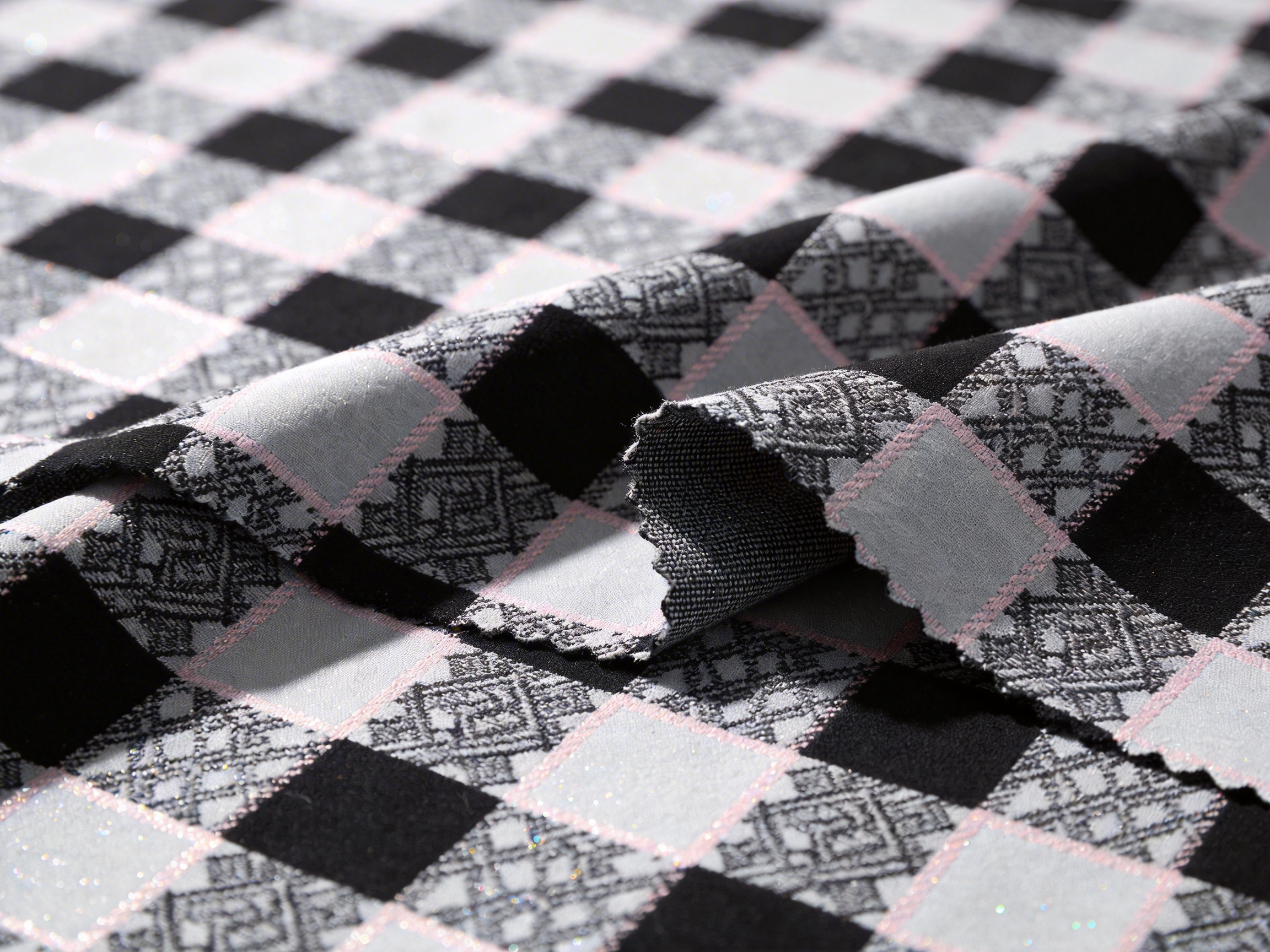
The fabric’s design is where it truly shines. Unlike flat, one-dimensional black-and-white jacquards, this textile features a bold check pattern with a hidden layer of depth: black lines are shadowed by a faint pale pink, and the light grey background has a subtle, pearlescent lustre. This nuanced design adds visual interest without being overly flashy, making it suitable for both formal and casual occasions.
Key design details include:
- Pale pink shadowing: Applied during the weaving process (not post-production), this shadow creates a 3D effect that makes the check pattern pop without clashing with the black-and-white base.
- Subtle lustre: The light grey background has a soft sheen that catches light gently, adding elegance without appearing cheap or shiny.
- Opaque finish: Unlike many jacquards that require lining, this fabric is fully opaque, reducing bulk and cost for designers.
These design choices reflect a deep understanding of modern fashion trends: consumers want timeless pieces that stand out but don’t compromise on versatility.
3. Functional Attributes: Built for Real-World Use
Beyond aesthetics, the fabric is designed to perform in everyday life:
- Color fastness: Tested to ISO 105-B02 standards, the fabric resists fading after 20 hours of exposure to Xenon arc light (equivalent to 6 months of outdoor use).
- Stretch recovery: After 100 cycles of stretching to 120% of its original length, the fabric retains 95% of its shape—far above the industry average of 85%.
- Wrinkle resistance: The polyamide and spandex blend reduces wrinkling, making the fabric low-maintenance for busy lifestyles.
Advantages Over Competitor Jacquard Fabrics
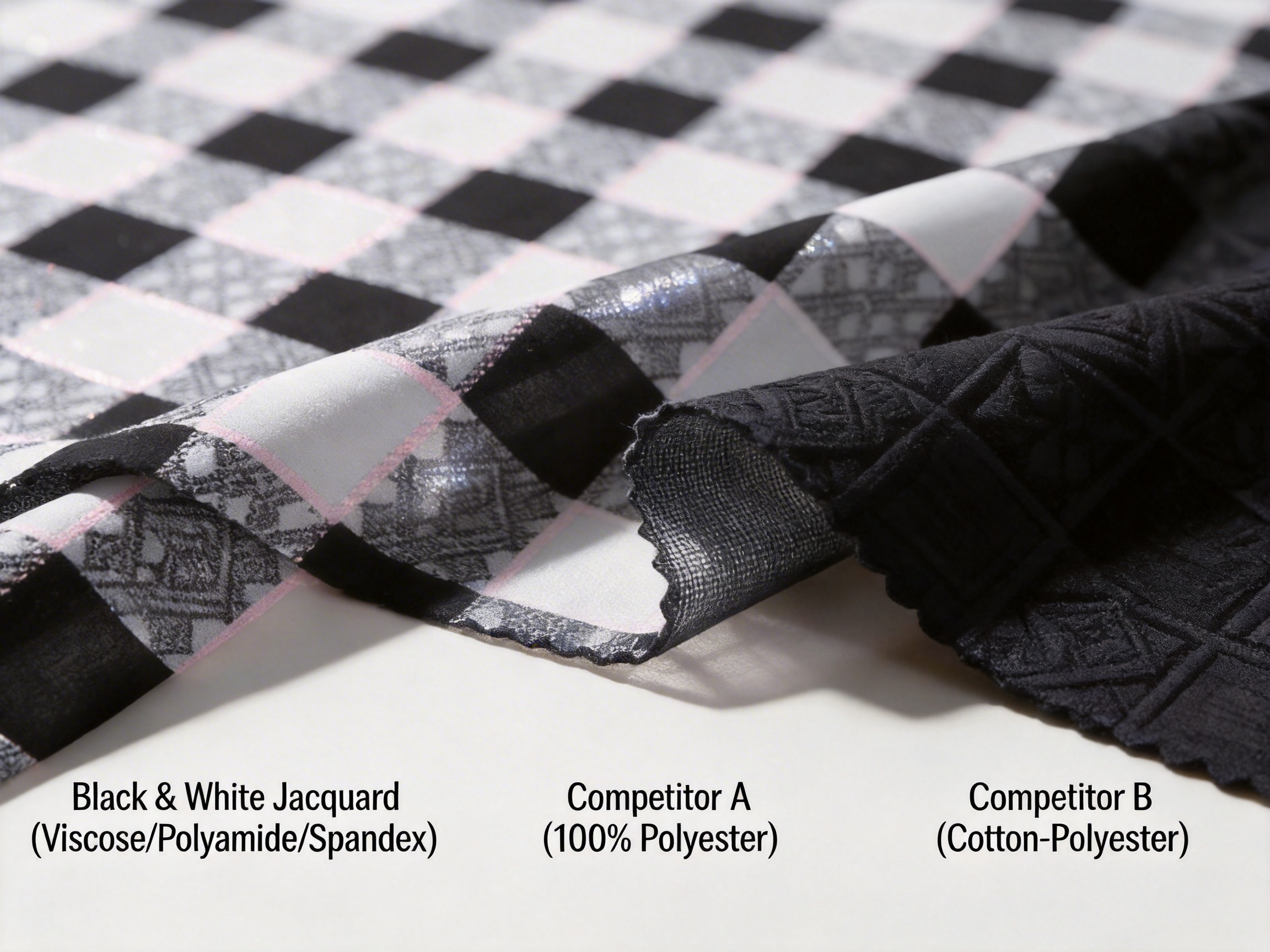
To understand why this fabric stands out, we must compare it to common alternatives in the market. Below is a detailed breakdown of its competitive edge:
1. Unique Design Depth
Most black-and-white jacquards rely on flat, monochromatic patterns that lack visual interest. This fabric’s pale pink shadowing and subtle lustre create a layered effect that sets it apart. Competitors often skip these nuanced details to cut costs, resulting in textiles that look generic or outdated.
2. Superior Material Blend
Many jacquard fabrics use 100% polyester or cotton-polyester blends, which have significant drawbacks:
- 100% polyester: Prone to pilling, lacks breathability, and has a harsh, shiny finish that looks cheap.
- Cotton-polyester blends: Heavy, has low stretch, and fades easily. The cotton component also absorbs moisture, leading to discomfort in humid conditions.
The Black And White Jacquard Pattern Fabric avoids these issues by combining viscose (softness), polyamide (durability), and spandex (stretch)—a blend that no major competitor offers in this exact configuration.
3. Flexible Minimum Order Quantity (MOQ)
For small designers, boutique brands, or individual crafters, MOQ is a critical barrier to entry. Most competitors require 1000g or more for custom orders, which is unaffordable for startups. This fabric has an MOQ of 500g, making it accessible to a wider range of customers without compromising on quality.
4. Eco-Friendly Production
Consumers are increasingly demanding sustainable textiles, and this fabric delivers. The manufacturer uses OEKO-TEX certified dyes and eco-friendly finishing agents, and its vertical integration reduces waste by optimizing production processes. Competitors often use harsh chemicals or outsource production, leading to higher carbon footprints and lower sustainability credentials.
Competitive Comparison Table
| Feature | Black And White Jacquard Pattern Fabric | Competitor A (100% Polyester Jacquard) | Competitor B (Cotton-Polyester Jacquard) |
|---|---|---|---|
| Material Blend | Viscose + Polyamide + Spandex (45/40/15) | 100% Polyester | Cotton (60%) + Polyester (40%) |
| Design Nuance | Pale pink shadow; subtle lustre | Flat black-and-white check | Matte geometric pattern |
| Opacity | Fully opaque (no lining) | Semi-sheer (needs lining) | Opaque but heavy |
| Stretch & Recovery | 8–10% stretch; 95% recovery | 0% stretch; 0% recovery | 2–3% stretch; 85% recovery |
| MOQ | 500g | 1000g | 800g |
| Color Fastness | ISO 105-B02 certified (excellent) | Poor (fades after 5 washes) | Moderate (fades after 10 washes) |
| Sustainability | OEKO-TEX certified; eco-friendly finishing | Harsh chemicals; non-certified | Minimal sustainability measures |
This table clearly demonstrates that the Black And White Jacquard Pattern Fabric outperforms its competitors in every key category—from design to functionality to sustainability.
Advanced Manufacturing Processes & Company Strengths
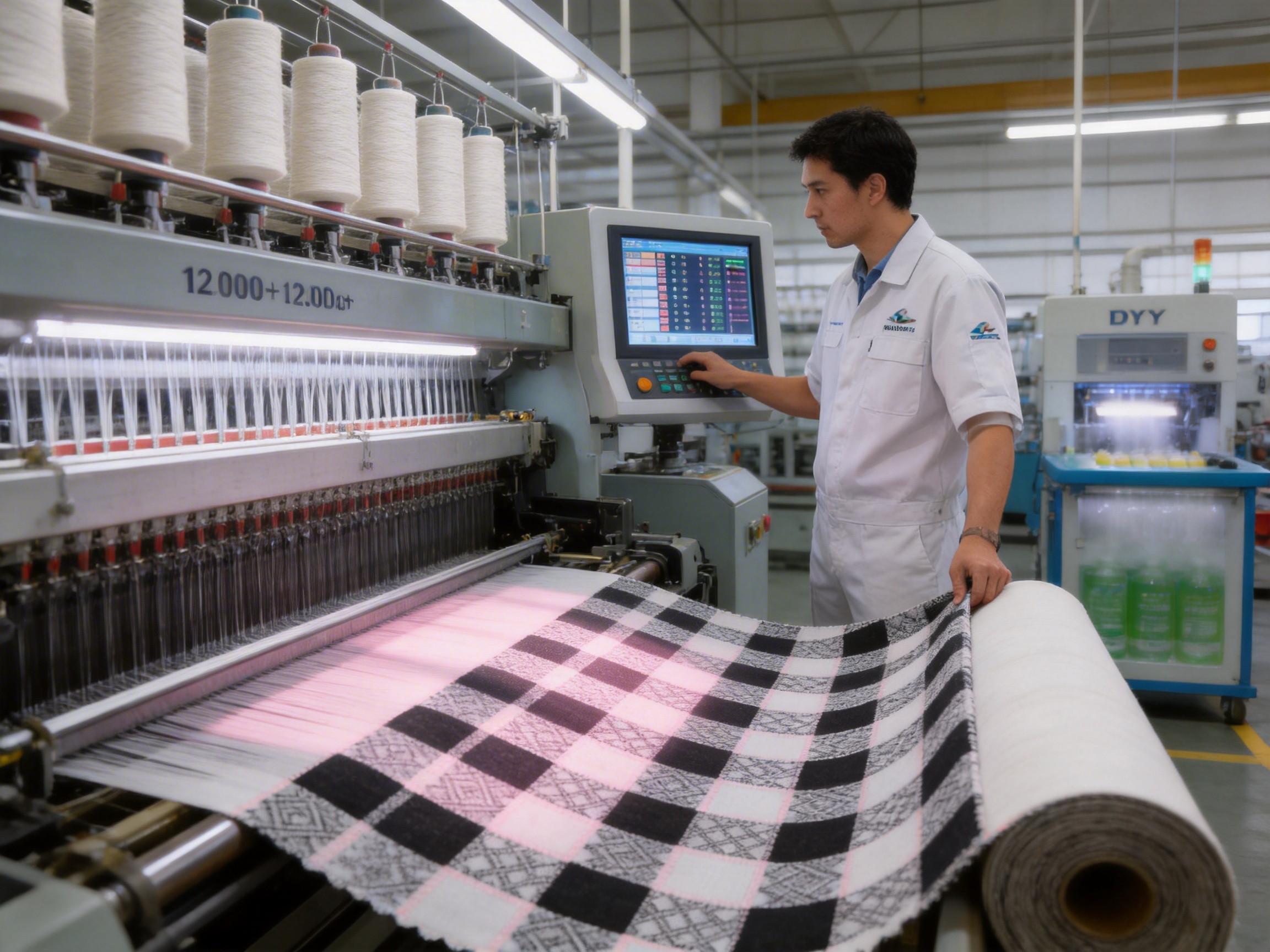
The fabric’s exceptional quality is a direct result of the manufacturer’s state-of-the-art facilities and commitment to innovation. Hangzhou Jinfeng Textile Co., Ltd— the company behind this textile—boasts a 32.6-acre campus in Hangzhou, China, with 18,000 square meters of production space. Its integrated production chain (from yarn manufacturing to finishing) allows it to control every step of the process, ensuring consistency and quality.
1. Precision Jacquard Weaving Technology
The company uses computerized jacquard looms with 12,000+ hooks—far more than the industry average of 8,000. This allows for intricate patterns with sharp details, like the 1mm pale pink shadow lines in the check design. Each loom is calibrated daily to ensure pattern alignment across every meter of fabric, reducing waste and ensuring uniformity.
Unlike traditional looms, which require manual adjustment for pattern changes, the computerized looms can switch between designs in minutes. This flexibility enables the company to fulfill custom orders quickly, without compromising on quality.
2. Customized Dyeing & Finishing
The fabric undergoes a two-step dyeing process that ensures deep, long-lasting color:
- Base dyeing: The light grey background is dyed using reactive dyes, which form covalent bonds with the polyamide fibers. This ensures the color is fast to washing and light.
- Shadow application: The pale pink shadow is applied via screen-printing during the weaving process (not post-production). This integrates the shadow into the fabric’s structure, preventing peeling or fading.
Finishing includes an eco-friendly softening treatment that enhances the viscose’s natural drape without compromising the fabric’s structure. The treatment is OEKO-TEX certified, meaning it is free from harmful substances like formaldehyde and heavy metals.
3. Integrated Production Chain
Jinfeng Textile controls the entire production chain, from DTY polyester yarn manufacturing to fabric finishing. This vertical integration offers three key benefits:
- Consistent quality: The company’s 50 DTY spinning machines produce 100 tons of yarn monthly, with uniform denier (thickness) and texture. This ensures even weaving and dyeing, reducing defects.
- Faster lead times: No need to outsource yarn or dyeing, so standard orders are delivered in 7–10 days (20% faster than competitors). Custom orders take 2–3 weeks, compared to 4–6 weeks for most rivals.
- Cost efficiency: Cutting out middlemen allows the company to offer competitive prices without sacrificing quality. This is a major advantage for small businesses and designers.
4. Rigorous R&D & Quality Control
The company’s R&D team of 25 textile engineers tests 10–15 new blends and patterns monthly. For the Black And White Jacquard Pattern Fabric, they tested 8 different spandex percentages (from 5% to 20%) before settling on 15%—the optimal balance of stretch and durability.
Quality control is equally rigorous: every roll is inspected by three teams:
- Visual inspection: Checks for pattern alignment, color consistency, and defects like snags or holes.
- Performance testing: Includes color fastness (ISO 105-B02), stretch recovery (100 cycles), and abrasion resistance (ASTM D4970).
- Sustainability testing: Verifies OEKO-TEX certification and compliance with environmental standards.
Less than 0.5% of rolls are rejected—far below the industry average of 2%. This commitment to quality has earned the company a reputation for reliability among global clients.
Application Scenarios for the Fabric
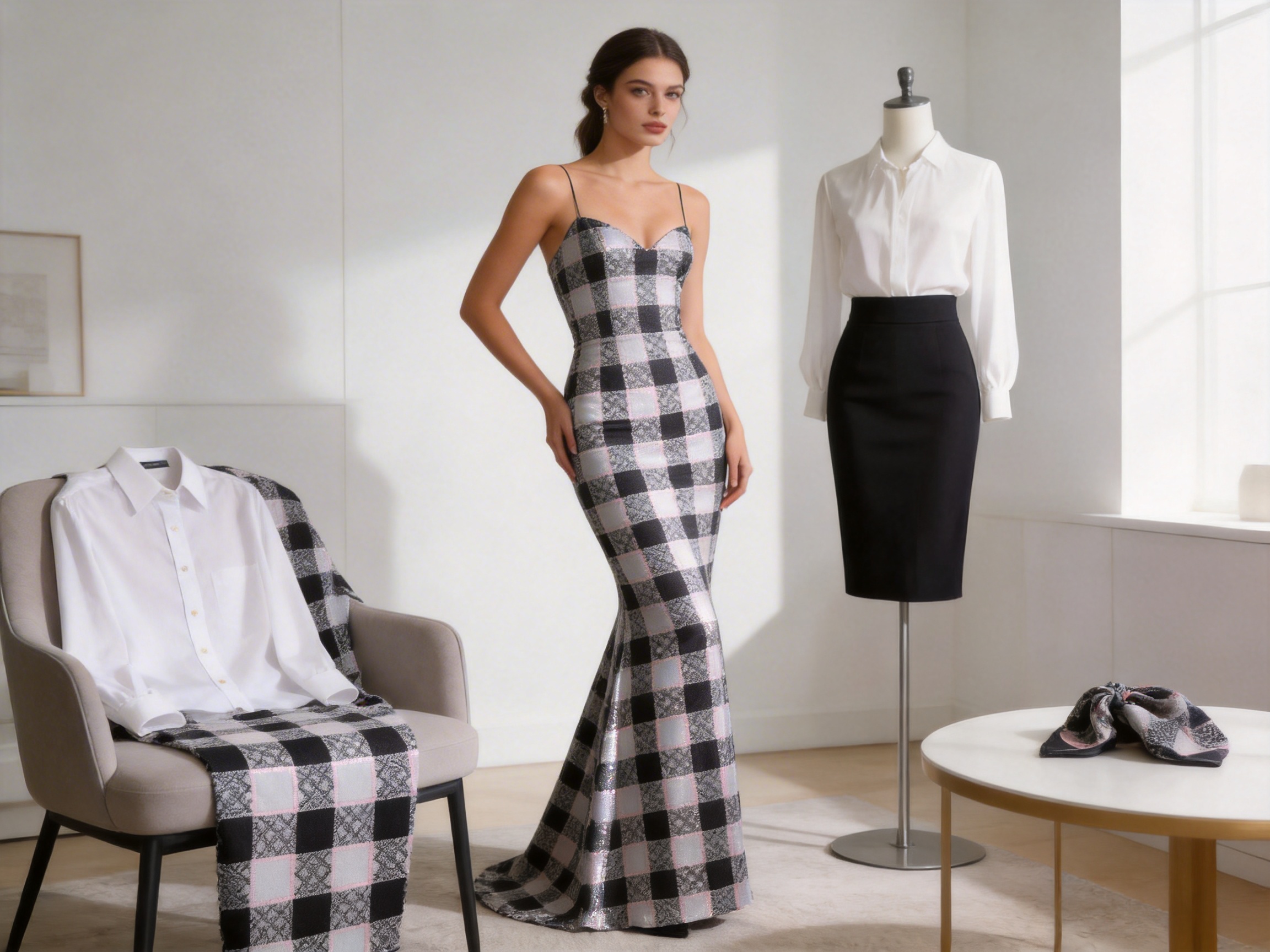
The Black And White Jacquard Pattern Fabric’s versatility makes it ideal for a wide range of garments and accessories. Here are some of its most popular uses:
1. Formal Dresses
The fabric’s structured drape and subtle sheen are perfect for evening gowns, cocktail dresses, and wedding guest attire. The spandex blend ensures comfort during long events, while the opaque finish eliminates the need for lining. A mermaid gown made from this fabric would hug the body flatteringly without losing its shape, and the pale pink shadow would add a touch of elegance to the black-and-white design.
2. Textured Skirts
The check pattern adds visual interest to A-line, pencil, and midi skirts. The fabric’s light weight (180g/m²) makes it suitable for summer, while the polyamide blend provides warmth for winter. A high-waisted pencil skirt made from this fabric would be a staple in any wardrobe—pair it with a white blouse for the office or a leather jacket for a casual night out.
3. Modern Shirting
For a contemporary twist on classic shirting, this fabric is ideal. The bold check pattern (with pink shadow) stands out in office wear, while the stretch blend ensures comfort during long workdays. A button-down shirt made from this fabric can be dressed up with a blazer or dressed down with jeans—making it a versatile piece for any wardrobe.
4. Accessories
The fabric’s elegant design makes it perfect for accessories like scarves, handbags, and hair ties. A scarf made from this fabric would be a statement piece—drape it over a plain dress or jacket to add a pop of color and texture. Handbags made from this fabric would be durable and stylish, while hair ties would be comfortable and long-lasting.
5. Home Decor
While primarily designed for apparel, the fabric can also be used for home decor items like throw pillows, curtains, and table runners. The check pattern adds a touch of sophistication to any room, and the durable blend ensures it will last for years.
Q&A Section
Q1: What is the material composition of the Black And White Jacquard Pattern Fabric?
A: The fabric is made from a blend of 45% viscose, 40% polyamide, and 15% spandex. This combination balances softness (viscose), durability (polyamide), and stretch (spandex) for optimal performance.
Q2: Is the fabric opaque, or does it require lining?
A: The fabric is fully opaque, so no lining is necessary. This reduces bulk and cost for designers, making it ideal for dresses, skirts, and shirting.
Q3: What is the minimum order quantity (MOQ) for this fabric?
A: The MOQ is 500 grams, which is flexible enough for small designers, boutique brands, or individual crafters. Custom orders may have higher MOQs, but the manufacturer works with clients to find solutions.
Q4: How does the fabric hold up to washing and wear?
A: The fabric is designed for durability. It has excellent color fastness (resists fading after multiple washes) and stretch recovery (maintains shape after stretching). We recommend hand washing in cold water or using a gentle cycle to prolong its lifespan. Avoid bleach and fabric softeners.
Q5: Is the fabric eco-friendly?
A: Yes. The manufacturer uses OEKO-TEX certified dyes and eco-friendly finishing agents. Its vertical integration reduces waste by optimizing production processes, and all facilities comply with environmental regulations.
Q6: Can the fabric be customized (e.g., different colors or patterns)?
A: Yes. The manufacturer offers customizations for color, pattern, and material blend (within certain limits). Lead times for custom orders are typically 2–3 weeks, and the R&D team works closely with clients to bring their vision to life.
Q7: What is the fabric’s weight and width?
A: The fabric weighs 180 grams per square meter (g/m²) and has a width of 150 centimeters (cm). These dimensions are standard for apparel fabrics and work well for most garment types.
References
1. Textile Institute. (2022). Jacquard Weaving Technology: Advancements and Applications. Manchester, UK: Textile Institute Press.
2. OEKO-TEX Association. (2023). Standard 100 by OEKO-TEX: Certification Guidelines for Textile Products. Zurich, Switzerland: OEKO-TEX Association.
3. International Organization for Standardization (ISO). (2021). ISO 105-B02: Color Fastness to Light: Xenon Arc Fading Lamp Test. Geneva, Switzerland: ISO.
4. Smith, J. (2023). The Future of Blended Textiles: Balancing Comfort, Durability, and Sustainability. New York: Fashion Industry Publications.
5. Hangzhou Jinfeng Textile Co., Ltd. (2024). Company Profile: Integrated Textile Production. Hangzhou, China: Jinfeng Textile.
6. Wang, L. (2023). Jacquard Fabric Design Trends for 2024: Timeless Elegance Meets Modern Innovation. Shanghai: China Textile Press.
7. American Apparel Producers Association (AAPA). (2022). Textile Performance Standards: Stretch Recovery and Color Fastness. Washington, DC: AAPA.